The Margin Squeeze in Halogen-Free Flame-Retardant Compounding

Regulatory restrictions, formulation challenges, and volatile raw material costs are reshaping flame-retardant compounds. Smaller suppliers face mounting pressure to absorb reformulation costs.
Halogen-free flame-retardant compounds are becoming increasingly important in electrical, electronic, automotive, and construction applications. For compounders, however, replacing brominated systems involves more than selecting a different additive. Flame-retardant performance must be balanced against mechanical properties, processing stability, and customer specifications, often requiring extensive formulation development and repeated testing.
You can also read: Balancing Fire Resistance and Transparency in PET
The transition also creates an economic challenge. While regulatory requirements and material specifications are typically established downstream, compounders must manage much of the technical work needed to deliver compliant formulations. Rising raw material costs and lengthy qualification cycles squeeze margins, particularly for suppliers with limited development resources.
Regulatory Pressure Reshapes Material Selection
The global flame retardants market was valued at approximately USD 8.1 billion in 2025 and is projected by MarketsandMarkets to reach USD 10.5 billion by 2030, reflecting a compound annual growth rate of 5.32%. Demand for non-halogenated systems is supported by regulatory developments and customer requirements across several end-use industries.
In Europe, Regulation (EU) 2019/2021 prohibits halogenated flame retardants in electronic display enclosures and stands. REACH and RoHS restrictions also influence the selection of flame-retardant substances, although requirements vary by chemical and application.
Regulatory scrutiny continues to expand. The European Chemicals Agency (ECHA) is preparing a restriction dossier addressing certain non-polymeric aromatic brominated flame retardants in electrical and electronic equipment, construction products, and textiles. Separately, decabromodiphenyl ethane (DBDPE), a brominated alternative to DecaBDE, was added to the REACH Candidate List of substances of great concern in November 2025 because of its very persistent and very bioaccumulative properties.
These developments are accelerating the reassessment of established formulations. They do not amount to a universal ban on brominated flame retardants, but they increase the importance of understanding substance-specific regulatory exposure and identifying technically viable alternatives.
The Formulation Costs Behind Halogen-Free Systems
Replacing brominated flame retardants is rarely a direct substitution. Different flame-retardant mechanisms, additive concentrations, and polymer interactions can significantly affect compound performance.
Mineral-based systems, including aluminum trihydrate (ATH) and magnesium hydroxide, often require relatively high loadings to achieve the desired flame-retardant performance. ATH formulations may contain 40–65 wt.% mineral filler, depending on the polymer, application, and performance requirements. At these concentrations, melt viscosity, elongation at break, impact resistance, and processing behavior can change significantly.
Flame retardant thermal stability is another important consideration. ATH releases water at temperatures that make it unsuitable for many high-temperature engineering thermoplastics, including PA66. Compounders working with these polymers must therefore consider alternatives such as phosphorus-based systems, selected inorganic synergists, or combinations of flame-retardant technologies.
Phosphorus-based additives can achieve the required performance at lower concentrations in suitable polymer systems. However, their effectiveness and compatibility depend on the chemistry involved. For the intended application, evaluate hydrolytic stability, moisture sensitivity, processing temperature, and interactions with other formulation components.
These differences have direct cost implications. A formulation that achieves UL 94 V-0 may still require further development to meet mechanical, electrical, aging, and processing requirements. Changes in the flame-retardant package can also affect color, surface appearance, dimensional stability, and the behavior of glass-fiber-reinforced compounds.
For compounders, the expense extends beyond additive pricing. Laboratory development, pilot compounding, performance testing, and customer qualification all contribute to the cost of introducing a replacement formulation.
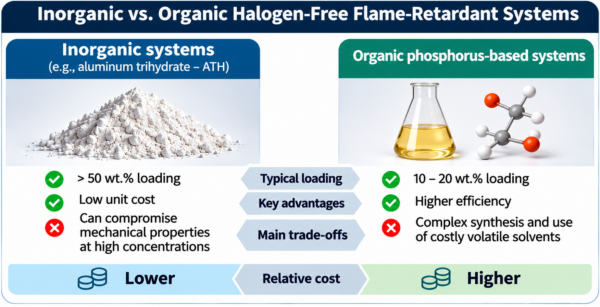
Inorganic halogen-free systems, led by aluminum trihydrate (ATH), which accounts for approximately 40% of global flame-retardant consumption, typically require loadings above 50 wt.%. Although these systems offer relatively low unit costs, high concentrations can compromise mechanical properties. Organic phosphorus-based alternatives can achieve flame-retardant performance at lower loadings (10–20 wt.%), but their complex synthesis and associated production costs make them more expensive. Image inspired by Stellarix. AI-generated for Plastics Engineering.
Raw Material Volatility Adds Financial Pressure
Supply-chain disruptions have increased cost uncertainty for compounders using both brominated and halogen-free flame-retardant systems. China’s restrictions on antimony exports drove substantial price increases for antimony trioxide, a widely used synergist in brominated formulations. Clariant reported prices of about USD 51,500 per metric ton in early 2025, highlighting the vulnerability of established flame-retardant systems to critical raw-material supply constraints.
Halogen-free alternatives also face price volatility. Mineral-based flame retardants rely on aluminum and magnesium supply chains, while phosphorus-based systems depend on phosphorus feedstock availability and chemical production costs. Compounders experience these pressures differently depending on their formulations, sourcing strategies, and ability to pass cost increases on to customers. High mineral loadings increase sensitivity to transportation and processing costs, while specialty phosphorus-based additives can account for a substantial share of formulation costs despite their lower loading levels.
These challenges complicate purchasing and formulation decisions. Compounders must assess whether flame-retardant systems meet technical specifications while keeping raw material costs and availability manageable throughout the product’s commercial life.
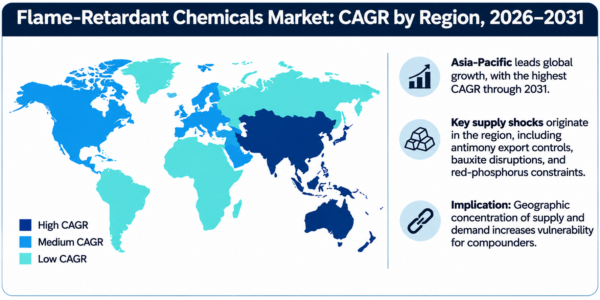
Asia-Pacific leads global flame-retardant chemicals market growth, with the highest projected CAGR through 2031. The region also faces supply disruptions involving antimony export controls, bauxite availability, and red-phosphorus production. For compounders dependent on Asian feedstocks, the geographic concentration of supply and demand creates vulnerabilities that market growth projections may not fully capture. Image inspired by Mordor Intelligence. AI-generated for Plastics Engineering.
Qualification Requirements Favor Larger Suppliers
Regulatory compliance is only one part of the transition. Flame-retardant compounds must also satisfy application-specific performance and qualification requirements.
UL 94 classifications provide an important measure of flammability behavior, but they do not establish compliance with every requirement for electrical and electronic applications. Depending on the product, additional testing may address comparative tracking index, glow-wire performance, mechanical properties, thermal aging, and other relevant characteristics.
Reformulating an established compound can therefore require multiple rounds of testing and customer evaluation. For applications with demanding qualification procedures, changes to the material formulation may also require updates to existing approvals or new qualification work.
Large specialty chemical suppliers, including Clariant, LANXESS, and BASF, can draw on extensive additive portfolios, application laboratories, and technical support capabilities. Independent compounders may have fewer resources available to investigate alternative systems, manage repeated trials, and support customers through qualification.
This difference creates a competitive advantage that extends beyond raw material purchasing power. Suppliers that can develop and qualify formulations efficiently are better positioned to respond to regulatory changes without absorbing prolonged development costs.
A Long-Term Challenge for Compounders
The shift toward halogen-free flame-retardant systems presents opportunities for innovation in additive chemistry and compound design. It also raises the technical and financial requirements for suppliers serving regulated applications.
For compounders, the central challenge is maintaining performance and profitability while navigating changes in material availability, regulatory expectations, and customer specifications. The ability to manage formulation costs, secure reliable feedstocks, and complete qualification programs efficiently will increasingly influence competitiveness.
The transition is therefore not simply about replacing brominated additives. It is a broader change in how flame-retardant compounds are developed, validated, and supplied—and in which companies can afford to support that process.

Mariana Holguin is a mechanical engineer with a master’s degree in finance. She specializes in the financial and strategic analysis of engineering projects, with experience evaluating capital investments, supply chain economics, and FP&A across industrial sectors.