
Surface Texturing and PTFE Work Together to Reduce Bearing Friction
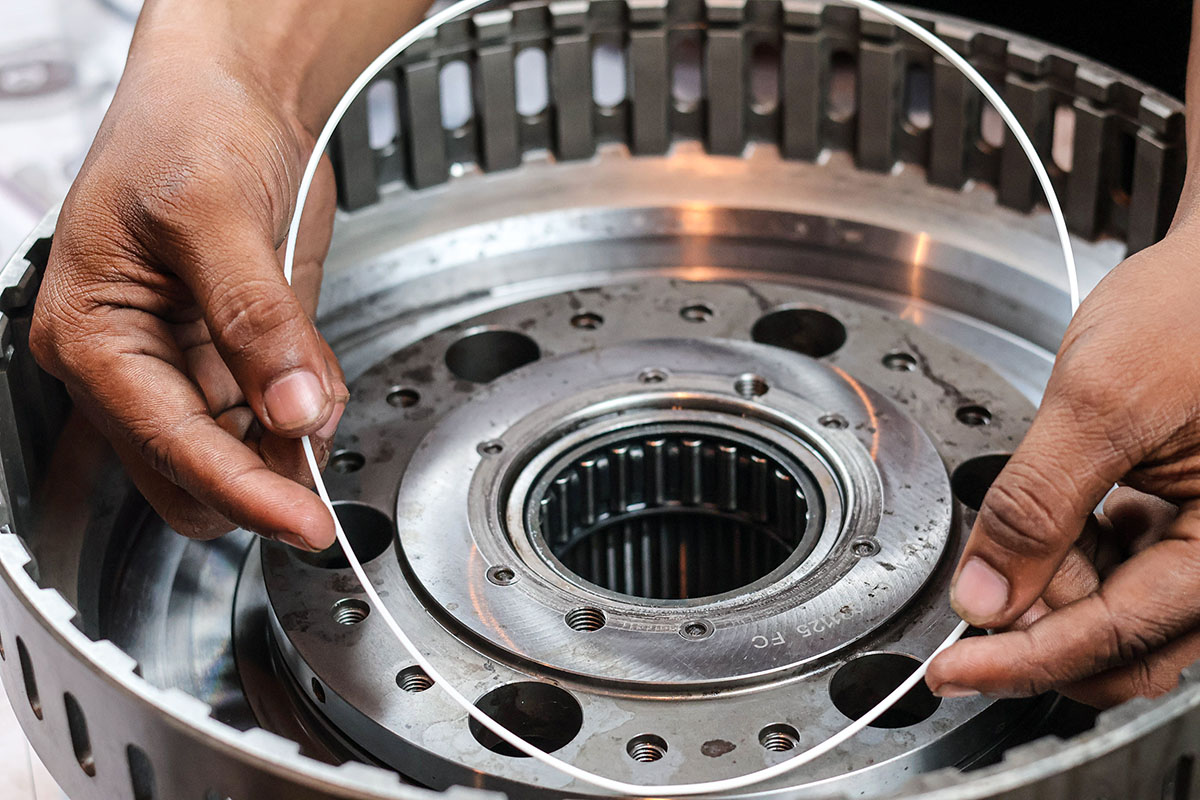
Engineers optimized seals and roller bearings with PTFE particles and dimple textures to reduce friction and operational wear.
Heavy machinery often battles reciprocating friction and poor lubrication. Traditional hydraulic seals and cylindrical roller thrust bearings degrade under continuous cyclic stress, generating frictional heat that triggers thermo-mechanical failures. To solve this, materials engineers integrate polytetrafluoroethylene (PTFE) nanoparticles and machine-specific surface textures into the contact zones. This approach promotes elastohydrodynamic lubrication, manipulating oil-film dynamics to separate mating surfaces and prevent direct material abrasion in demanding heavy industrial applications.
You can also read: Self-Lubricating PEEK Bushings for Heavy-Duty Equipment
Combating Reciprocating Seal Degradation
Designers rely heavily on reciprocating rod and piston seals, but complex thermal-mechanical interactions often compromise these systems. Polyurethane and fluoroelastomer materials dominate the market, but they present distinct vulnerabilities in harsh tribological environments. Researchers observed that minor deviations in contact pressure or sliding speed quickly initiate stick-slip instabilities. These micro-vibrations fracture the fluid film, allowing localized frictional heating to sever molecular bonds within the elastomer matrix. To extend operational lifespans, manufacturers now rigorously evaluate custom laboratory-compounded elastomers against standard commercial options. Engineers prioritize formulations that maintain asymmetric fluid film formation during both in-stroke and out-stroke cycles, successfully limiting thermal oxidation, abrasive swelling, and premature component degradation
| Material Formulation | Max Depth (µm) | Ra (µm) | Sa (µm) | COF | Wear Rate (mm³/Nm) | Estimated Lifetime (Years) |
| TPU 4203 | 50 | 3.2 | 4.1 | 0.480 | 2.29 × 10⁻⁴ | 3.93 |
| TPU 4758 | 380 | 6.8 | 8.4 | 0.343 | 1.93 × 10⁻⁴ | 4.66 |
| EPDM + Carbon Black | 466 | 12.5 | 15.3 | 0.480 | 1.45 × 10⁻⁴ | 6.20 |
| EPDM + Silica | 442 | 10.8 | 13.6 | 0.036 | 2.44 × 10⁻⁴ | 3.68 |
| EPDM + Silica + DOS | 410 | 8.9 | 11.4 | 0.237 | 2.88 × 10⁻⁴ | 3.12 |
Topographical and tribological properties of custom-compounded elastomeric seal formulations, correlating surface roughness to estimated operational lifetime. Adapted from Experimental Comparison of Elastomeric Materials for Hydraulic Seal Durability Under Reciprocating Conditions.
Surface Texture and PTFE Synergy
Beyond polymer chemistry, engineers manipulate the physical bearing surfaces to control lubricant behavior. Researchers tested cylindrical roller thrust bearings under starved lubrication conditions, pairing different surface textures with varying mass fractions of solid PTFE nano-additives. Because PTFE has low shear strength, the particles form a robust, self-lubricating boundary layer. Engineers discovered that underlying surface topography heavily dictates the success of this boundary layer, leading to the following operational conclusions:
| Bearing Surface Texture | Base Oil Mean COF | 0.5 wt% PTFE Mean COF | 1.0 wt% PTFE Mean COF | 3.0 wt% PTFE Mean COF | COF Variation from Base Oil to highest wt% PTFE |
| Smooth | 0.0291 | 0.0236 | 0.0185 | 0.0153 | -47.42% |
| Wholly Distributed Dimples | 0.0228 | 0.0186 | 0.0144 | 0.0111 | -51.31% |
| Locally Distributed Dimples | 0.0254 | 0.0231 | 0.0159 | 0.0146 | -42.52 |
| Grooves | 0.0195 | 0.0256 | 0.0341 | -* | 74.87% |
Bearing Surface Texture performance comparison when increasing PTFE Content. *3.0 wt% for groove texture was not measured due to early failure. Adapted from Synergism of PTFE Nano-Particles and Surface Textures on the Tribological Performance of Cylindrical Roller Thrust Bearings Under Starved Lubrication.
Engineers conclude from this data that solid lubricant additives require compatible geometric voids, such as uniformly distributed dimples, to properly trap the particles and continuously supply the contact patch. Both smooth surfaces and dimpled topographies demonstrate a steady reduction in the coefficient of friction as operators increase the PTFE concentration. In contrast, continuous grooves actively hinder solid lubricant transport. Friction increases as the PTFE weight percentage rises, flushing the nanoparticles out of the load-bearing zone and destroying the synergistic benefits.
Thermo-Elastohydrodynamic Lubrication Control
To predict these complex interactions, designers utilize thermo-elastohydrodynamic lubrication (TEHL) mathematical models. By combining energy equations for temperature fields with viscosity-temperature calculations, software systems map the exact oil film thickness distribution across rotary composite seals. Engineers analyze how tiny cavities randomly form convergent gaps during high-speed rotation. These microscopic gaps generate localized hydrodynamic pressure, powerfully reducing friction torque across the sealing zone. When builders combine standard rubber O-rings with custom PTFE sealing rings, the resulting composite structure supplies a sustained elastic force. This combination easily adapts to the harsh vibrations and high-pressure spikes common in heavy industrial hydraulic cylinders.
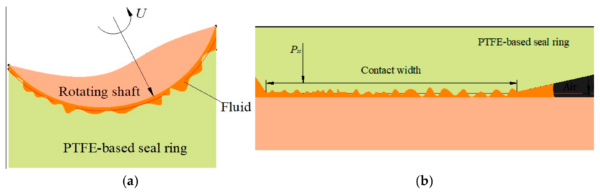
Schematic diagram of lubricant film formation: (a) rotating state of sealing ring; (b) expansion state of sealing ring. Courtesy of Solution and Analysis of Thermal Elastohydrodynamic Lubrication Model for Combined Seals.
Using dimpled surface textures and advanced TEHL modeling, engineers improve the durability of hydraulic seals and thrust bearings by integrating PTFE nano-additives. This technology directly impacts commercial manufacturing by extending maintenance intervals for turbomachinery and heavy equipment. Companies can readily manufacture these dimpled surfaces using current laser-texturing tools, making the transition highly viable. Adopting these multi-phase tribological solutions allows industries to run high-pressure systems cooler, with significantly reduced unexpected downtime.

Andres Delgado is a mechanical engineer specializing in design and quality assurance, with experience in precision seal design, turbomachinery maintenance, and orthopedic medical devices. He currently works as a Design Quality Engineer focused on New Product Introductions for knee implants and compliance with advanced manufacturing standards.