
Supramolecular Additives Reshape PA6 Crystallization
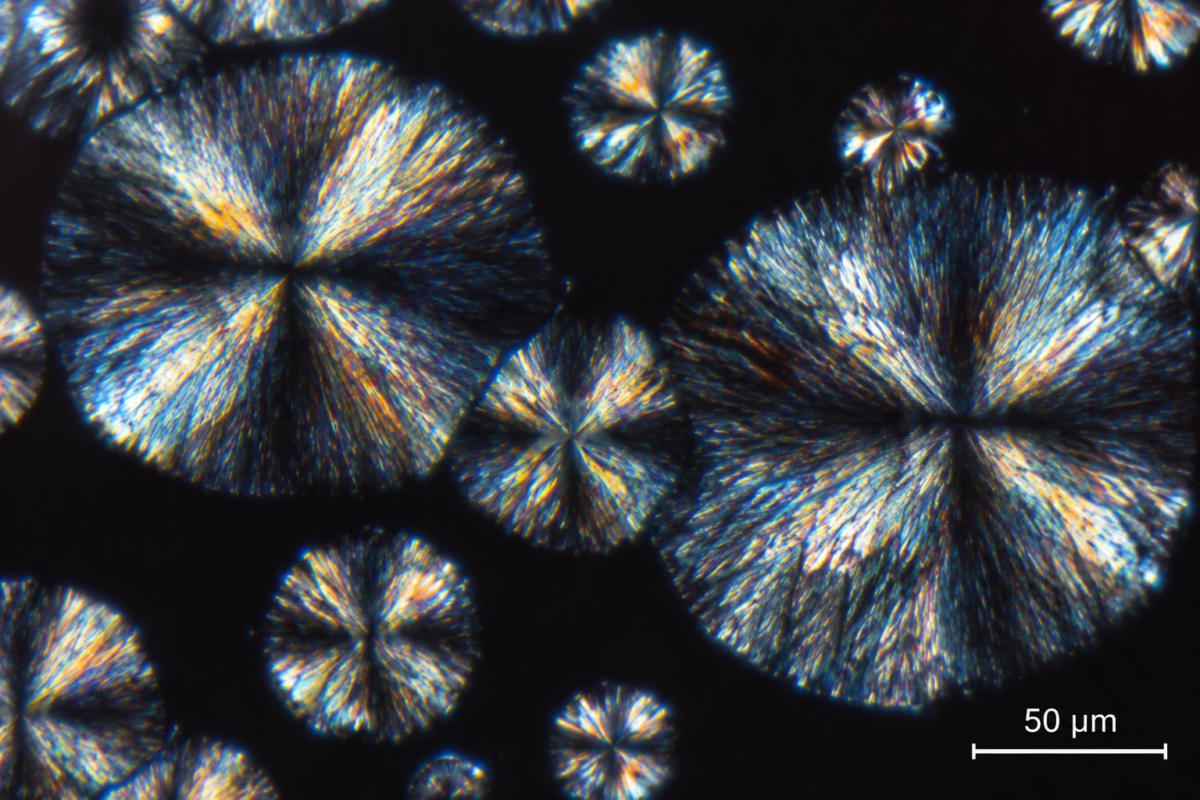
Bisurea-based nucleating agents accelerate PA6 crystallization, favor α-phase formation, and improve optical clarity in injection-molded specimens.
Conventional nucleating agents influence polymer crystallization by providing sites for crystal formation. Supramolecular additives offer a more targeted approach, using molecular self-assembly to influence nucleation kinetics and crystalline morphology.
You can also read: Introduction to PVC Gelation and Formulation: Fusion, Additives, and Processing
In a 2025 study, Kremer and colleagues developed bisurea-based additives that significantly accelerated crystallization in polyamide 6 (PA6) while promoting formation of the α crystalline phase. The changes translated into a substantial reduction in haze and improved optical clarity in injection-molded specimens.
The findings demonstrate how additive molecular architecture can influence crystallization behavior and final part properties without substantially changing overall crystallinity.
Molecular Design and Nucleation Behavior
The researchers synthesized six bisurea compounds based on a trans-1,4-disubstituted cyclohexane core, varying the aliphatic side groups to investigate their influence on nucleation performance. The bisurea groups form hydrogen-bonded supramolecular assemblies that act as heterogeneous nucleation sites within the PA6 matrix. Their molecular architecture influences how these structures develop and interact with the surrounding polymer during cooling.
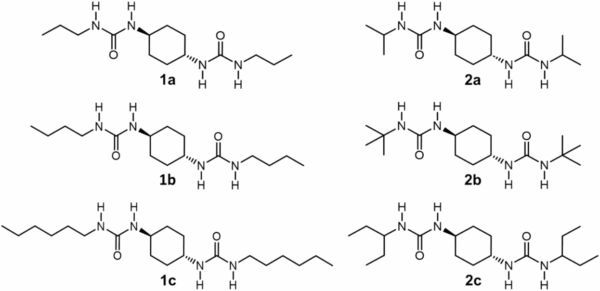
Molecular structures of the bisurea additives, featuring a trans-1,4-disubstituted cyclohexane core and different aliphatic side groups. Courtesy of Nucleation and Clarification of Polyamides With Supramolecular Additives.
After compounding at 250°C, differential scanning calorimetry revealed a measurable nucleating effect at concentrations as low as 0.02 wt.%. The peak crystallization temperature increased from 186.5°C for neat PA6 to above 191°C with the additives.
Thermal cycling experiments also indicated that the nucleating effect persisted after repeated processing. For one representative compound, the peak crystallization temperature decreased by only 0.8°C after 12 heating and cooling cycles.
Faster Crystallization and Changes in Growth Behavior
Beyond increasing crystallization temperature, the additives altered crystallization kinetics.
At an isothermal crystallization temperature of 206°C, bisurea compound 2b reduced the crystallization half-time from 21.3 minutes for neat PA6 to 10.8 minutes at 0.02 wt.%. Increasing the concentration to 1.0 wt.% reduced the half-time to 5.3 minutes.
| Bisurea 2b concentration | Crystallization half-time |
|---|---|
| Neat PA6 | 21.3 min |
| 0.02 wt.% | 10.8 min |
| 0.4 wt.% | 6.5 min |
| 1.0 wt.% | 5.3 min |
Avrami analysis indicated a shift in crystallization behavior with increasing additive concentration, consistent with changes in nucleation and crystal growth.
These kinetic effects are relevant to thermoplastic processing, where crystallization rates influence solidification and potentially cycle time. However, the study did not establish corresponding reductions in industrial injection-molding cycle times.
Shifting the Balance Between α and γ Crystalline Phases
X-ray diffraction analysis revealed that bisurea 2b also influenced PA6 polymorphism.
Injection-molded neat PA6 exhibited 30.2% total crystallinity, with an α/γ phase ratio of 57/43. At 1.0 wt.% additive, total crystallinity remained relatively unchanged at 31.0%, while the α/γ ratio shifted to 90/10. The increase in α-phase content occurred without a substantial increase in the overall crystalline fraction, indicating that the additive influenced crystalline phase selection rather than simply promoting greater crystallinity.
Polarized optical microscopy further revealed smaller crystallites in the modified specimens, consistent with increased nucleation density.
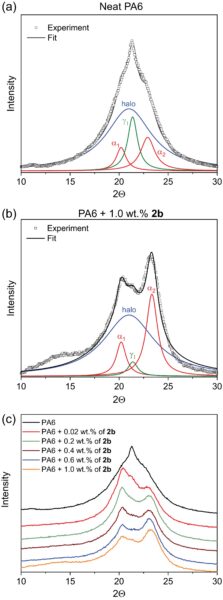
X-ray diffraction patterns show a shift toward α-phase crystallization with bisurea additive 2b, while total PA6 crystallinity remains largely unchanged. Courtesy of Nucleation and Clarification of Polyamides With Supramolecular Additives.
Crystalline Morphology Drives Optical Improvements
Bisurea 2b also influenced the optical properties of injection-molded PA6. Moreover, researchers evaluated 1.1-mm-thick specimens using ASTM D1003. Neat PA6 exhibited 98.2% haze and 68.4% clarity. With additive concentrations between 0.8 and 1.5 wt.%, haze decreased to approximately 19–20%, while clarity exceeded 97%. This haze reduction is consistent with the formation of smaller crystalline structures that reduce light scattering. Changes in crystalline phase composition may also contribute to the optical response.
Notably, the improvements occurred with only minor changes in total crystallinity, reinforcing the importance of crystalline morphology and polymorphism in determining the optical performance of semicrystalline polymers.
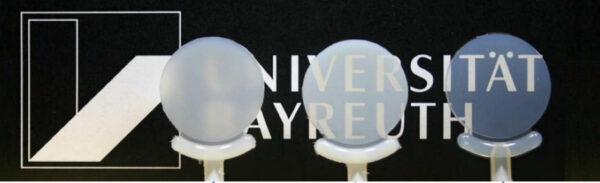
Photograph of injection-molded specimens of neat PA6 (left), PA6 with 0.05 wt.% 2b (center), and PA6 with 1.0 wt.% 2b (right), with the latter in the haze plateau regime. Clarity increases from left to right from 68.4% to 97.1% to 97.7%, as shown by the sharpness of the underlying text. The haze decreases from left to right from 98.2% to 77.8% to 20.0%, as shown by the increasing transparency of the specimens.
Implications for Polymer Processing
The study demonstrates that supramolecular additives can influence several aspects of PA6 crystallization simultaneously, including nucleation temperature, crystallization kinetics, crystalline phase composition, and optical performance. For compounders and processors, this approach could provide greater control over polymer morphology without requiring major changes to the base resin. The relatively low concentrations needed to accelerate crystallization are particularly relevant, although the highest optical improvements required greater additive loading. Further investigation is needed to determine how these compounds affect mechanical properties, long-term stability, and processing behavior across different PA6 grades and manufacturing conditions. Nevertheless, the results establish a useful direction for additive development: tailoring molecular architecture to influence polymer crystallization and achieve specific performance requirements in the finished component.

Paula Sánchez is a recent mechanical engineering graduate focused on sustainable manufacturing and materials innovation, with research experience in bio-assisted manufacturing at Purdue University and bioplastics at Universidad de los Andes, Colombia.