Superhydrophilic Membrane Tackles Marine Nanoplastic and Oil Pollution
Researchers developed a superhydrophilic membrane for nanoplastic and oil removal, achieving high separation efficiency while reducing membrane fouling.
When Plastic Particles and Oil Interact
Oil pollution and plastic particles pose environmental challenges in marine ecosystems. Their interactions can further complicate remediation efforts.
Maritime transportation and oil spills introduce petroleum pollutants into marine environments. During spill response, chemical dispersants break oil into smaller droplets to spread it more widely. However, these dispersants can also facilitate interactions between oil droplets and plastic particles, potentially forming persistent aggregates.
You can also read: Inside the Analytical Challenges of Measuring Microplastics
Such interactions may alter contaminant transport, environmental persistence, and exposure pathways. They also raise concerns about combined ecological effects, although toxicity depends on the pollutants and environmental conditions.
Challenges in Removing Multiple Contaminants
Conventional remediation methods often target individual pollutants, making it challenging to remove plastic particles and oil simultaneously.
Membrane separation offers a promising alternative, but membrane fouling can limit its performance. Oil droplets and hydrophobic plastic particles may accumulate on membrane surfaces, reducing water permeability and separation efficiency.
Plastic particles can also promote oil adhesion, making fouling more difficult to reverse. To address these challenges, researchers developed a superhydrophilic membrane designed to separate oil droplets and polystyrene particles while resisting contaminant adhesion.
A Superhydrophilic Membrane for Improved Separation
Researchers co-deposited caffeic acid and ε-polylysine to modify the membrane surface. These compounds create a highly hydrophilic surface that forms a stable hydration layer in water. This layer reduces direct contact between the membrane and hydrophobic contaminants, limiting adhesion of oil and plastic particles. The researchers used gravity-driven filtration to demonstrate simultaneous separation of oil droplets and 100 nm polystyrene particles.
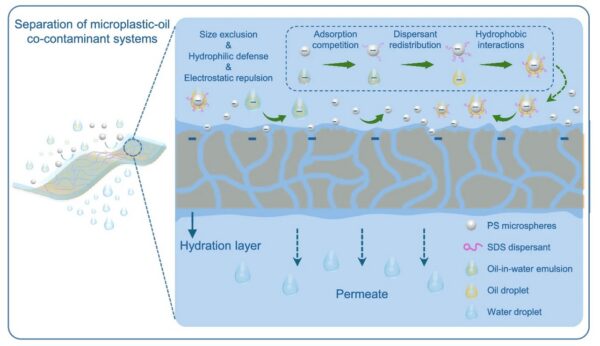
The membrane’s hydration layer reduces adhesion of oil and plastic particles, helping prevent fouling. Figure courtesy of High-performance caffeic acid-based superhydrophilic membranes for efficient removal of microplastics-oil co-contaminants.
Antibacterial Performance
The caffeic acid and ε-polylysine coating also provides antibacterial functionality. Caffeic acid contains phenolic groups associated with antimicrobial activity. Meanwhile, positively charged ε-polylysine can interact with bacterial cell membranes and disrupt their integrity. The modified membrane achieved antibacterial efficiency exceeding 93.4% against Escherichia coli (E. coli). The researchers also reported that the membrane maintained its antibacterial performance after 30 days of water immersion.
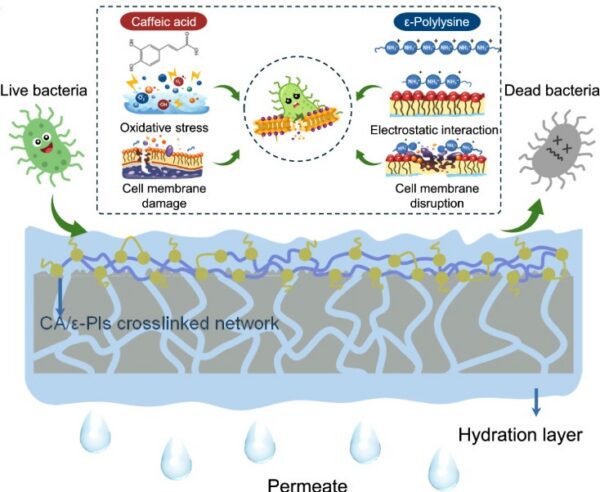
The caffeic acid/ε-polylysine membrane demonstrated antibacterial activity against E. coli. Figure courtesy of High-performance caffeic acid-based superhydrophilic membranes for efficient removal of microplastics-oil co-contaminants.
Separation Efficiency and Future Challenges
During extended filtration tests, the modified membrane achieved 99.89% oil rejection and 96.99% rejection of 100 nm polystyrene particles in a mixed-contaminant system. It also demonstrated strong antifouling performance and high water-flux recovery.
These findings suggest that surface modification could improve membrane performance when treating water containing multiple contaminants.
However, several limitations remain. Researchers used polyvinylidene fluoride (PVDF) as the membrane substrate. Although PVDF provides chemical resistance and durability, its persistence and resistance to biodegradation raise end-of-life considerations. Future research could investigate alternative substrates and assess their environmental performance.
Importantly, the researchers tested 100 nm polystyrene particles, which fall within the nanoplastic size range under commonly used definitions. Although the original study refers to microplastics, its reported particle rejection results specifically concern nanoscale polystyrene.
Environmental plastic pollution contains particles with diverse sizes, shapes, compositions, and surface properties. Consequently, researchers cannot generalize the reported 96.99% rejection efficiency to other particle sizes or polymer types without further testing.
Studies using environmentally representative particles, complex water matrices, and longer operating periods will help determine the membrane’s practical applicability.
The findings demonstrate a promising laboratory approach to simultaneously removing oil and nanoplastics. Its broader environmental value will depend on separation performance, membrane durability, and sustainability throughout the material’s life cycle.

Having studied Geology, Julienne Smith focuses on environmentalism, sustainability, and the policies that impact plastics professionals today. As a technical writer, she is passionate about the intersection of science, technology, and communication. In her free time, she loves learning new things and writing fiction.