
Structural Color Without Dyes: Rethinking Film Aesthetics
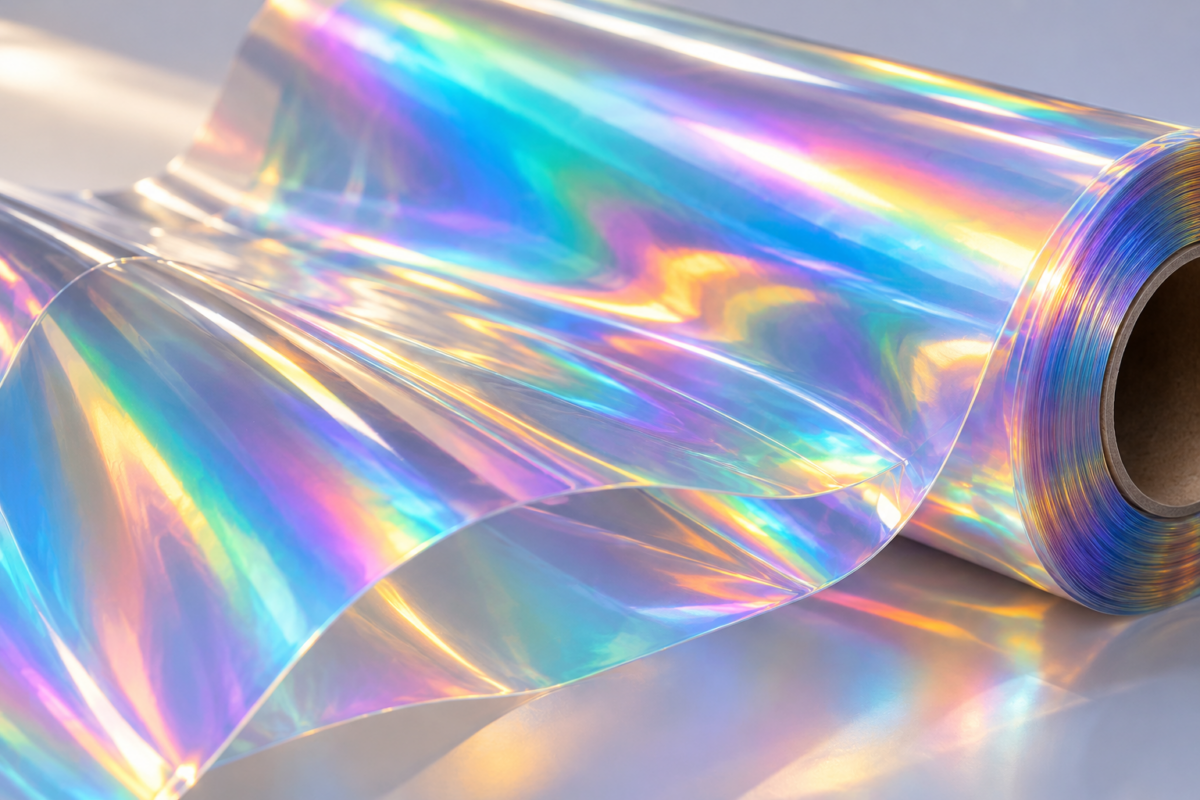
Ditch the masterbatches: a new roll-to-roll process uses physical shear to extrude brilliant, sustainable colors.
For decades, the plastics industry has relied on pigments and dyes to color products. These chemical additives complicate recycling, increase regulatory challenges, and often limit long-term color stability. A new approach is gaining attention by shifting color production from chemical additives to physical control of light. By manipulating internal microstructures directly within polymer films, researchers produce vivid, tunable hues without a single molecule of traditional colorant.
You can also read: Is Color Affecting Plastic Recycling?
Shearing Replaces Pigments
Structural color works through a different principle than conventional coloration. Instead of absorbing specific wavelengths, engineered structures control reflected light through interference and scattering. Nature provides clear examples of this approach. Butterfly wings and beetle shells create brilliant iridescent colors through microscopic structures rather than chemical pigments.
Replicating these effects in synthetic plastics previously required slow, expensive methods such as vacuum deposition. The new research breaks this bottleneck by leveraging shear-induced self-assembly. Rather than stamping a surface pattern with a mold, the research team dispersed microscopic particles directly into a fluid polymer matrix. They then fed this mixture through a roll-to-roll machine. Mechanical shearing forces stretch the polymer chains and align the dispersed particles into highly ordered, periodic structures. Because this internal colloidal architecture dictates the optical output, the film itself functions as the optical element.
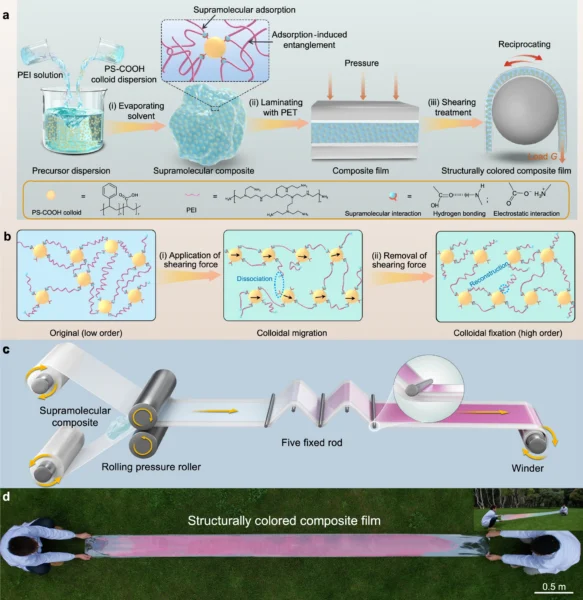
Construction of SCCFs by shearing supramolecular composites.Courtesy of Scalable production of structurally colored composite films by shearing supramolecular composites of polymers and colloids.
Manufacturing at Ambient Conditions
Scalability remains the ultimate test for any new polymer technology. The research team showed that their shear-based method integrates easily into standard continuous manufacturing lines. The process operates entirely at ambient room temperature. This breakthrough eliminates the need for high-energy curing ovens, vacuum chambers, or complex thermal management systems.
The system achieves uniform structural features across meter-scale films in mere minutes. By treating the entire polymer matrix as an optical component, it bypasses pigment dispersion entirely. Eliminating masterbatches transforms the extrusion floor layout. Plant managers reclaim valuable floor space and drastically cut capital spending on heavy compounding equipment. Converters can seamlessly adapt their current coating machinery to handle these colloidal polymer mixtures.
Rheology and Mechanical Control
In this framework, physical force, not chemistry, dictates color. The specific shear rate, mechanical gap distance, and polymer viscosity determine the exact spacing between the internal particles. As a result, manufacturers tune color by adjusting rolling pressure and web speed rather than additive concentrations.
This reliance on mechanical control creates immediate production benefits. Plant managers spend less time on color-matching trials and machine purging during changeovers. A simple adjustment of roll-to-roll processing parameters can define a new visual appearance. Operators replace complex chemical changes with a clean, real-time mechanical adjustment. Extrusion engineers must now consider web tension, shear stress, and rheology as key factors in achieving the desired color effect.
Sustainability and Circular Economy
This technology can greatly benefit packaging and consumer products. Structural color creates strong visual appeal while improving recyclability. Because these films contain no chemical colorants or toxic heavy metals, they maintain material quality and simplify recycling.
Because structural color relies on physical structures rather than chemical bonds, it can withstand degradation from ultraviolet exposure and harsh environments. The color does not fade or leach like many traditional additives. Manufacturers can also create optical security features and anti-counterfeiting elements within packaging materials by adjusting shear forces during production. This approach gives brand owners a single-material solution that helps them comply with stricter environmental regulations.
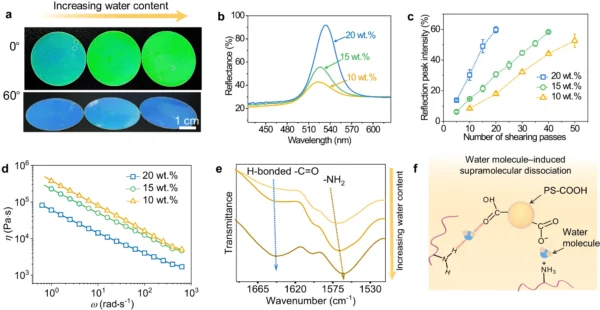
Effect of water on the processing performance of the supramolecular composite. Courtesy of Scalable production of structurally colored composite films by shearing supramolecular composites of polymers and colloids.
Looking Beyond Traditional Formulations
Structural color will not immediately replace all conventional pigments. Many applications still require opaque, precisely matched colors that current structural color technologies cannot yet provide. Nevertheless, this technology changes how engineers approach plastic design. Instead of adding pigments during formulation, designers control optical effects by managing shear forces and particle alignment. As manufacturing equipment adapts to these flow conditions, structural color can move from laboratory research to industrial polymer films. This shift could lead to plastics whose visual appeal comes from controlled physical structures rather than complex chemical additives.

María José Vargas is a mechanical engineer and MSc candidate in Materials Engineering and Nanotechnology at Politecnico di Milano. Her work focuses on environmental stress cracking in polyethylene, polymer failure behavior, plastics processing, and sustainable polymer applications.