Purifying Recycled Polymers Requires a Balancing Act
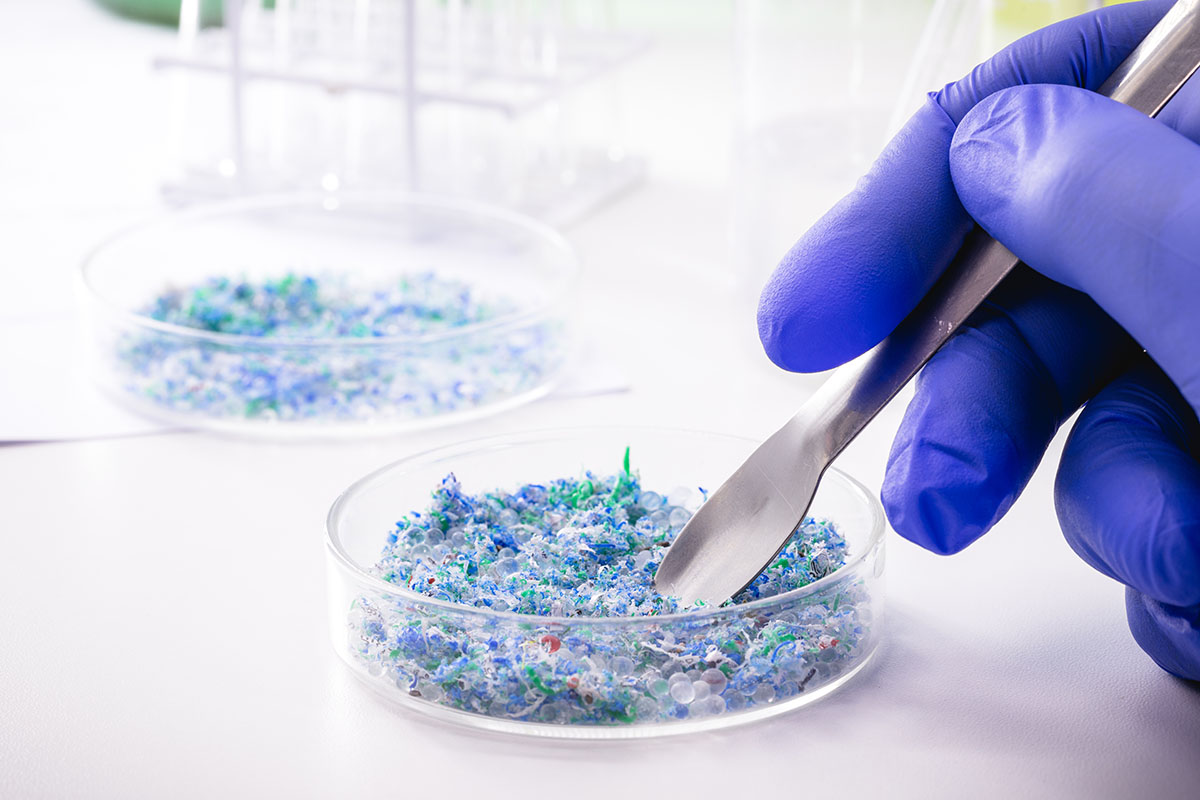
Membrane purification removes more than 90% of HBCD from polystyrene, revealing trade-offs between contaminant removal, polymer retention, and processing efficiency.
Controlling Molecular Contamination in Recycling
Mechanical recycling can recover polymers without restoring their original purity. Additives, residual contaminants, and degradation products may remain in recycled materials and restrict their reuse. Removing these substances without degrading or losing valuable polymer chains adds another processing challenge.
A 2025 study by Laviolette, Eslami, and Doucet investigated membrane-based nanopurification as a potential solution. The researchers targeted polystyrene (PS) contaminated with hexabromocyclododecane (HBCD), a brominated flame retardant. Their approach exploited differences in molecular size to separate the polymer from the contaminant.
You can also read: Plastic Films: Solvent-Recycling Solutions
Molecular Size Drives Separation
The researchers dissolved PS and HBCD in toluene and processed the solution through ceramic tubular membranes. The membranes retained larger polymer chains while allowing smaller contaminant molecules to pass into the permeate.
Molecular size underpins this separation. HBCD has a molecular weight of 641.7 Da, while virgin and post-consumer PS had mass-average molecular weights of 365,000 and 191,891 Da, respectively. The researchers also calculated hydrodynamic radii of 16.7 and 11.6 nm for the two PS samples in toluene.
These differences enable selective removal of small-molecule contaminants while retaining polymer chains. However, separation efficiency also depends on membrane characteristics, operating conditions, and solvent exchange.
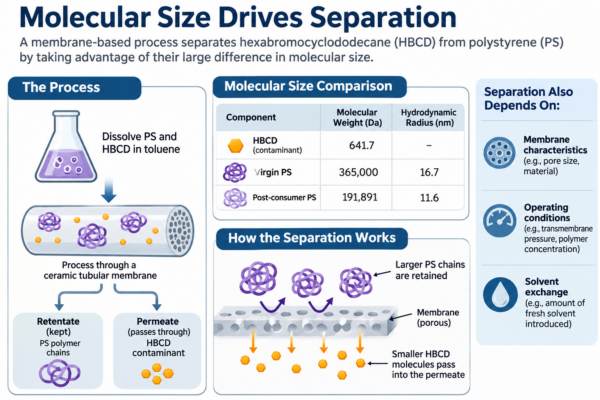
Membrane-based nanopurification uses molecular size differences to retain larger polystyrene (PS) chains while allowing smaller HBCD molecules to pass into the permeate. Separation efficiency also depends on membrane characteristics, operating conditions, and solvent exchange. Image generated with AI for Plastics Engineering.
Membrane Purification Removes More Than 90% of HBCD
The researchers evaluated membranes with nominal pore sizes of 1, 2, and 10 nm. They tested a controlled PS/HBCD mixture and post-consumer expanded polystyrene recovered through mechanical sorting.
Under the tested conditions, the process removed more than 90% of HBCD. Solvent exchange played a central role in contaminant removal.
The researchers quantified solvent replacement using the mass turnover number (MTN), which relates the cumulative mass of introduced solvent to the initial solution mass. HBCD concentration decreased as solvent turnover increased.
The study identified MTN as a significant factor influencing contaminant removal. However, greater solvent turnover could also increase polymer loss, creating a tradeoff between purification efficiency and material recovery.
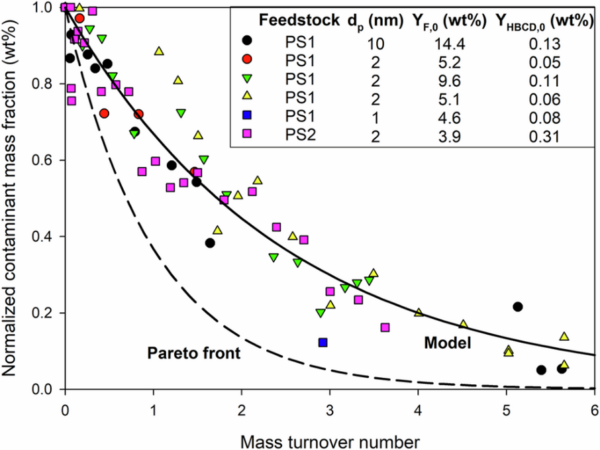
Membrane purification reduced HBCD concentration by more than 90% as solvent turnover increased. Courtesy of Membrane-based Nanopurification for Plastic Recycling.
Polymer Retention Defines the Tradeoff
Membrane selection requires balancing contaminant removal, polymer retention, and processing efficiency.
The researchers measured permeate flux under different operating conditions. Increasing transmembrane pressure produced a linear increase in flux, while larger membrane pores generally allowed higher flow rates.
Higher polymer concentrations reduced flux. The researchers attributed this behavior to increased solution viscosity and osmotic pressure.
These findings highlight an important engineering tradeoff. Increasing purification intensity may improve contaminant removal but also increase solvent consumption and polymer loss.
A process that removes contaminants efficiently but sacrifices too much polymer may deliver an unattractive recovery yield. Conversely, maximizing polymer retention without considering purification performance could limit the quality of the recovered material.
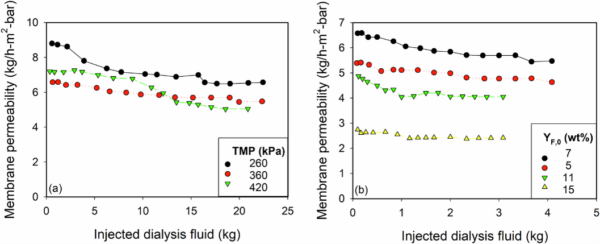
Permeate flux varies with transmembrane pressure, solvent turnover, and polymer concentration, highlighting important process variables. Courtesy of Membrane-based Nanopurification for Plastic Recycling.
Scale-Up Requires Integrated Process Control
The researchers used their experimental results to develop a model describing membrane purification performance. Their findings suggest that engineers must evaluate membrane pore size, transmembrane pressure, polymer concentration, solvent exchange, and polymer recovery together. The study also identified polyethylene (PE), polypropylene (PP), polystyrene (PS), polyvinyl chloride (PVC), and polyurethane (PU) as potential candidates for membrane-based purification. Their polymer chains can differ substantially in molecular size from smaller additives. Moreover, according to the authors, these five polymer families account for about 68.5% of global plastics consumption. However, this figure describes their market share, not a demonstrated recycling rate or recovery yield. Further research must evaluate other polymer-additive combinations and alternative solvents before assessing broader industrial implementation.
Purification Adds Another Tool to Plastics Recycling
The study demonstrates the potential of membrane-based purification to remove HBCD from polystyrene without depolymerizing the material. It also highlights the interconnected variables governing separation performance. For plastics processors and recyclers, these findings offer another approach to improving recycled polymer quality. Future recycling systems may need to optimize not only polymer recovery but also contaminant removal that limits material reuse.
Membrane purification offers one possible solution. Its industrial viability will ultimately depend on balancing contaminant removal, polymer retention, throughput, solvent recovery, and processing costs at a practical scale.
Key Takeaways for Polymer Recycling
- Effective contaminant removal: Membrane-based purification removed more than 90% of HBCD from polystyrene, demonstrating its potential to improve recycled polymer quality without depolymerization.
- Balancing process performance: Contaminant removal, polymer retention, and permeate flux depend on interconnected operating conditions, requiring engineers to balance purification efficiency with material recovery and throughput.
- Challenges for industrial scale-up: Broader implementation will require further evaluation of polymer-additive combinations, alternative solvents, solvent recovery, and process economics to determine commercial viability.

Paula Sánchez is a recent mechanical engineering graduate focused on sustainable manufacturing and materials innovation, with research experience in bio-assisted manufacturing at Purdue University and bioplastics at Universidad de los Andes, Colombia.