Predicting Plastic Color Before It Leaves the Extruder
Machine learning is giving plastics processors a faster way to match color by linking inline measurements with offline color predictions.
Machine learning can add value to plastic color matching by providing faster feedback during extrusion. An inline system can detect a color shift as material moves through the process, while a predictive model can estimate the corresponding offline color before operators produce molded specimens and complete laboratory measurements. This capability can reduce formulation iterations and help processors respond earlier when pigment concentration, dispersion, or other process variables shift color from specification. It also supports real-time quality monitoring by linking inline spectroscopy with machine learning to predict final color from process data.
You can also read: Real-Time Melt Monitoring in Extrusion and Injection Molding
A recent study presents a different approach: combining inline color measurements from extrusion with machine learning to predict the color obtained through conventional offline measurement. Rather than attempting to “design the perfect color,” the approach links two measurement stages and uses data to shorten the color-matching feedback loop.
Moving Color Measurement into the Process
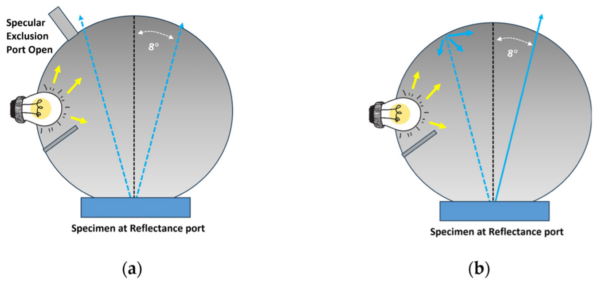
Working principle of an offline bench-top spectrophotometer with (a) Specular Component Excluded and (b) Specular Component Included. Courtesy of Development of a Machine Learning Model to Predict the Color of Extruded Thermoplastic Resins.
Traditional color matching separates processing from evaluation. Manufacturers compound polymer with pigments, produce molded specimens, and measure CIE L*a*b* values with a bench-top spectrophotometer. If the color falls outside the target range, the processor adjusts the formulation and repeats the process.
Inline spectroscopy moves color measurement into the extrusion process. In the study, researchers installed an inline spectrophotometer with a reflection polymer melt probe at the extruder die. The system recorded CIE L*a*b* values every two seconds under a D65 illuminant and a 10-degree standard observer.
Researchers paired the inline measurements with offline measurements from injection-molded color chips, averaging data from 10 chips per formulation. The inline signal characterized the polymer melt during compounding, while the offline measurement characterized the molded material. Because these measurements represent different physical states, the machine-learning model captures the relationship between processing-stage and final color measurements rather than simply reproducing one instrument’s output.
Training the Model
The researchers evaluated four machine-learning approaches: Multiple Linear Regression, a Deep Neural Network, Random Forest Regression, and Bagging with Decision Tree Regression. The models combined inline color measurements with material dosage data to predict offline color. Tree-based methods delivered the strongest results, with Bagging and Random Forest Regression producing aggregated color differences of approximately 10.8 and 10.75 dE, respectively. Prediction accuracy also improved as the researchers expanded the training dataset.
These results highlight the value of machine learning for polymer color matching. Color response can vary nonlinearly with pigment concentration, formulation, processing conditions, and measurement geometry. Tree-based models can capture these relationships without requiring engineers to define every interaction explicitly. The models also provide feature-importance information, helping engineers identify which inputs most strongly influence the predicted color and supporting more informed process adjustments.
From Prediction to Faster Corrections
The main benefit comes from faster feedback. An inline system can detect a color shift as material moves through the extruder. A predictive model can then estimate the offline color before operators produce molded specimens or complete lab measurements.
This capability can reduce formulation iterations during color matching. It can also help processors respond sooner when pigment concentration, dispersion, or other process variables shift color from the target. The approach supports real-time quality monitoring in plastics processing. Inline spectroscopy provides data on material composition and process conditions, while machine learning converts these signals into color predictions.
AI Still Needs Better Data
The study also exposes an important limitation: the model does not yet provide production-level accuracy. The authors describe the aggregated dE values as relatively high for industrial application and emphasize that prediction improves with larger training datasets.
For plastics processors, the more realistic path may therefore involve building color datasets directly from production lines. As those datasets grow, machine-learning models could better predict offline color from inline measurements. The result would not replace spectrophotometers or experienced color technicians. It would give them faster feedback.
Achieving precise color matching requires continuous measurement, formulation, and iteration. Machine learning can shorten this loop by connecting what the extruder sees with what the laboratory expects. In plastics manufacturing, that may be the most useful form of AI.

María José Vargas is a mechanical engineer and MSc candidate in Materials Engineering and Nanotechnology at Politecnico di Milano. Her work focuses on environmental stress cracking in polyethylene, polymer failure behavior, plastics processing, and sustainable polymer applications.