
Plastics in Footwear Manufacturing: 3 Key Innovations
Emerging plastic fabrication methods optimize footwear stiffness, durability, and mass production through additive manufacturing, sprayed thermoplastics, and reinforced midsoles.
Footwear manufacturing combines digital pattern making, manual fabrication, and commodity plastics in a $480 billion global industry. Almost all footwear contains some kind of plastic, from polyester mesh textiles that provide structure for the upper component, to ethylene-vinyl acetate foams for the midsole, to polyurethane rubbers for the outsoles. From everyday wear to athletic preperformance, footwear fabricators have borrowed various plastic manufacturing technologies to deliver innovative fashion.
You can also read: Exploring Supercritical Foaming Technology
How Advanced Polymers Are Transforming Footwear Production
Over the last two decades, the footwear sector has excelled at integrating existing plastics technology. Footwear producers like Nike, Adidas, and Puma, as well as international giants like Anta Sport Products and Fila Holdings, have begun publicly sharing footwear innovations with new capabilities. Additionally, a quick look at Google Patents shows a steep rise in applications and awards under the ‘Footwear and Its Accessory, Manufacturing Method and Apparatus’ header, highlighting the serious leap in innovation. These advancements aim to reduce reliance on manual labor, minimize waste, and improve fabrication efficiency.
The footwear industry typically uses technologies like polymer additive manufacturing (AM) and reinforced foams for specialized components, but it has leveraged them to mass-manufacture shoes. Aerospace and motorsports have long used advanced plastics and manufacturing technologies, but shoe designers and manufacturers are now adopting them to improve running shoes’ strength‑to‑weight ratio and stiffness.
Additive Manufacturing Enables Complex Footwear Designs
While AM is generally a niche fabrication technique, footwear giants like Adidas are using it to mass-produce consumer shoes. In 2024, Adidas partnered with Carbon, the Silicon Valley-based additive powerhouse, to print Climacool shoes and Futurecraft 4D midsoles. Climacool is a fully additively manufactured, open-latticed, lace-free shoe design, while the Futurecraft 4D shoe features an additively manufactured, latticed midsole. Both components are fabricated using Carbons Digital Light Synthesis (DLS) technology. DLS lets designers design and produce final components immediately, eliminating the need for conventional tooling in footwear development.
DLS uses liquid photopolymer resin to produce components that are difficult to make with traditional fabrication techniques, such as multi-lattice designs. Next-generation AM plastics like Carbon’s EPU 41, a highly tear-resistant and energy-returning elastomer, were the primary resin for both shoes. Not just large names like Adidas are participating in AM footwear. Smaller, boutique companies like HILOS and Zellerfeld are helping advance the AM footwear sector. These small production companies print polymer components in commodity plastics and some tailored photopolymers to make the final goods.

Thermoplastic Spray Technology Automates Upper Production
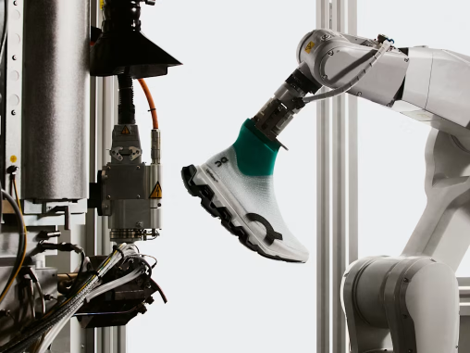
On, the Swiss running shoe designer and manufacturer developed LightSpray, a proprietary thermoplastic filament spray technology. LightSpray, like AM, deposits material layer by layer to create an object. Unlike AM, it uses pressurized air to spray helical molten plastic filaments onto a multi-axis robot-controlled mold, ultimately creating the final shape. The result is a complex, textile-like upper pattern, with almost 1600 meters of sprayed thermoplastic, no glue, and no seams. This delivers a performance-ready upper component with no laces and a precision fit. Using LightSpray, On bonds its sprayed thermoplastic upper to proprietary Pebax elastic foam in the shoe’s mid- and outsoles. On’s seven patent applications and proprietary plastics have led to commercial footwear worn by recent Boston and New York marathon winners.
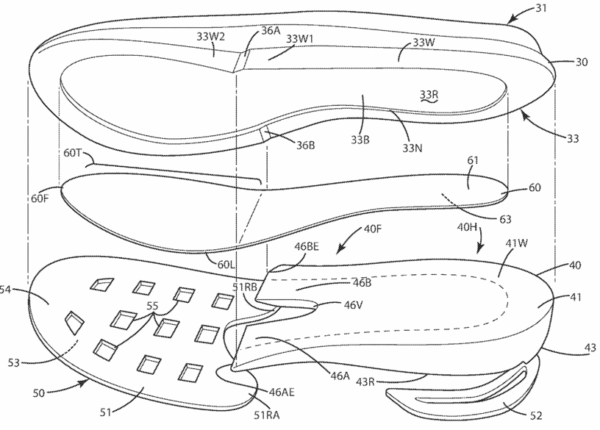
Saucony Inc. composite plate sole assembly. Courtesy of Saucony Inc. Patent US No. US 11,478,039 B2.
Polyamide Plates Reinforce Running Shoe Midsoles
As additive manufacturing and spray fabrication transform footwear production, manufacturers are also incorporating reinforced midsoles to enhance athletic performance. Companies such as Brooks Running and Saucony Inc. design, manufacture, and sell running shoes with nylon-reinforced midsole plates. Manufacturers typically use unfilled nylon for these plates, but they are also developing glass-fiber-reinforced polyamide alternatives to achieve different stiffness-to-weight ratios.
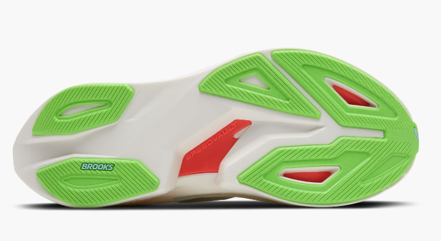
Outsole view of Brooks Hyperion Max 3 showcasing the pink SPEEDVAULT nylon plate. Courtesy of Brooks Running.
Global polyamide manufacturers like Arkema, Celanese, and Evonik are collaborating with footwear companies to supply polyamide and similar elastic-recovering polymers for stiffening plates. This may deliver more rigid midsoles without unduly compromising consumer comfort, maintain stiffness over product lifespans compared to non-plated midsoles, and provide higher energy return than non-reinforced midsoles.

Jennifer Chavez is a chemist-turned materials scientist with expertise in advanced plastics manufacturing and experience spanning orthodontic medical devices, consumer products, and renewable energy. She currently works as a materials engineer in the aerospace sector, focusing on process development and compliance for flight-critical hardware.