Phosphinate Flame Retardants Offer Alternative to Antimony in Adhesives
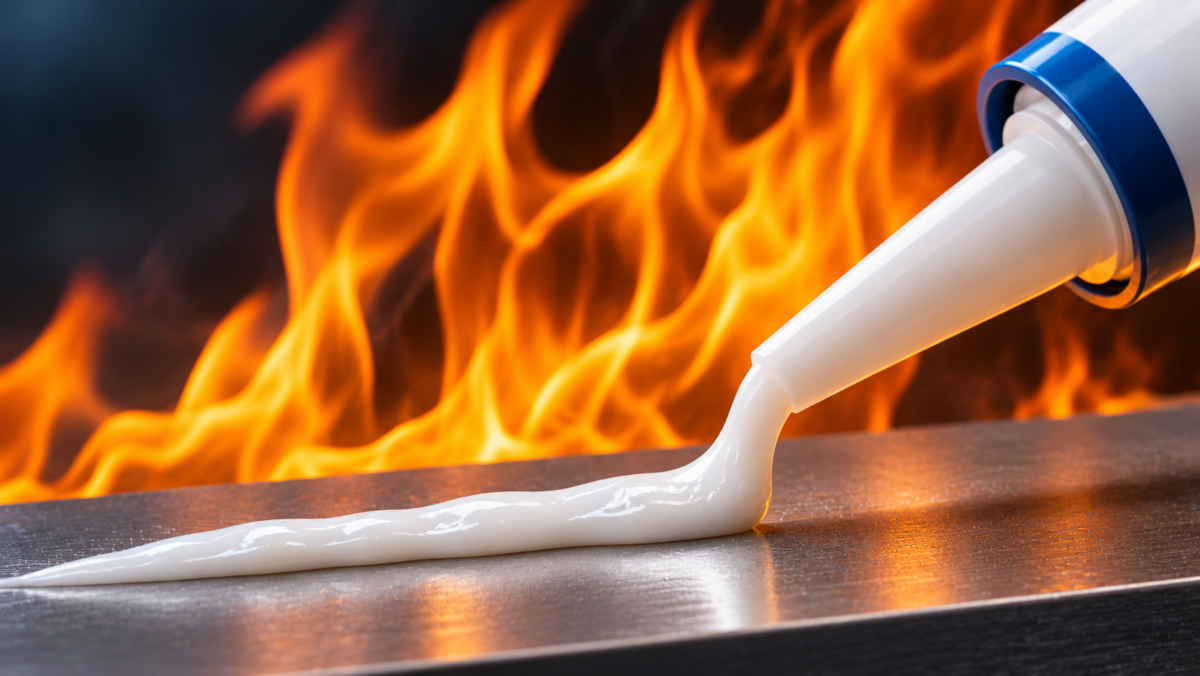
Rising antimony costs, supply uncertainty, and demand for halogen-free materials are encouraging adhesive manufacturers to reconsider conventional flame-retardant formulations.
Antimony trioxide (ATO) has long been used alongside halogenated flame retardants to improve fire resistance in polymer-based adhesives. However, rising raw material costs, supply chain uncertainty, and evolving chemical requirements are prompting manufacturers to evaluate alternative technologies.
You can also read: Balancing Fire Resistance and Transparency in PET
Rising antimony prices, concentrated supply chains, and demand for halogen-free materials are accelerating the development of alternative flame-retardant technologies for industrial adhesives. Antimony trioxide (ATO) has long been used alongside halogenated flame retardants to improve fire resistance in polymer-based adhesives. However, rising raw material costs, supply chain uncertainty, and evolving chemical requirements are prompting manufacturers to evaluate alternative technologies.
Phosphinates Emerge as Antimony Alternatives
In January 2026, specialty chemicals company Clariant highlighted phosphinate-based flame retardants as an alternative to conventional antimony-containing systems. According to the company, these halogen-free additives can deliver fire protection through different chemical mechanisms while offering greater flexibility in material selection and sourcing.
The development reflects growing interest in flame-retardant systems that balance fire safety, adhesive performance, and economic viability across construction, automotive, and aerospace applications.
Antimony Prices and Supply Risks Drive Reformulation
Conventional flame-retardant formulations frequently combine ATO with brominated or chlorinated compounds. In these systems, antimony acts as a synergist, enhancing the flame-inhibition mechanisms of halogenated additives. Although effective, this approach exposes adhesive manufacturers to fluctuations in antimony availability and pricing. In a June 2025 announcement, Adrian Beard of Clariant’s Flame Retardants business described the need to reconsider established material sourcing strategies.
“This isn’t just about solving today’s problem – it’s about implementing a more resilient approach for the future.”
The challenge extends beyond material costs. Manufacturers must also consider changing regulatory requirements, customer demand for halogen-free alternatives, and the technical implications of reformulating established adhesive systems.

Antimony trioxide (ATO) prices increased by 400% in the year preceding June 2025, while an estimated 75–80% of global ATO production is concentrated in China, highlighting cost volatility and supply chain risks for flame-retardant manufacturers. Source: Clariant, June 2025. Infographic generated with AI for Plastics Engineering.
The Chemistry Behind Phosphinate Flame Retardants
Clariant’s proposed alternative relies on phosphinate-based flame retardants, which use phosphorus-containing chemistry instead of the conventional combination of antimony and halogenated additives.
Depending on their chemical structure and polymer matrix, phosphorus-based flame retardants can influence combustion through gas-phase and condensed-phase mechanisms.
These mechanisms include:
Gas-phase flame inhibition: Phosphorus-containing species released during thermal decomposition can interfere with radical reactions that sustain combustion.
Condensed-phase protection: Certain formulations promote protective residues or char formation, limiting heat transfer and the release of combustible decomposition products.
Heat release reduction: By modifying combustion and thermal degradation behavior, suitable formulations can reduce heat release and flame propagation.
Clariant reports that its phosphinate-based technologies can form protective barriers while helping suppress combustion reactions in the gas phase.
The relative contribution of each mechanism depends on the additive chemistry and adhesive formulation. Consequently, replacing an ATO-containing system requires evaluating the complete flame-retardant package rather than substituting one additive on an equal-weight basis.
Balancing Fire Safety and Adhesive Performance
For adhesive manufacturers, flame retardancy is only one of several performance requirements. Adhesive formulations must also deliver appropriate viscosity, curing behavior, substrate compatibility, mechanical strength, and long-term durability. Introducing a new flame-retardant additive can influence these characteristics, making formulation optimization essential. Clariant states that its phosphinate-based technologies can achieve competitive fire performance at loading levels comparable to those used in conventional ATO-containing systems. The company also reports benefits related to flame spread, heat release, smoke development, and char formation.
Exolit OP 945 Demonstrates Flame-Retardant Performance
Clariant’s Exolit OP 945 demonstrates the technical potential of phosphinate-based additives.
The fine-particle flame retardant is intended for applications that include thin adhesive layers, such as those used in flexible printed circuits. Its reported particle-size distribution has a D95 of 5 µm or less, a characteristic relevant to dispersion and processing in thin-layer applications.
According to Clariant’s product data, a specified resin formulation achieved the following UL 94 classifications at a thickness of 1.6 mm:
| Flame-retardant loading | UL 94 classification |
|---|---|
| Approximately 10 parts per 100 parts resin | V-1 |
| Approximately 30 parts per 100 parts resin | V-0 |
These manufacturer-reported results illustrate how additive concentration can influence fire performance. However, they are specific to the tested formulation and do not establish equivalent performance across all adhesive chemistries. UL 94 classifications also do not directly quantify smoke generation or heat release, which require different test methods.
For manufacturers evaluating alternative flame-retardant technologies, several formulation parameters remain critical:
Additive loading and dispersion: The concentration required to achieve fire protection and its influence on formulation homogeneity.
Processing and curing: Potential effects on viscosity, application conditions, and crosslinking reactions.
Mechanical performance: Changes in adhesion, cohesive strength, flexibility, and thermal durability.
Fire-test performance: Flame spread, heat release, smoke generation, and other relevant safety requirements.
Long-term stability: The influence of aging, moisture, temperature, and environmental exposure on adhesive performance.
The challenge is to achieve the required fire classification without compromising the adhesive’s primary bonding function.
Applications Across Construction, Automotive, and Aerospace
The potential applications of phosphinate-based flame retardants extend across industries that depend on adhesive bonding and polymer-based materials.
- Construction: Building products rely on adhesives for flooring installation, panel bonding, and structural applications involving engineered wood and other materials. In these systems, flame-retardant additives must support compliance with applicable building requirements while preserving mechanical performance and processing characteristics.
- Automotive: Manufacturers increasingly use adhesives to join dissimilar materials, bond lightweight composites, and assemble interior components. Alternative flame-retardant formulations must be compatible with the adhesive matrix while meeting relevant fire-safety and durability requirements.
- Aerospace: These applications impose demanding requirements on structural and interior adhesive systems. Any change in flame-retardant chemistry requires careful evaluation of fire performance, smoke generation, mechanical properties, and applicable qualification procedures.
Clariant identifies these industries as potential application areas for its phosphinate-based technologies. Its broader flame-retardant portfolio also serves engineering thermoplastics, electrical and electronic components, wire and cable systems, and fiber-reinforced composites.
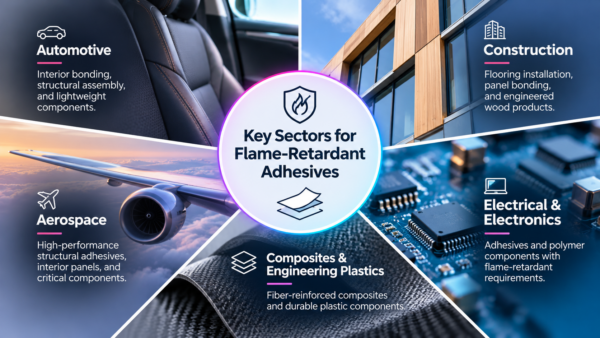
Flame-retardant adhesives support fire safety across automotive, construction, and aerospace applications, while flame-retardant polymers are also used in electronics and fiber-reinforced composites. Image generated with AI for Plastics Engineering (PE).
Supply Security and Sustainability Considerations
Beyond fire performance, manufacturers are increasingly evaluating flame-retardant technologies based on raw material availability, formulation flexibility, and environmental considerations.
Clariant identifies supply security and competitive costs as advantages of its phosphinate-based solutions. The company also positions its halogen-free composition as an opportunity to support material sustainability objectives. Reducing dependence on antimony could help manufacturers diversify their raw material sourcing. However, the economic benefits of switching technologies depend on additive pricing, loading levels, processing requirements, and qualification costs.
Similarly, halogen-free chemistry does not automatically establish a lower environmental footprint. Comparative assessments must consider additive production, toxicity, material compatibility, product durability, and end-of-life behavior. These considerations are particularly important when evaluating flame-retardant additives for adhesives used in long-service-life applications.
The Future of Antimony-Free Adhesives
The search for alternatives to conventional ATO-halogen systems reflects a broader shift in flame-retardant technology.
Clariant’s reported 400% antimony price increase and the concentration of global ATO production illustrate the economic pressures encouraging manufacturers to investigate alternative chemistries. Phosphinate-based additives offer one pathway toward reducing this dependence. Their ability to influence combustion through different mechanisms creates opportunities for developing halogen-free formulations across multiple polymer systems. Product-specific results, such as those reported for Exolit OP 945, also demonstrate the importance of additive loading and formulation design in achieving targeted fire classifications. Nevertheless, successful implementation depends on balancing flame retardancy with adhesive performance, processing compatibility, cost, and application-specific regulatory requirements. As supply chains evolve, alternative flame-retardant technologies could provide manufacturers with greater flexibility in meeting fire-safety requirements while reducing reliance on conventional antimony-containing systems.
Editorial note
The article is based primarily on Clariant’s January 27, 2026 technical overview.
Primary sources: Clariant: Why Antimony No Longer Works for Modern Adhesives · Clariant: Exolit AP 422 A Announcement, June 2026

Juliana Montoya is Director of Content for Plastics Engineering. A mechanical engineer with an MSc in materials engineering, she has experience as a sustainability and packaging consultant focused on ecodesign and recycling. Her work centers on technical content for the plastics industry, connecting polymer innovation, manufacturing trends, and sustainability strategy for industry audiences.