
PFAS Distribution in China’s Yellow River Basin
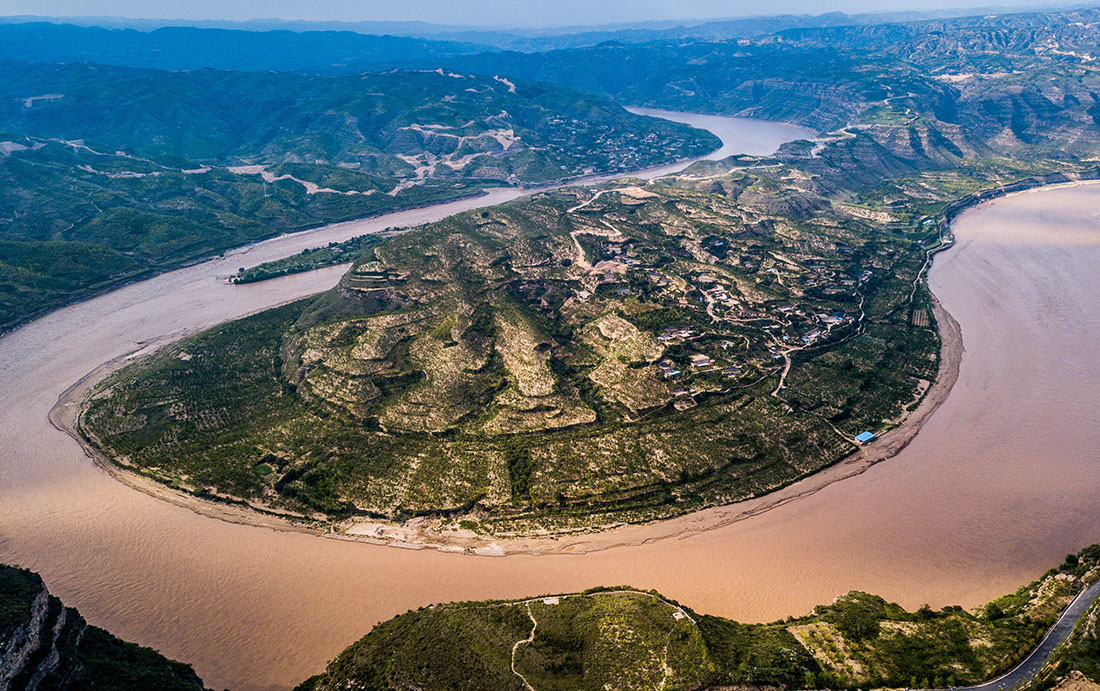
Researchers studied a river in China to better predict where environmental PFAS pollution accumulates.
When per- and polyfluoroalkyl substances (PFAS) enter the environment through urban runoff and industrial discharge, water often governs their transport. Just like sediment, hydro-geomorphological features can influence how PFAS pollution travels and behaves in riverine systems. Additionally, socioeconomic factors, regional industrial activities, and land-use patterns can also influence PFAS fate. Modeling and predicting environmental PFAS behavior and distribution thus requires accounting for a wide range of variables.
You can also read: Changing Seasons, Shifting Chemistry: PFAS Variability in the Arctic
Yellow River: A Case Study
The Yellow River in China is one of the world’s most sediment-laden rivers. In some locations, climate change-driven extreme rainfall events have further intensified soil erosion. For example, increased precipitation formed a super-elevated channel in the Loess Plateau. This displaced sediment increases river turbidity and can alter hydrological dynamics. Understanding PFAS behavior in sediment-laden rivers like the Yellow River remains limited.
Recently, researchers conducted a study to better understand the fate of PFAS in the Yellow River. In this study, they created a multivariate model to predict PFAS pollutant occurrence. This strategy combined diverse data with artificial intelligence to show how suspended sediment influences PFAS behavior. This modeling strategy included:
- Self-organizing map (SOM), a neural network inspired by biology that enables visualization and clustering of pollution patterns
- Geographically weighted regression (GWR), a model that can capture spatial associations between PFAS concentrations, environmental covariates, and socioeconomic covariates
- Machine learning (ML) to predict pollution occurrence, transport, and risks
To collect PFAS accumulation data, researchers collected water, sediment, and organism (fish) samples from 57 sites.
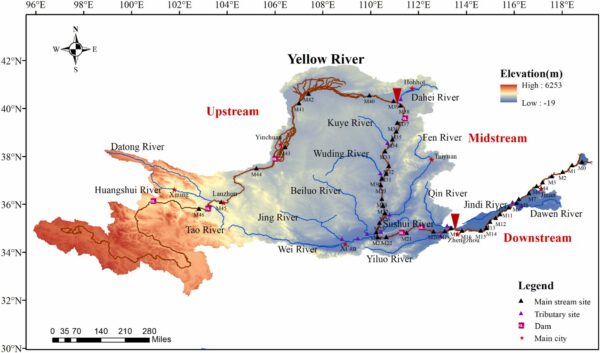
The Yellow River passes through industrial zones, erosion-prone lands, and agricultural regions. Figure courtesy of Spatial distribution of per- and polyfluoroalkyl substances in the Yellow River basin: Role of suspended sediment on the PFAS partition and accumulation.
Higher PFAS Concentrations Downstream
Researchers observed a PFAS accumulation gradient across the basin, with lower concentrations in the upper reaches. Downstream regions demonstrated elevated PFAS levels, including emerging perfluoroalkyl ether carboxylic acids (PFECAs). To describe pollutant behavior, researchers calculated the partition coefficient (LogKoc) of PFAS in water. Obtained values ranged from 0.43 to 4.64 for legacy PFAS and -0.06 to 4.63 for emerging PFAS. Upstream regions exhibited higher LogKoc values. This may be due to lower pH and higher ionic strength. These factors can enhance electrostatic and hydrophobic interactions, promoting PFAS sorption onto particulate matter.
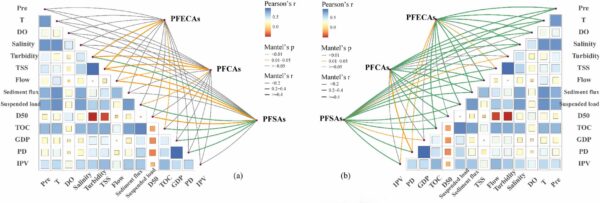
Many environmental factors influence PFAS distribution in sediment (a) and water (b). Figure courtesy of Spatial distribution of per- and polyfluoroalkyl substances in the Yellow River basin: Role of suspended sediment on the PFAS partition and accumulation.
Stirring Up PFAS
Re-suspension events from turbulent hydrodynamics (e.g., storms) and sediment-laden flow redistribute PFAS between the aqueous and particulate phases. This interaction with suspended sediments prolongs PFAS residence time in the environment and enhances downstream transport. In turbid systems, suspended sediments increase PFAS mobility and retention.
In lower reaches of the river, researchers attributed higher PFAS concentrations to anthropogenic activities, sediment transport, and hydrodynamic variations. Predictive modeling confirmed that industrial production, population density, and other socioeconomic factors influence PFAS volume. This study outlined a repeatable approach for monitoring PFAS-particle interactions in dynamic fluvial environments.

Having studied Geology, Julienne Smith focuses on environmentalism, sustainability, and the policies that impact plastics professionals today. As a technical writer, she is passionate about the intersection of science, technology, and communication. In her free time, she loves learning new things and writing fiction.