PACK EXPO 2026: How Changing Materials Are Reshaping Packaging Equipment
PMMI insights from PACK EXPO 2026 show how changing materials and sustainability goals are pushing packaging equipment toward greater flexibility.
Packaging manufacturers increasingly face a difficult investment question: how do they buy equipment for materials they may not use for years? At PACK EXPO International 2026 in Chicago, PMMI shared insights into changing materials, sustainability targets, workforce pressures, and operational uncertainty. One message stood out: packaging equipment must increasingly prepare for evolving materials and structures.
You can also read: Custom Blow Molding Machines Redefine Packaging Efficiency
Recycled-content requirements, lightweighting, new formats, and changing regulations continue to reshape packaging material choices across the industry. However, manufacturers cannot replace a packaging line every time a new film, resin, or structure reaches the market. That tension is making flexibility a bigger part of machinery investment and long-term packaging strategy.
Material Change Is Becoming an Equipment Challenge
A sustainable packaging decision rarely affects only the package itself. PMMI emphasized that material changes can ripple through packaging and processing operations, affecting how equipment runs and how lines are configured.
For example:
- Lightweighting can change how films feed through equipment and behave during forming, filling, or sealing.
- Downgauging can affect stiffness, web handling, and dimensional stability.
- Higher PCR content may introduce greater material variability during processing.
- Eliminating secondary packaging can place additional performance demands on the primary package.
As a result, sustainability is becoming part of the equipment specification rather than a separate packaging decision. Manufacturers are no longer asking only whether a machine can run today’s structure. They also need to know whether it can handle tomorrow’s materials.
That may require:
- broader processing windows,
- modular machine designs,
- easier retrofit options,
- and more adaptable control systems.
The Industry Does Not Know Exactly What Comes Next
The problem is not simply adapting to one known material transition. Companies often do not know which packaging materials they will need three or five years from now.
PMMI has been tracking that uncertainty by asking PACK EXPO attendees which materials they use today and which they expect to use in the future. Over three years, the organization has collected about 60,000 data points through this material-transition initiative.
The goal is not to identify one winning material. Instead, the data help show where the market may be moving. That information can influence machinery purchases because a company may optimize equipment for one structure today while still requiring retrofit options for several likely future materials.
In that environment, adaptability can become almost as important as initial machine performance.
Not Every Material Trend Keeps Accelerating
PMMI’s tracking also shows how quickly expectations around sustainable materials can change. The organization initially recorded strong interest in compostable materials, but that interest later moderated. Biodegradable materials showed a similar pattern.
Companies continue exploring both approaches, but adoption hasn’t accelerated as quickly as early interest suggested. For machinery suppliers, that creates a difficult engineering problem. Equipment designed around one highly specific material may perform very well today but offer less flexibility later.
A more adaptable platform can therefore give processors more room to respond as sustainability strategies evolve.
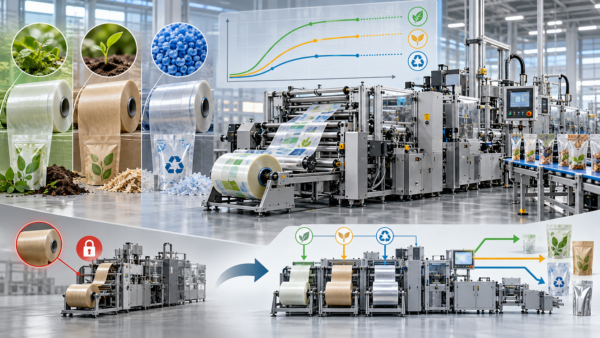
Shifting interest in compostable, biodegradable, and recyclable materials is pushing packaging equipment toward greater flexibility. Adaptable machinery can help processors respond as sustainability strategies and material choices continue to evolve. Image generated with AI for Plastics Engineering magazine.
Productivity Means More Than Maximum Speed
Material flexibility also connects with a broader shift in how manufacturers define productivity. PMMI said companies increasingly care less about maximum machine speed and more about total usable output during a shift.
That calculation includes SKU changes, sanitation, startups, material transitions, downtime, and operator experience. As a result, metrics such as changeover losses, startup time, mixed-adjusted throughput, and time to operator independence are becoming more relevant.
A machine that runs one structure extremely fast may deliver less value than equipment that can handle several materials efficiently. In practice, flexibility and resilience may matter more than headline speed.
Designing for the Unknown
Packaging equipment will still need reliability, speed, and consistent output, but manufacturers increasingly need another capability: resilience. Future lines may need to handle higher recycled content, thinner films, new barrier structures, smaller formats, or unfamiliar materials.
That changes the investment question. Instead of asking only how well equipment runs today’s package, manufacturers may also ask how easily it can adapt when the package changes.
In a market where packaging materials keep evolving, future-ready equipment may not be the machine optimized for one substrate. It may be the one designed to handle what comes next.

Juliana Montoya is Director of Content for Plastics Engineering. A mechanical engineer with an MSc in materials engineering, she has experience as a sustainability and packaging consultant focused on ecodesign and recycling. Her work centers on technical content for the plastics industry, connecting polymer innovation, manufacturing trends, and sustainability strategy for industry audiences.