
Optimizing Carbon Fiber-Reinforced PA6 Through Precision Processing
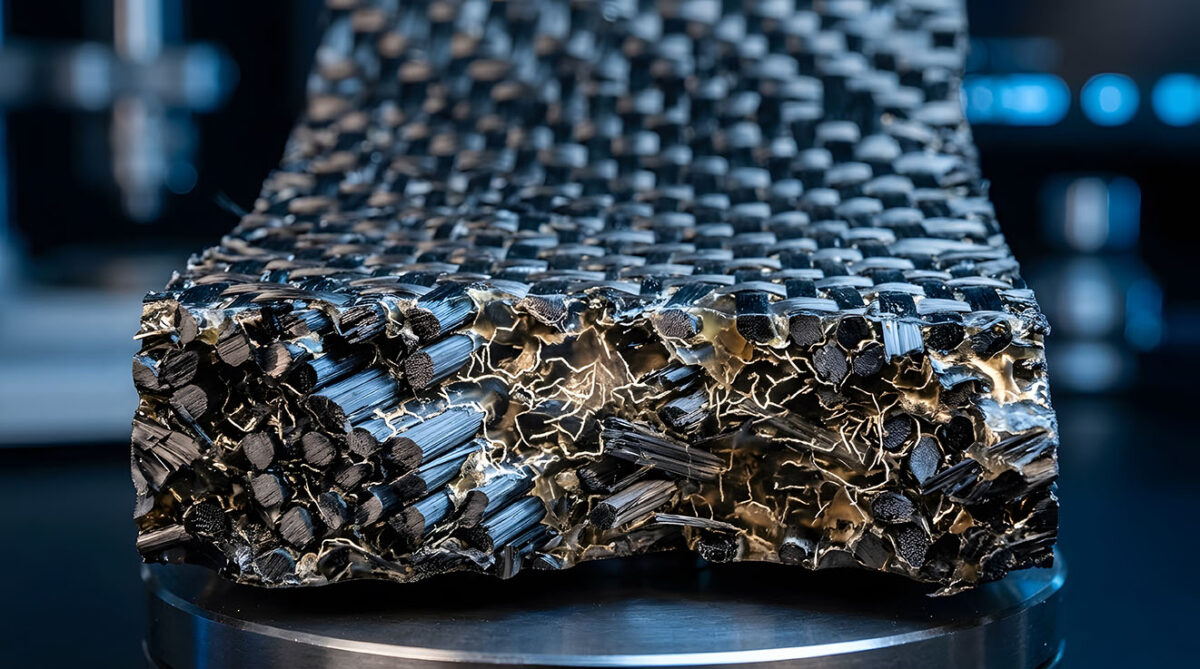
Researchers optimize carbon fiber-reinforced PA6 through fiber loading, cooling control, and processing parameters to improve composite performance.
Manufacturers demand lightweight, high-strength components, but traditional thermoset resins introduce severe recycling and processing bottlenecks. To address this, materials engineers use carbon-fiber-reinforced polyamide 6 (CF/PA6), a thermoplastic composite that can be melted and reformed repeatedly. By leveraging shear-thinning fluid dynamics and targeted thermal controls, producers force the polymer matrix to align its molecular chains around the carbon fibers. This physics-driven approach lets factories mold highly resilient parts at scale, cutting production cycle times and material waste.
You can also read: Why Carbon Fiber Reinforcement Works—or doesn’t—in 3D Printing
Mastering Rheology and Fiber Loading
Industrial extrusion equipment requires predictable fluid behavior to prevent clogging and ensure complete mold fill. Researchers found that adding carbon fiber directly alters PA6’s rheological properties, transforming the melt into a shear-thinning, pseudoplastic fluid. As production machines apply shear force, the viscosity drops. This shift in fluid dynamics allows the plastic to flow smoothly into complex mold geometries without excessive energy consumption.
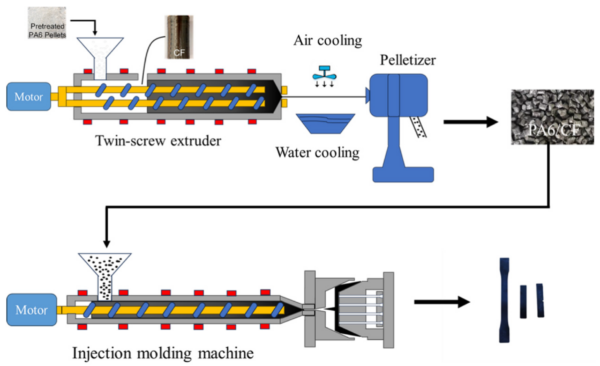
Schematic diagram of CF/PA6 composite sample preparation. Courtesy of Carbon Fiber-Reinforced Polyamide 6 Composites: Impact of Fiber Type and Concentration on the Mechanical Properties.
Engineers pinpointed 40 wt.% carbon fiber as the critical threshold for maximum performance. At this concentration, the composite achieves optimal fiber dispersion and superior interfacial bonding between the carbon reinforcement and the polymer matrix. The material also reaches a peak crystallinity of 55.16%. If manufacturers exceed this limit, the fibers tangle. The PA6 matrix fails to infiltrate the dense network, degrading interfacial strength and causing molding defects on the factory floor, according to Effects of Carbon Fiber Content on the Crystallization and Rheological Properties of Carbon Fiber-Reinforced Polyamide 6.
Thermal Control and Impact Resistance
Beyond fiber volume, cooling rates dictate the final mechanical properties of the fabricated part. When manufacturers employ self-resistance electric (SRE) heating technology with compression molding, they must tightly control the temperature down-ramp. Cooling speed directly influences the matrix’s crystalline structure.
| Cooling Rate (°C/min) | Matrix Crystallinity (%) | Mechanical Application Focus |
| 29.56 | 25.97 | High impact resistance for crash components |
| 2.64 | 37.22 | High stiffness for structural supports |
Comparison of mechanical application focus between fast and slow composite cooling rates. Adapted from Carbon Fiber-Reinforced Polyamide 6 Composites: Impact of Fiber Type and Concentration on the Mechanical Properties
The data confirms that manipulating thermal transitions alters the composite’s real-world utility. Rapid cooling starves polymer chains of the time needed to form highly ordered structures that absorb sudden physical shocks better. Conversely, slow cooling promotes dense crystallization, yielding rigid parts suitable for load-bearing applications.
Optimizing SRE Heating Parameters
To commercialize these composites, production facilities need repeatable, scalable manufacturing parameters. SRE heating offers an efficient way to form these laminates if factory operators calibrate the machinery precisely.
| Targeted Characteristic | Temperature (ºC) | Pressure (MPa) | Time (min) |
| Void Content | 270 | 2 | 20 |
| Flexural Strength | 270 | 2.5 | 20 |
| Impregnation quality | 270 | 2.5 | 15 |
| Impact Strength | The effect of the process parameters is not significant | ||
Optimal process parameters to obtain the best performance of targeted characteristics. Adapted from Optimization of Process Parameters for Carbon Fiber Reinforced Polyamide 6 Composites Fabricated by Self-Resistance Electric Heating Technology
Engineers established a precise processing window for optimal laminate formation. Technicians achieve optimal forming quality by running the SRE equipment at 270 °C, applying 2.5 MPa pressure, and holding the impregnation time at exactly 15 minutes, since flexural properties are similar and 15 min is more conducive to reducing energy consumption and improving efficiency. This combination ensures the polyamide fully melts and permeates the carbon-fiber weave before cooling begins. Operators must continuously monitor the cross-sectional temperature field; uneven heat distribution causes variable impregnation rates and creates mechanical weak points.
Targeted optimization of CF/PA6 composites turns a raw thermoplastic into an industrial-grade powerhouse. By capping carbon fiber content at 40 wt.% and implementing precise SRE heating parameters, manufacturers ensure flawless matrix infiltration and consistent mechanical output. Adjusting the cooling rate lets product developers quickly pivot between rigid structural beams and impact-absorbing panels using the same base material. This material control delivers scalable, recyclable components that meet the stringent demands of modern aerospace and automotive supply chains.
Key Takeaways for CF/PA6 Manufacturing
- Optimize fiber content: Carbon fiber loading influences melt viscosity, fiber dispersion, and mechanical performance. Researchers identified 40 wt.% as the optimal concentration among the formulations tested.
- Control cooling rates: Cooling conditions affect PA6 crystallinity and mechanical behavior. Slower cooling increases crystallinity, while faster cooling may improve certain impact-related properties.
- Fine-tune processing parameters: Self-resistance electric heating enables controlled consolidation of the laminate. Optimizing temperature, pressure, and holding time can improve impregnation quality and manufacturing efficiency.

Andres Delgado is a mechanical engineer specializing in design and quality assurance, with experience in precision seal design, turbomachinery maintenance, and orthopedic medical devices. He currently works as a Design Quality Engineer focused on New Product Introductions for knee implants and compliance with advanced manufacturing standards.