From South Korea to PACK EXPO: PVOH Coatings for Recyclable Packaging
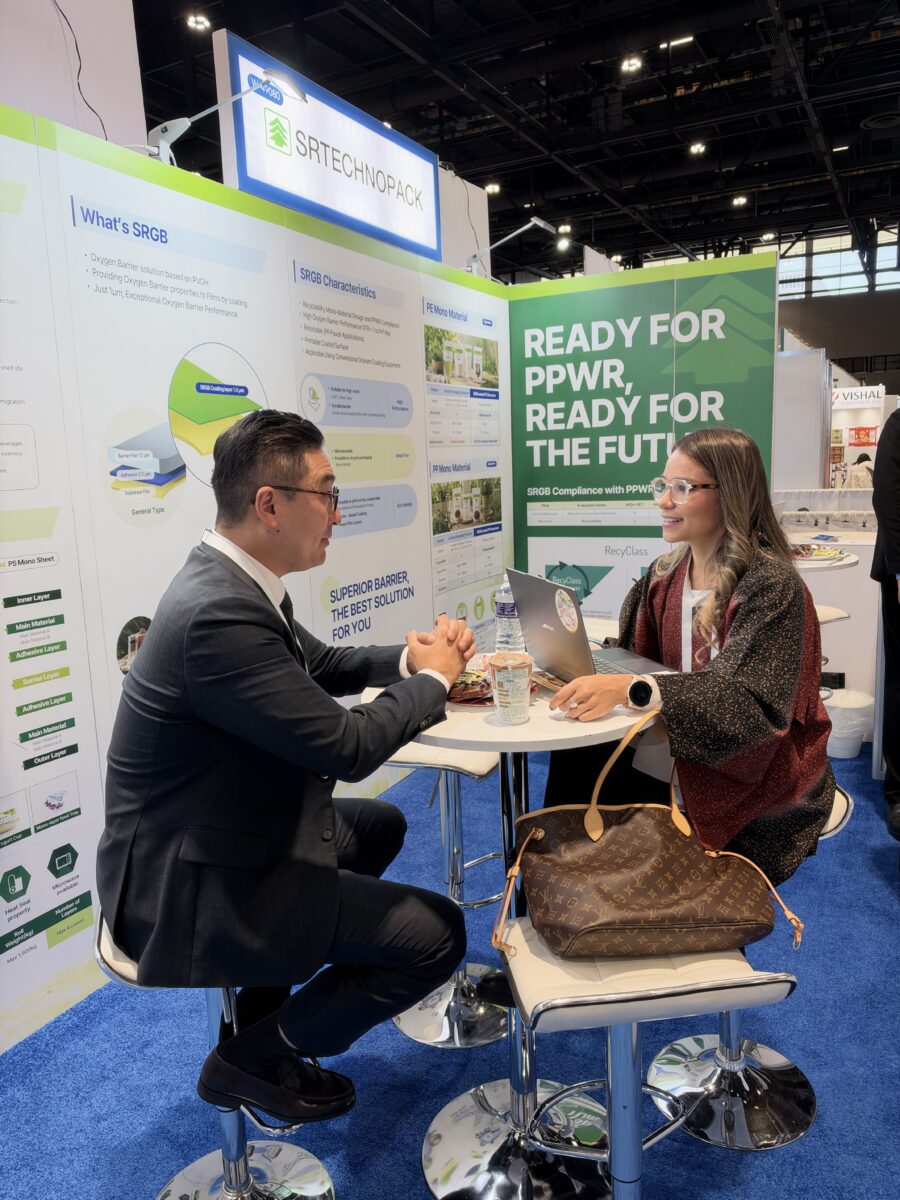
At PACK EXPO 2026, South Korea’s SR TECHNOPACK discussed PVOH barrier coatings, RecyClass approval, and preparing recyclable packaging for EU PPWR rules.
Packaging innovation increasingly crosses regional boundaries. While European regulations are driving changes in packaging design, manufacturers across Asia are developing technologies to meet these requirements and serve international markets.
At PACK EXPO International 2026 in Chicago, Plastics Engineering interviewed South Korea-based SR TECHNOPACK to learn how Asian packaging manufacturers are responding to the shift toward recyclable structures.
The company has developed SRGB, a water-based polyvinyl alcohol (PVOH) coating that provides barrier functionality in polyethylene (PE) and polypropylene (PP) packaging. Its approach replaces selected conventional barrier layers with a thin coating, reducing material complexity while maintaining product protection.
Replacing Multilayer Barriers with PVOH
Conventional high-barrier flexible packaging often combines polyolefins with aluminum, metalized films, polyamide, or ethylene vinyl alcohol (EVOH). Although these materials provide effective protection, their combination can complicate mechanical recycling. SR TECHNOPACK addresses this challenge by applying SRGB directly to polyolefin substrates.
According to the company, the dried coating measures approximately 1 µm thick, with a coating weight of 1.8 g/m². This low coating weight lets manufacturers add barrier functionality without adding a separate film. Although the resulting structure is not entirely monomaterial, it maintains a high proportion of PE or PP. They also see this approach as an alternative for applications where conventional multilayer structures present recycling challenges.
Barrier Performance and RecyClass Approval
PVOH provides oxygen-barrier properties, but its moisture sensitivity can affect performance under humid conditions. SR TECHNOPACK identifies moisture resistance as an important feature of SRGB. According to the company, the coating maintains barrier functionality during packaging use while allowing removal during the washing stages of mechanical recycling.
The company also reported RecyClass approval for both PE and PP pouch structures, with a B recyclability classification.
This assessment supports the company’s efforts to develop packaging compatible with recycling processes, although recyclability ultimately depends on the complete structure and applicable recycling system. Meanwhile, SR TECHNOPACK continues improving SRGB’s barrier performance for applications requiring extended shelf life.
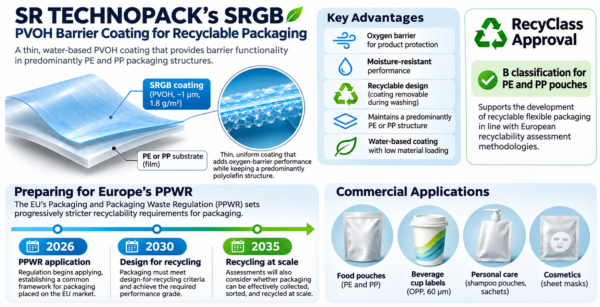
SR TECHNOPACK’s SRGB technology uses a thin, water-based PVOH coating to provide barrier functionality in predominantly PE and PP packaging structures. The infographic highlights the coating’s technical characteristics, the company’s reported RecyClass B classification, commercial applications, and key milestones under the EU’s Packaging and Packaging Waste Regulation (PPWR). AI-generated for Plastics Engineering, based on information provided by SR TECHNOPACK.
Production Challenges and Commercial Applications
Despite its advantages, SRGB introduces manufacturing challenges. The company currently applies its coating at speeds below 100 meters per minute, which limits production throughput compared with conventional printing processes. Consequently, manufacturing efficiency remains an important factor in the technology’s competitiveness. Nevertheless, SR TECHNOPACK has introduced SRGB into several commercial applications. Since early 2024, the company has supplied PP-based packaging to a customer operating in India that exports food products to Europe. An Australian customer began using its PP pouches for chicken and prawn stock products in early 2025.
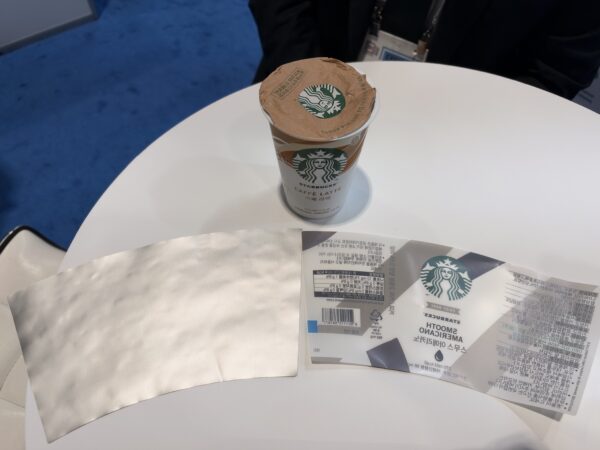
The technology also extends beyond flexible pouches. In 2019, SR TECHNOPACK introduced a coated, 60 µm oriented polypropylene (OPP) film to replace a multilayer beverage cup label containing aluminum. Also, the company is also exploring applications in personal care and cosmetics, including shampoo pouches, sachets, and sheet-mask packaging.
SR TECHNOPACK’s SRGB technology uses a thin, water-based PVOH coating to provide barrier functionality in predominantly polyethylene (PE) and polypropylene (PP) packaging structures. The company reports RecyClass approval for its PE and PP pouches, supporting the development of recyclable alternatives to conventional multilayer packaging.
Asian Innovation Meets Global Packaging Requirements
The European Union’s Packaging and Packaging Waste Regulation (PPWR) is influencing packaging development far beyond Europe. During the interview, the spokesman described growing interest in recyclable structures among international customers and packaging manufacturers. For Asian suppliers, this shift presents opportunities to develop barrier technologies that meet the expectations of multiple markets. However, replacing conventional materials requires more than demonstrating recyclability. Manufacturers must also deliver consistent barrier performance, competitive production costs, and reliable processing. SR TECHNOPACK’s experience illustrates how South Korean packaging innovation is contributing to this transition.
As the industry works toward more recyclable structures, developments emerging from Asia deserve attention—not only as alternatives to existing materials, but also as examples of how manufacturers are translating global sustainability requirements into commercial packaging solutions.
Preparing for Europe’s New Packaging Rules
For SR TECHNOPACK, developing recyclable packaging also helps position its technology in international markets, particularly Europe. The European Union’s Packaging and Packaging Waste Regulation (PPWR), which began applying on August 12, 2026, establishes requirements for packaging placed on the European market, regardless of where manufacturers produce it.
The regulation introduces progressively stricter recyclability requirements:
- 2026 – PPWR application: The regulation begins applying, establishing a common regulatory framework for packaging sold in the EU.
- 2030 – Design for recycling: Packaging must meet design-for-recycling criteria and achieve the required recyclability performance grade.
- 2035 – Recycling at scale: Recyclability assessments will also consider whether packaging can be effectively collected, sorted, and recycled at scale.
These requirements extend beyond European manufacturers. Companies in South Korea and other Asian markets must consider the PPWR when developing packaging for products destined for the EU.
SR TECHNOPACK has already taken steps to prepare for this transition:
- RecyClass approval: The company reports a B recyclability classification for its PE and PP pouch structures, providing supporting evidence for customers evaluating recyclable alternatives. However, RecyClass approval does not automatically establish PPWR compliance.
- European market exposure: SR TECHNOPACK supplies packaging to a customer operating in India that exports food products to Europe.
- Packaging redesign: Its SRGB coating technology reduces reliance on conventional multilayer barrier structures while maintaining a predominantly polyolefin composition.
As Europe strengthens its requirements, Asian suppliers increasingly need to incorporate recyclability into material development rather than treating it as a final qualification step. For emerging players seeking access to the European market, success will depend on demonstrating both packaging performance and compatibility with evolving recycling standards.

Juliana Montoya is Director of Content for Plastics Engineering. A mechanical engineer with an MSc in materials engineering, she has experience as a sustainability and packaging consultant focused on ecodesign and recycling. Her work centers on technical content for the plastics industry, connecting polymer innovation, manufacturing trends, and sustainability strategy for industry audiences.