
Why MFI and Capillary Rheometry Can Miss Molding Behavior
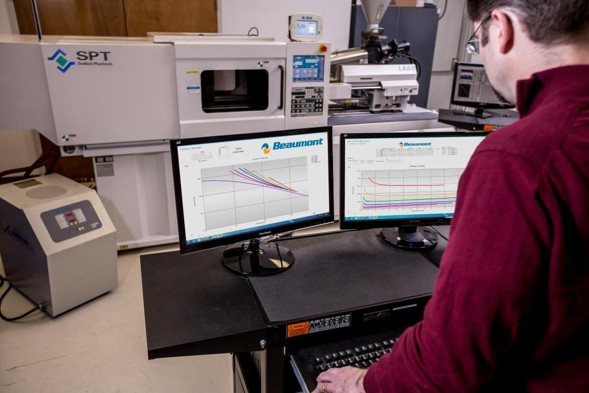
MFI and capillary rheometry provide useful flow data, but they may not fully predict polymer behavior under injection molding conditions.
A polymer that appears easy to process based on laboratory data can behave very differently under the high shear rates, cold mold surfaces, and rapidly changing flow conditions of injection molding. Melt Flow Index (MFI) and capillary rheometry remain widely used tools for characterizing polymer flow. Both provide valuable information under controlled conditions, but neither reproduces the full thermal, shear, and transient flow history of injection molding. That difference matters when processors use laboratory rheology data to select materials, predict filling pressure, evaluate thin-wall applications, or compare grades.
Eric Bowersox, Director of Beaumont Advanced Processing, addressed this gap at the 2026 SPE Injection Molding Innovation Summit in his presentation, “How MFI and capillary rheometers fail in characterizing how a polymer will injection mold.” The session examined where conventional flow measurements may provide an incomplete picture of injection moldability and how testing under molding conditions can add process-specific information.
You can also read: At ANTEC 2026: Process-Specific Rheology for Advanced Material Selection
One Number Cannot Describe the Whole Flow Curve
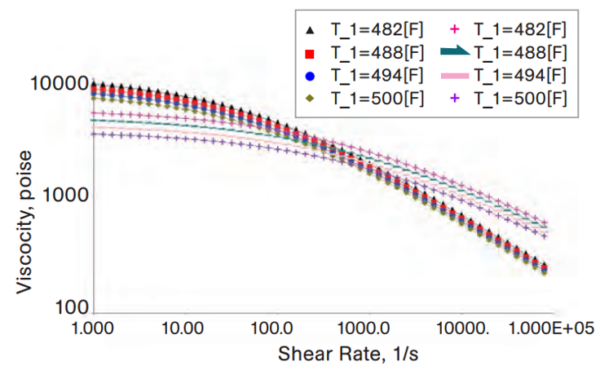
Viscosity versus shear rate for two 15% glass-filled PBT grades with the same MFI of 10. Their relative viscosities reverse as shear rate increases. Courtesy of Beaumont Technologies.
MFI provides a simple and widely established method for comparing polymer flow behavior. During the test, the barrel heats the material while a piston applies a specified load. The result reports the mass of polymer passing through a die over 10 minutes. However, MFI reports flow under a defined temperature and load rather than directly measuring viscosity across controlled shear rates.
This limitation becomes important because thermoplastic melts are non-Newtonian, meaning their apparent viscosity decreases as shear rate increases. Materials with similar MFI values can therefore behave very differently under injection molding conditions. Beaumont has demonstrated this with glass-filled PBT grades that shared the same MFI but exhibited different viscosity curves. Their relative flow behavior even reversed as shear rate increased, meaning the material that appeared more viscous according to MFI became easier flowing at higher rates.
The difference in operating range helps explain this behavior. Beaumont reports that MFI can correspond to shear rates of roughly 0.5 to 200 s⁻¹, depending on the material and test conditions, while Injection molding can expose polymers to much higher values, with gate shear rates exceeding 40,000 s⁻¹.
Capillary Rheometry Goes Further, But Not All the Way
Capillary rheometry provides a more detailed characterization of polymer flow than MFI. By forcing molten polymer through a capillary at controlled rates and measuring pressure, the method can generate viscosity data across a broad shear-rate range.
This approach supports material comparison and rheological modeling for injection molding simulation. However, conventional capillary testing does not reproduce several conditions that influence flow inside an injection molding machine. The rheometer maintains the polymer inside an approximately isothermal heated barrel, and Beaumont notes that the material may remain there for more than 10 minutes during testing. In contrast, an injection molding machine plasticizes each shot through screw rotation, compression, shear, and barrel heating before injecting the melt within a much shorter cycle. These differences can produce a different thermal and shear history before the material begins to flow through the mold.
Shear-rate capability also creates a limitation. Beaumont reports that typical benchtop capillary rheometers may reach shear rates around 10,000 s⁻¹, depending on the instrument and test setup, while its injection-molding-based rheometer can characterize materials at shear rates above 60,000 s⁻¹.
The Mold Changes the Flow While the Polymer Is Moving
Injection molding adds complexity that neither MFI nor a standard heated capillary fully captures: the effective flow channel changes continuously during cavity filling. As the hot polymer contacts the substantially colder mold surface, the material near the wall cools and solidifies, forming a frozen layer. As this layer grows, it progressively reduces the cross-sectional area available for melt flow.
At the same time, shear generates heat within the flowing polymer. The melt therefore loses heat through conduction to the mold while gaining heat through viscous dissipation. Wall thickness, gate geometry, flow length, injection speed, material properties, and mold temperature all influence this thermal balance. Consequently, Injection molding is therefore strongly non-isothermal. Temperature, viscosity, shear rate, and effective flow-channel thickness all evolve as the cavity fills.
Bringing Material Characterization Into the Molding Process
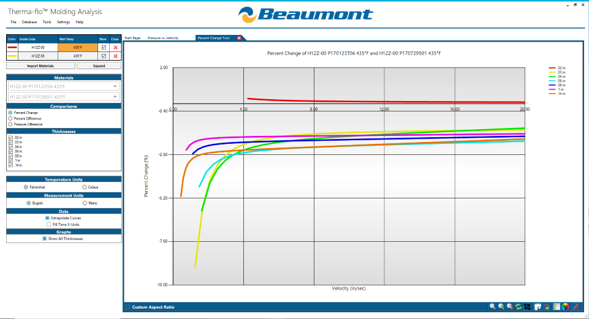
Therma-flo™ Molding Analysis compares material flow behavior across different cavity thicknesses and flow velocities under injection molding conditions. Courtesy of Beaumont Technologies.
Beaumont uses injection-molding-based characterization to more closely reproduce processing conditions than conventional laboratory tests. Its Injection Molding Rheometer prepares material with a conventional reciprocating screw, allowing evaluation after a thermal and shear history closer to production molding. Beaumont also developed its Therma-flo™ method, which compares material flow across different cavity thicknesses, geometries, and velocities under molding conditions.
This does not make MFI or capillary rheometry obsolete. MFI remains useful for quality control and comparative screening, while capillary rheometry provides valuable viscosity data for material characterization and simulation. The limitation arises when processors expect either method alone to predict how a polymer will behave during cavity filling. MFI remains useful for rapid quality control and comparisons between similar material lots, while capillary rheometers provide detailed viscosity data across controlled shear rates. Limitations arise when processors use these methods to predict a different outcome: How will this polymer actually fill the mold?
For processors working with thinner parts, demanding materials, or narrow processing windows, understanding that distinction can support more reliable material selection, simulation inputs, and process decisions.

María José Vargas is a mechanical engineer and MSc candidate in Materials Engineering and Nanotechnology at Politecnico di Milano. Her work focuses on environmental stress cracking in polyethylene, polymer failure behavior, plastics processing, and sustainable polymer applications.