Polymeric Membranes Improve Gas Separation in Oil and Gas
Polymeric membranes improve gas separation efficiency through tailored permeability, selectivity, and resistance to aging and plasticization.
Polymer membrane separation is nowadays an energy-efficient industrial alternative for various operations. It plays a key role in gas separation within the O&G industry. Key features include good integration into hybrid systems, low energy consumption, and operational simplicity. Membranes offer modularity and a small footprint compared to conventional alternatives such as amine absorption, cryogenic distillation, or pressure swing adsorption. Although they have not yet displaced conventional technologies, membranes improve overall system economics.
You can also read: High-Performance Membranes Made from Plastic Waste
These advantages have driven their adoption in applications including the purification, recovery, and conditioning of streams in O&G facilities. These streams contain acid gases, hydrogen, light hydrocarbons, water, and volatile organic compounds. Performance depends on solubility, diffusion, and polymer structure, as well as operational phenomena such as plasticization and aging. Polymer engineering adjusts membrane performance through physicochemical molecular design and morphology control.
Transport Fundamentals
In dense membranes, the solution-diffusion model dominates and comprises three stages: sorption, diffusion, and desorption. First, gas sorption occurs at the feed surface. Then diffusion occurs through the polymeric volume, and lastly desorption occurs on the low-pressure side. Researchers express permeability P as the product of diffusivity D and solubility S. The overall behavior results from the combination of the penetrant’s thermodynamic affinity and kinetic mobility. This formulation explains why highly condensable gases, such as CO₂, typically exhibit higher solubility in polymers. Meanwhile, small, less condensable molecules may diffuse faster.
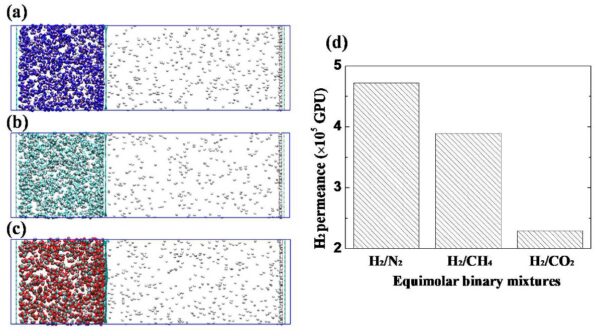
H2 permeation of three equimolar binary mixtures crossing the Graphdiyne membrane: (a) H2/N2, (b) H2/CH4, and (c) H2/CO2. (d) The H2 permeance of different binary mixtures. Courtesy of Enhanced Selective Hydrogen Permeation through Graphdiyne Membrane: A Theoretical Study. Open Access CC BY 4.0.
In porous membranes, transport occurs via different mechanisms depending on pore size and surface interactions. These include Knudsen diffusion, surface diffusion, capillary condensation, and molecular sieving. Here, when pore sizes approach the kinetic size of the molecules, selectivity increases. However, this can reduce useful flow rate if effective porosity decreases. This duality explains why porous systems are attractive for highly specific separations.
Polymeric Materials Characteristics
Engineers primarily classify membrane materials for gas separation as rubbery and glassy. Rubbery polymers exhibit high permeability but low selectivity due to high segmental mobility and sorption-dominated transport. They are particularly useful in dehydration and VOC recovery, where high affinity for organic vapors is advantageous. In contrast, glassy polymers offer greater selectivity due to their more rigid structure and lower free volume. However, emerging materials such as intrinsically microporous polymers and mixed-matrix membranes make a broad classification possible.
Polyimides have gained prominence due to their superior thermal and chemical stability. In fact, designers use PPO and aromatics as matrices for composite membranes because they balance processability and performance. In addition, PIMs have opened a new technological path thanks to their inefficient chain packing and high pore volume. These characteristics confer exceptionally high permeabilities. However, this benefit often comes with accelerated aging, with progressive permeability loss due to free-volume compaction. Similarly, mixed-matrix membranes seek to combine the processability of the polymer. They do it by incorporating fillers such as zeolites, MOFs, or hypercrosslinked polymers, generating additional channels and improved structural stability.
Overall, in polymer engineering, material design must simultaneously consider manufacturability, aging behavior, chemical resistance, and interaction with actual contaminants. Several investigations show that small variations in chain stiffness, polarity, and free volume can significantly alter permeability and selectivity. Consequently, membrane development depends on polymer synthesis, casting control, drying, heat treatment, and compatibilization with fillers.
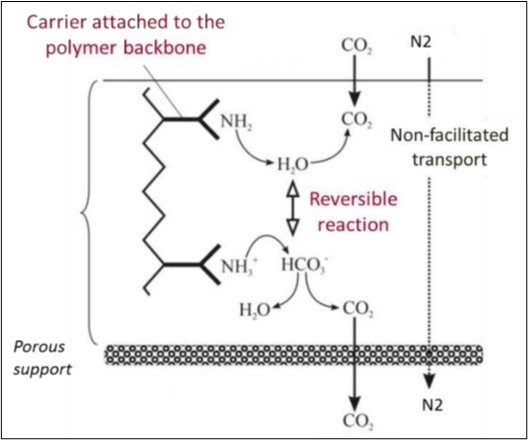
Facilitated transport mechanism of fixed-site amine carrier membrane. Courtesy of Analysis of CO2 Facilitation Transport Effect through a Hybrid Poly (Allyl Amine) Membrane: Pathways for Further Improvement. Open Access CC BY 4.0.
Oil & Gas Applications
Membranes are particularly competitive in processes that require intermediate-purity streams. Engineers use membranes in the following applications:
- In natural gas processing, membranes remove H₂S and CO₂ before transport, reducing corrosion and ensuring compliance. This application is particularly well-established when the feed stream contains moderate concentrations of sour gas. The system’s simplicity compensates for lower product purity compared with cryogenic or absorption technologies. In fact, these membranes operate without solvents and with minimal auxiliary infrastructure. For instance, cellulose acetate has historically been the standard material for natural gas purification and CO₂/H₂S separation.
- Another important application is Hydrogen recovery in hydrotreating, hydrocracking, and reforming units. Here, the goal is to recycle H2 from tail streams containing light hydrocarbons, making material selection critical. Depending on gas composition and required purity, engineers typically use polyimides, polysulfones, and composite membranes. A balance between pore size, affinity, and architecture governs selectivity toward H₂ versus CH₄, N₂, or CO₂.
- Third, recovering VOCs and LPG from refinery gases offers both economic and environmental opportunities. Rubbery membranes such as PDMS are suitable for recovering organic vapors due to their high solubility for condensable compounds. Meanwhile, stiffer materials can offer better discrimination in complex mixtures.
- Finally, in oxygen enrichment or nitrogen separation applications, engineers prioritize membranes with O₂/N₂ selectivity. These membranes generate sufficient useful streams to improve combustion and regenerate process units.
Constraints & Improvement Strategies
The current challenge is not only to increase flux, but also to maintain selectivity under real industrial conditions. In other words, permeability and selectivity are often in trade-off, as described by the Robeson upper limit. In design, increasing polymer free volume typically increases flux but compromises molecular discrimination. Therefore, real improvement requires fine-tuning the molecular architecture. Although Engineers have designed hybrid strategies to overcome certain intrinsic limitations, serious challenges remain, such as plasticization and physical aging.
First, plasticization is critical in CO₂ streams or heavy hydrocarbons, as the permeant increases segmental mobility and drastically reduces selectivity. This primarily affects glassy polymers as the partial pressure of the plasticizing gas rises and the matrix loses effective rigidity. Second, physical aging affects high-permeability polymers such as PIM-1, where free-volume loss reduces flow over time. This necessitates designing systems with conservative operating margins and, in some cases, applying crosslinking or protective layers. In particular, porous fillers can increase permeability while slowing the free-volume collapse associated with aging.
Another relevant development is surface modification and the introduction of chemical functionality to control hydrophobicity and CO₂ affinity. In systems where vapors or condensable hydrocarbons degrade performance, surface tuning is as important as the composition of the bulk. Likewise, rigid polymers with intrinsic microporosity remain attractive; however, they require morphological stabilization strategies to prevent premature densification. In short, advances in PIMs, mixed-matrix membranes, and hypercrosslinked materials suggest a solid technological path for more demanding applications. The future of phase separation will depend less on a single “ideal” material and more on the integrated engineering of structure, transport, and operational stability.

Carlos Ruidiaz is a mechanical and aeronautical engineer with experience in fluid systems design for Aero-Propulsion, Oil & Gas, and Power Generation.