Moldex3D Brings DOE and Machine Data Into Injection Molding
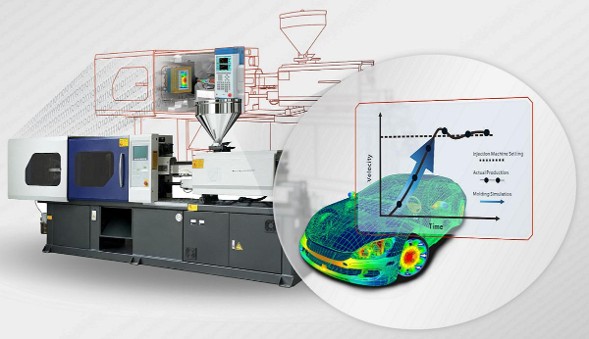
Automation, virtual DOE, and connected production data are reshaping how engineers optimize injection molding processes.
Injection molding optimization often starts with adjusting machine settings, inspecting parts, and running repeated trials until the process meets acceptable conditions. Simulation and digital manufacturing tools now offer a more systematic path. Engineers can evaluate process behavior before production, compare virtual results with machine data, and refine decisions with feedback from the molding floor.
To see how this approach works in practice, Plastics Engineering spoke with Ken Cheng of Moldex3D about process automation, Design of Experiments (DOE), and integrating simulation with production data.
You can also read: Industry 4.0 in Injection Molding
Bringing Real Machine Behavior Into Simulation
A key challenge arises when engineers transfer simulation parameters to an actual injection molding machine. While simulation can define ideal pressure and velocity profiles, the physical press introduces machine-specific behavior that can alter the final process response. Controller delays, check ring behavior, backflow, and pressure response can therefore create discrepancies between virtual predictions and shop-floor conditions.
Moldex3D addresses this gap through its Machine Characterization Service. Engineers conduct physical DOE trials on a specific press to characterize factors such as backflow and speed or pressure response. Machine Mode then incorporates this information through an .mmip machine model file, allowing the simulation to reflect the actual press’s behavior more accurately.
By accounting for machine-specific characteristics rather than relying on an idealized press model, this approach can improve the transfer of optimized processing conditions from CAE to production.
Adapting to Changes in Material Behavior
Machine behavior is not the only source of variability in injection molding. Resin viscosity can shift between material batches, while factors such as moisture can further alter melt behavior. As a result, a process window based on a single nominal viscosity may lose accuracy as production conditions change. Moldex3D combines its Molding Window Advisor (MWA) with iSLM to establish pressure and viscosity limits that define a more robust operating baseline.
Real-time pressure-controlled systems such as iMFLUX can then respond to the melt’s actual resistance and adjust flow conditions accordingly, rather than relying only on a fixed velocity profile. This approach shifts process optimization away from a single fixed combination of machine settings and toward an operating range that accommodates material variation while maintaining acceptable process conditions.
Using DOE to Separate the Causes of Defects
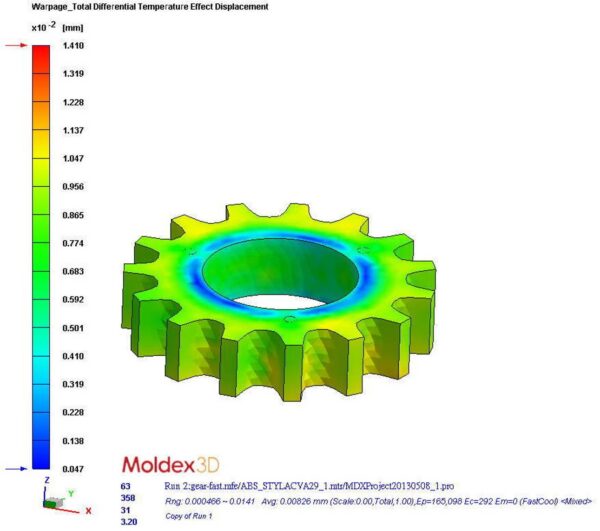
Moldex3D warpage analysis helps processors identify differential shrinkage and deformation before they compromise final part quality. Courtesy of Moldex3D.
Virtual DOE offers another route to systematic optimization by letting engineers explore combinations of processing variables in simulation and reduce physical trials on the molding floor. However, the analysis’s value depends strongly on the selected response, especially when several physical mechanisms contribute to the same defect.
Warpage illustrates this challenge because temperature gradients, shrinkage differences, and fiber orientation can all influence the final distortion. Nonlinear events such as premature gate freeze-off can complicate the response further by creating abrupt changes that a conventional Response Surface Model may not capture well.
Moldex3D addresses this problem through Warp Decomposition, which separates total warpage into contributors such as differential temperature, differential shrinkage, and fiber orientation. Engineers can then build response surfaces around individual mechanisms instead of relying on total displacement as one general output. This separation makes virtual DOE results easier to interpret and helps identify which processing variables drive a specific defect.
Connecting Simulation With Production Data
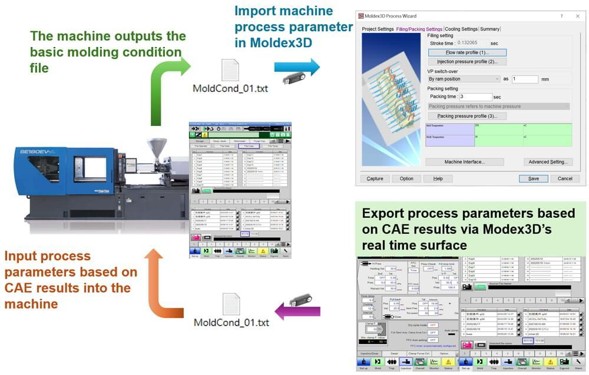
Digital workflow connecting CAE simulation results with injection molding machine process parameters. Courtesy of Moldex3D.
Systematic optimization also depends on exchanging information across a digital workflow that connects simulation software, injection molding machines, and Manufacturing Execution Systems. Protocols such as OPC UA and Euromap support this communication, but mixed machine brands, different controller generations, and inconsistent data structures can complicate integration. Even with connectivity in place, actual press behavior may still differ from simulation because of hardware response delays, check ring behavior, and melt compressibility.
Cavity sensors help close this gap by providing direct feedback from production. Engineers can upload pressure and temperature time-series data into Moldex3D iSLM and compare measured curves with simulation profiles throughout the molding cycle. They can then refine viscosity parameters, heat transfer coefficients, and sensor coordinates to improve future models.
Together, machine characterization, virtual DOE, and production feedback create a more systematic workflow that reduces trial-and-error adjustments and strengthens the connection between simulation, automation, and real manufacturing conditions.

María José Vargas is a mechanical engineer and MSc candidate in Materials Engineering and Nanotechnology at Politecnico di Milano. Her work focuses on environmental stress cracking in polyethylene, polymer failure behavior, plastics processing, and sustainable polymer applications.