Liquid Crystal Film Reduces Ghost Images in Automotive Displays
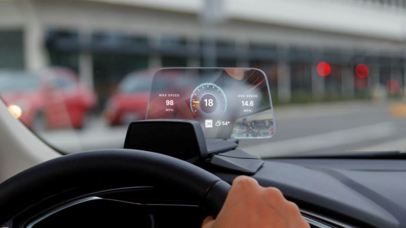
A double-layer liquid crystal polymer film reduces ghost images in automotive AR-HUDs while improving reflectivity and maintaining windshield transparency.
Automotive head-up displays (HUDs) use windshield display technology, where the windshield reflects light from a picture generation unit to form a virtual image the driver can see. Researchers state that the global HUD market will reach USD 15.26 billion by 2030, growing at a compound annual growth rate of 15.7% from 2023 to 2030.
You can also read: Polymer Aerogels for Advanced Thermal Control
But this technology carries a persistent optical flaw: ghost images. Engineers explain this phenomenon as the windshield’s front and rear surfaces both reflecting the light, producing a faint duplicate of the image offset from the real one. According to Mercedes-Benz driver tests, a primary-to-secondary image intensity ratio below 100:1 can produce noticeable ghost images in the HUD, potentially compromising driver perception and safety.
Manufacturers currently solve this with wedge-shaped windshield glass, which angles the front and rear surfaces, so the two reflections overlap. Manufacturers must custom-fabricate the glass for each vehicle model, and installers cannot retrofit it. It also caps light-source reflectivity below 20% to preserve enough environmental light transmittance for safe driving, wasting the projector’s energy.
A Retrofittable Alternative
Researchers propose a thin, flexible liquid crystal polymer film that attaches directly to any existing windshield’s interior surface, no custom glass required. The film stacks two LC layers. The outer layer is a cholesteric LC coating that reflects left-handed circularly polarized light from the PGU back toward the driver with high efficiency. The inner layer, a nematic LC quarter-wave plate, sits between the cholesteric layer and the glass. It flips the polarization of light reflected off the windshield’s rear surface, so the light bounces back off the cholesteric layer instead of reaching the driver’s eyes as a ghost. Therefore, engineers state that eliminating the ghost image relies on the high reflectivity of the cholesteric reflective LC layer.
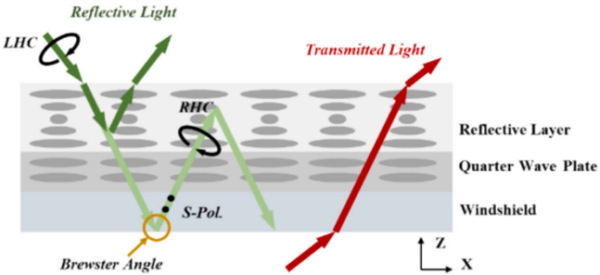
The working principle of the high-reflectivity double-layer LC polymer film features a cholesteric LC coating and a nematic LC quarter-wave plate. Courtesy of A high-reflectivity double-layer liquid crystal polymer film for eliminating automotive head-up display ghost image.
Using rigorous coupled-wave analysis (RCWA), the researchers tuned the cholesteric layer’s thickness to 2μm. This allowed a maximum reflectivity of 80% for circularly polarized green light at Brewster’s angle, the incidence angle at which manufacturers typically design windshields to operate. Engineers capped reflectivity at 80%, rather than pushing higher, to keep enough ambient light passing through for driver visibility.
Built by Spin-Coating
Researchers produced the film by using standard photoalignment and spin-coating techniques. A photoalignment layer set the LC director orientation. Manufacturers spin-coated the toluene-dissolved RM257 liquid crystal polymer, mixed with a photoinitiator and doped with a chiral agent to control pitch, on top, then cured it with UV light. The finished film, laminated with optically clear adhesive, peels away from its glass substrate as a standalone 10cm disc that users can apply to any windshield.
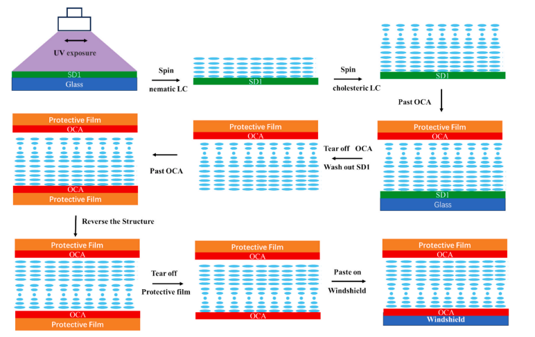
The method researchers developed lets users remove the protective film on one side and attach it to any windshield. Courtesy of A high-reflectivity double-layer liquid crystal polymer film for eliminating automotive head-up display ghost image.
Performance Matches Theory
Engineers state that measurements aligned closely with the RCWA predictions. The film reached 80% reflectivity for the projector’s light at a 56° incidence angle, held above 70% transmittance for ambient light, and stayed uniform across nine tested regions and a 10°C to 90°C temperature range.
In a vehicle-mounted HUD test bench, the ghost image visible with bare windshield glass disappeared mostly once engineers applied the film, while the driver’s view of the road stayed clear. The primary-to-secondary image contrast exceeded 100:1, reaching as high as 133:1 in the most demanding polarization scenario, comfortably clearing the 100:1 threshold that automakers consider necessary for safe driving.
Toward Full Color
The single-layer film reflects only green light and has a faint red tint, a side effect of the high-reflectivity cholesteric LC layer that reduces natural-light transmittance in the 475 nm to 575 nm range. The researchers propose that lower-birefringence LC materials could narrow the reflective bandwidth further and improve the film’s appearance.
They also simulated a six-layer version, stacking three cholesteric layers tuned to red, green, and blue, with three matched waveplate layers, and optimized the design using RCWA combined with a genetic algorithm. Researchers simulated a structure that maintained over 80% front-side transmittance and contrast ratios between 500:1 and 2,500:1 across all three colors, suggesting a path toward full-color AR-HUD films.
Compared to conventional wedge-shaped glass, the double-layer film can increase HUD energy efficiency while remaining flexible, easy to fabricate, and compatible with existing windshields, a combination the authors say makes it a strong candidate for large-area production.

Daniela Castaño is a mechanical engineer specializing in automotive and motorsport engineering, with experience in material testing, vehicle performance, advanced manufacturing, and emerging transportation systems.