
How Processing Conditions Affect Polycarbonate Color Consistency
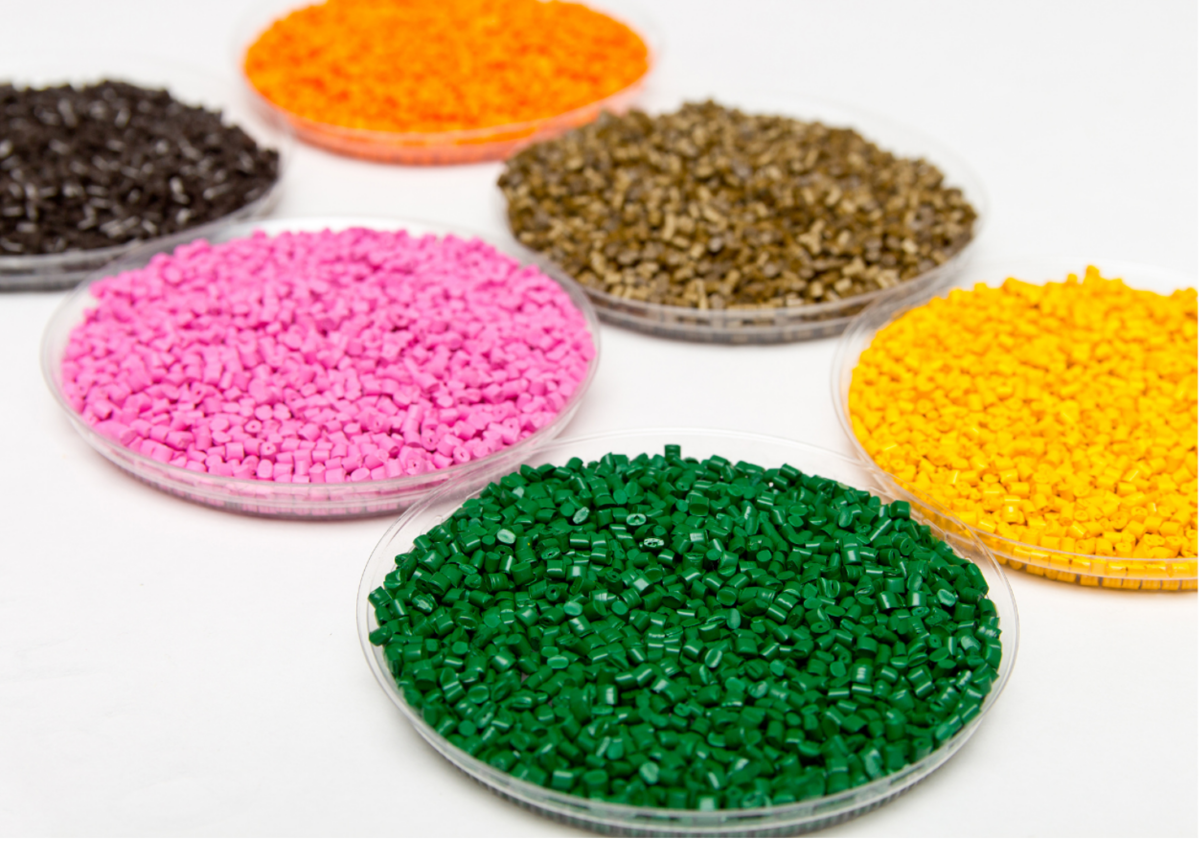
Temperature, screw speed, and feed rate can shift polycarbonate color by changing melt viscosity, shear, and pigment dispersion.
A color formulation can match consistently in one production run yet vary measurably in another, even when the material composition remains unchanged. In polycarbonate compounding, processing conditions can affect final color because temperature, screw speed, and feed rate influence melt viscosity and pigment dispersion.
A recent study investigated this issue using a transparent polycarbonate blend and a red letdown pigment. The researchers combined two PC grades with different melt-flow characteristics and varied extrusion temperature, screw speed, and feed rate in a co-rotating twin-screw extruder. The analysis correlated these processing conditions with CIE L*, a*, b*, and ΔE* values to evaluate their influence on final color consistency.
You can also read: Setting the Tone with Functional Pigments
Color Starts in the Melt
Effective pigment dispersion requires sufficient melt mobility and shear during compounding. High melt viscosity can limit pigment distribution and retain agglomerates, causing variations in color intensity, gloss, opacity, and hue. Increasing the processing temperature reduces PC melt viscosity, while higher screw speeds increase shear and mixing intensity. Together, these effects promote pigment wetting, agglomerate breakup, and a more homogeneous distribution throughout the polymer matrix.
Color difference decreased substantially as processing temperature increased from the lowest tested condition and remained comparatively low across the higher-temperature range. Rheological measurements showed a corresponding reduction in the PC blends’ complex viscosity. The resulting increase in melt mobility facilitated pigment and additive distribution, leading to a more homogeneous dispersion throughout the polymer matrix.
However, increasing barrel temperature beyond the optimal range can compromise color stability. Excessive thermal exposure may degrade the polymer, pigment, or additive system, introducing additional color variation. The processing window must therefore provide sufficient thermal and mechanical energy for effective dispersion while maintaining material stability.
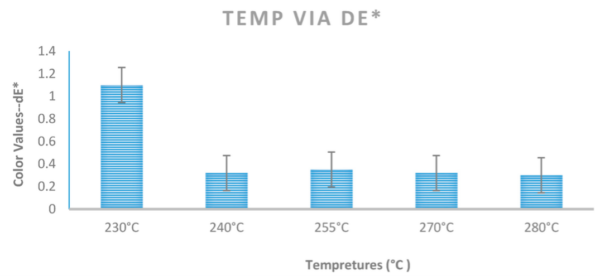
Effect of processing temperature on color difference (ΔE*) for the investigated polycarbonate blend. Courtesy of Evaluating Processing Parameter Effects on Polymer Grades and Plastic Coloring: Insights from Experimental Design and Characterization Studies.
Screw Speed Changes More Than Throughput
Screw speed also significantly affected color consistency. Increasing rotational speed generally reduced ΔE*, indicating closer agreement with the target color. Higher screw speeds increase shear intensity and promote more uniform pigment distribution throughout the PC melt.
At the highest screw speed evaluated, approximately 800 rpm, the improvement in color performance began to diminish. Increased shear and associated thermal input may have promoted material degradation, offsetting the benefits of improved pigment dispersion. This result highlights the need to balance dispersive efficiency with thermal and mechanical stability when defining the processing window.
Feed rate also influenced color performance. Under specific processing conditions, higher feed rates reduced color difference by changing material flow and shear within the extruder, promoting more effective pigment dispersion. However, its effect depended on interactions with temperature and screw speed rather than on feed rate alone.
Finding the Processing Window
Response-surface analysis enabled evaluation of these interactions. At a constant screw speed of 750 rpm, the lowest color difference occurred near 260 °C with a feed rate between 24 and 28 kg/h. Temperatures above approximately 265 °C or feed rates below 22 kg/h could shift the process toward higher ΔE* values within the modeled processing window.
These values do not represent universal processing conditions for PC. Resin molecular weight, pigment chemistry, additive composition, screw design, residence time, and equipment geometry can all shift the optimum. The broader implication is methodological: processors can establish a defined color-processing window rather than rely on a single formulation and fixed machine settings.
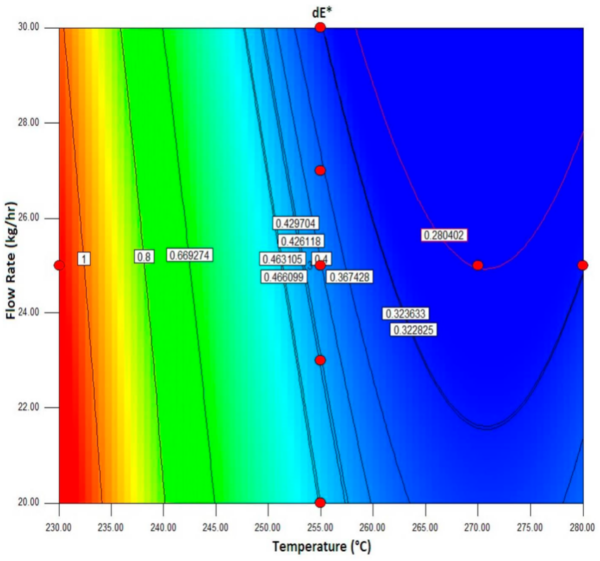
Interaction of processing temperature and feed rate on color difference (ΔE*) at a fixed screw speed of 750 rpm, highlighting the operating region associated with lower color variation. Courtesy of Evaluating Processing Parameter Effects on Polymer Grades and Plastic Coloring: Insights from Experimental Design and Characterization Studies.
What This Means on the Production Floor
Color correction often begins with the concentrate. Operators may add pigment, modify the letdown ratio, or reformulate the masterbatch when molded parts fail to meet the target. These adjustments can correct formulation errors but may also obscure underlying processing issues.
A systematic troubleshooting approach should first compare barrel temperature, screw speed, feed rate, residence time, and melt behavior with the conditions that produced the approved color. A formulation that meets the color target at one viscosity may produce a different result when processing changes alter pigment dispersion.
The study shows that color consistency depends as much on process control as on formulation. A narrower operating window can reduce repeated color adjustments, minimize scrap, and facilitate the transition from laboratory matching to stable production. Even at a constant pigment concentration, variations in shear and thermal history can alter the final appearance. Controlling these conditions therefore provides an effective way to maintain ΔE* within acceptable limits.

María José Vargas is a mechanical engineer and MSc candidate in Materials Engineering and Nanotechnology at Politecnico di Milano. Her work focuses on environmental stress cracking in polyethylene, polymer failure behavior, plastics processing, and sustainable polymer applications.