Bio-Based Additives Face a Cost Premium Problem

Bio-based additives support sustainable plastics, but cost premiums, feedstock volatility, and compliance pressure complicate adoption.
A Market Pulled by Mandate, Held Back by Price
Bio-based plasticizers, stabilizers, and coupling agents now appear in product lines from every major supplier. Yet the market tells a more cautious story. Global Market Insights values the bio-based plasticizers market at USD 1.94 billion in 2025. That represents less than 10% of total plasticizer demand, per Persistence Market Research. Petrochemical-based additives still account for about 85% of total plastic additive volumes. Despite a projected 6.5% CAGR through 2035, bio-based additives remain a niche segment inside a large petrochemical-dominated market. ESG mandates and regulatory pressure are driving demand. Cost sensitivity keeps it in check.
The Cost Gap Nobody Wants to Quantify
Bio-additives carry raw material premiums of 20 to 50% over petroleum-based equivalents, per Bio Future Additives. Eco-friendly PVC stabilizer systems, calcium-zinc formulations replacing lead-based alternatives, can cost 20 to 30% more, per 24 Chemical Research. Bio-propylene pricing consistently reaches two to three times the cost of fossil-based material, S&P Global’s Bio-Chemicals 2025 report confirms. These are not marginal differences. They reshape procurement conversations at every tier of the supply chain.
Feedstock volatility compounds the challenge. Coherent Market Insights notes that bio-plasticizer producers face agricultural price swings that petrochemical suppliers largely avoid. Competing demand from food, biofuel, and industrial sectors adds further instability to supply. A 2025 study in the Journal of Composites Science tested a bio-based phthalate-free plasticizer against DINP in NBR compounds. The bio-based alternative matched performance at half the weight loading. Technical progress is real. Commercial scale remains constrained.
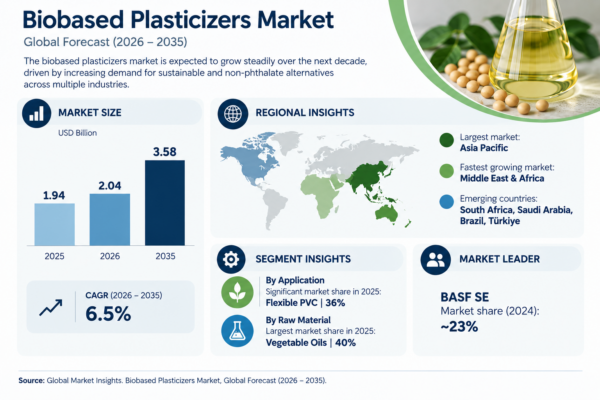
The bio-based plasticizers market grows from USD 1.94 billion in 2025 to a 6.5% CAGR through 2035. That trajectory masks a persistent cost gap; bio-based alternatives still carry 20 to 50% raw material premiums over petrochemical equivalents. Source: Global Market Insights, “Biobased Plasticizers Market, Global Forecast (2026–2035).” Data visualization recreated by Plastics Engineering.
Who Absorbs the Premium and Who Doesn’t
The cost gap creates a standoff across the value chain. Future Market Insights clearly identifies the dynamic. Large brand owners like Unilever, Nestlé, and P&G negotiate volume pricing and co-development partnerships. Packaging converters procure through distributors with limited negotiating power. They absorb cost increases but cannot pass them forward easily. That mismatch concentrates financial pressure on mid-tier processors, the segment least equipped to carry it. Orders for bio-propylene derivatives often run between 5 and 100 metric tons, per S&P Global. That volume remains negligible globally.
ESG procurement mandates accelerate this tension. Sustainability requirements in 2026 now extend beyond material specifications. They now cover contract structure, qualification risk, and lifecycle documentation. Brand owners demand compliance. Converters supply it, neither side wants to own the price delta.
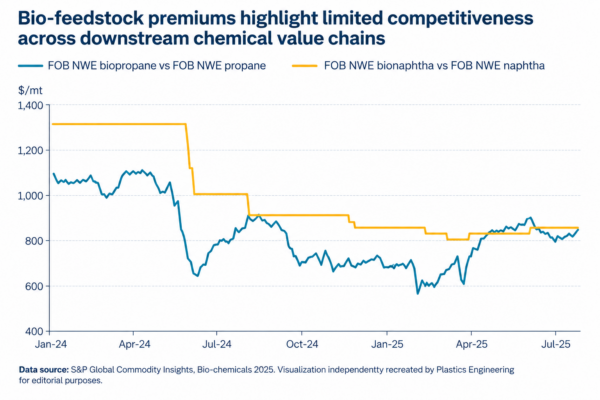
Bio-feedstock premiums for bio-propane and bio-naphtha consistently track above their fossil-based equivalents across 2024 and 2025, despite notable convergence mid-year. That persistent price gap flows directly into bio-additive formulation costs and lands on converters’ desks with little room to absorb it. Courtesy of S&P Global Commodity Insights.Data visualization recreated by Plastics Engineering.
When Regulation Removes the Choice
Regulatory timelines are shortening the debate. Europe’s phthalate restriction, finalized in 2025, forces reformulation across flexible bio-film applications, per Mordor Intelligence. The EU’s Packaging and Packaging Waste Regulation becomes enforceable in August 2026. These mandates remove the optionality from bio-additive adoption. Converters no longer choose whether to reformulate. They choose whether to do it efficiently or reactively. The cost of bio-additives remains real. But the cost of non-compliance now rises alongside it. For procurement leads and formulators, the gap between rhetoric and reality is closing. Not because bio-additives have gotten cheaper, but because the alternative has gotten more expensive.
You can also read: Bio-Based Plasticizers: A Sustainable Approach to Enhance PLA Performance

Mariana Holguin is a mechanical engineer with a master’s degree in finance. She specializes in the financial and strategic analysis of engineering projects, with experience evaluating capital investments, supply chain economics, and FP&A across industrial sectors.