
Automotive Shredder Residue Targets Concrete Applications
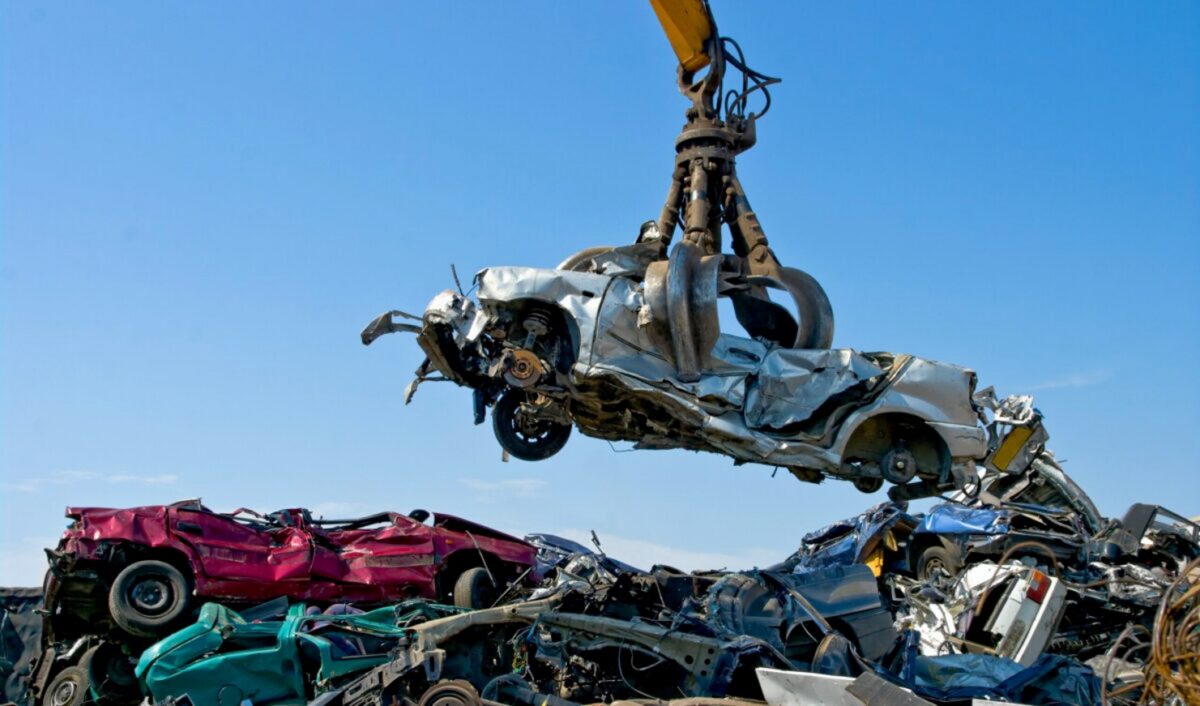
ASR plastics from end-of-life vehicles could replace natural sand in concrete, reducing landfill waste while supporting infrastructure use.
As manufacturers seek lower vehicle weight and improved performance, the automotive industry continues to increase its use of plastics and polymer-based composites. At the end of a vehicle’s service life, however, those materials create a difficult recycling challenge. Vehicle dismantling and shredding generate automotive shredder residue (ASR), a complex mixture that contains plastics, rubber, textiles, wood, glass, metals, and other materials.
You can also read: Recycled Automotive Plastics Face Cabin-Grade Challenges
Furthermore, at a microscopic level, the analysis revealed glass-fiber-reinforced composite material within the ASR plastic fraction, raising questions about how the composition and architecture of automotive plastics influence their performance in cementitious materials. Studies have achieved replacement levels of up to 45% by volume and maintained useful mechanical and durability performance. Furthermore, microscopic analysis revealed glass-fiber-reinforced composite material within the ASR plastic fraction, raising questions about how the composition and architecture of automotive plastics influence their performance in cementitious materials.
The Overlooked Plastics Fraction of End-of-Life Vehicles
The automotive sector reports that waste generation accounts for 1.4 million tons a year, corresponding to approximately 850,000 End-of-Life vehicles (ELVs). The Federal Chamber of Automotive Industries and Motor Trades Association of Australia noted that ELV recycling in Australia is mainly driven by metal recovery, with limited attention given to other waste materials produced during the recycling process. As a result, Australia deposits over 400,000 tonnes of ELV waste in landfill each year.
Mixed plastics are the predominant composition among the light fraction, accounting for 10 wt.% or 50 vol% of an ELV. Researchers note that electric vehicles contain significantly more plastic than conventional fuel-based vehicles due to energy-efficiency requirements. Conventional recycling methods, including pyrolysis, gasification, and their variants, have clear limitations when processing ASR. For instance, plastics such as Polyvinyl Chloride (PVC), Polyurethane (PU), or Nylon could release toxic gases such as hydrogen chloride and hydrogen cyanide. Also, the high demand for chemical energy makes the process economically unfeasible.
Previous efforts have examined generic mixed plastics such as packaging waste in concrete with positive effects. Therefore, researchers note that using ASR plastics as a replacement for natural aggregate in concrete is a promising opportunity, as it is the most consumed human-made material worldwide.
From Mixed Waste to Aggregate
Researchers collected ASR from an end-of-life vehicle recycling facility in New South Wales, Australia. The material was characterized, and rigid plastic accounted for 13.8 wt.% of the sampled ASR. Rubber represented another 13.7 wt.%, while fine and mixed material below 8 mm accounted for 41.7 wt.%. The resulting plastic aggregate had a density of approximately 911 kg/m³ and a specific gravity of 0.913, in accordance with ASTM. Natural fine aggregate, by comparison, had a much higher density. Engineers replaced natural sand with ASR plastic aggregate at volumetric rates of 15%, 25%, 35%, and 45%. At the highest replacement level, the mixture replaced approximately 324 kg of natural sand per cubic meter of concrete. Engineers kept a portion of 350 Kg/m3 of general-purpose cement Type 1 and a 36% water/cement ratio across each variation.
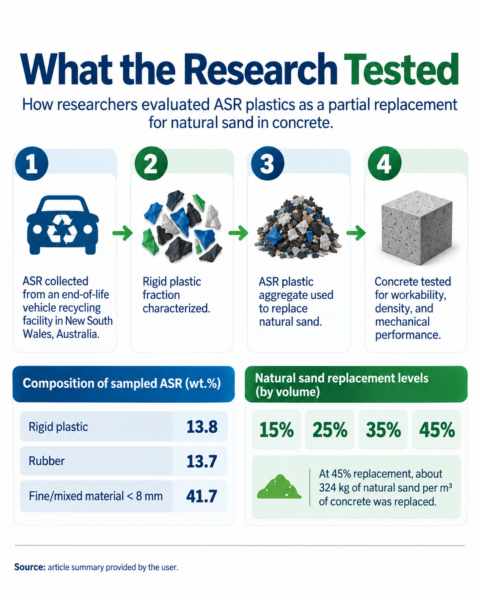
Researchers evaluated automotive shredder residue (ASR) plastics as a partial replacement for natural sand in concrete, testing different replacement levels and characterizing the mixed waste stream. Credit: Plastics Engineering- generated with AI.
The Properties Show the Feasibility
The study showed that the first major trade-off appeared in workability. The control concrete produced a maximum slump of 170 mm. The 45% ASR mixture produced only 40 mm. The 15% mixture, however, retained a slump of 150 mm. Engineers linked this reduction to the physical characteristics of the shredded plastics. Unlike smooth, manufactured plastic pellets, the ASR particles had irregular shapes and rough, fibrous surfaces. These characteristics increased friction between particles and reduced the fresh concrete’s ability to flow. Nevertheless, researchers note that the workability range of 40 to 90 mm at high replacement rates of 35% to 45% could suffice for the majority of applications, such as mass concrete (30 – 80 mm), pavements and slabs (50 – 80 mm), beams, reinforced footings and walls, and columns (50 – 100 mm).
The plastic’s low density also reduced the concrete’s density. At 45% replacement, the researchers measured a dry density of approximately 2019 kg/m³. The authors identified the 35% and 45% mixtures within the Australian lightweight-concrete density range. Therefore, ASR plastics could provide two simultaneous material benefits: waste diversion and partial lightweighting.
The Mechanical Trade-Off
Increasing the plastic content reduced all measured mechanical properties. However, the reductions remained moderate compared with previous studies using mixed post-consumer plastics.
The 45% ASR mixture reached 36.79 MPa, a 35% reduction relative to the control mix. The same mixture recorded:
- 06 MPa flexural strength compared with 8.08 MPa for the control, a 25% reduction.
- 64 MPa splitting tensile strength compared with 6.09 MPa, a 24% reduction.
- 64 GPa modulus of elasticity compared with 43.17 GPa, a 36% reduction.
The modulus of elasticity showed particularly clear sensitivity to plastic content. Polymer materials are less stiff than mineral aggregates, so increasing the polymer fraction naturally reduces the composite’s stiffness.
Engineers state that these results meet the standard strength requirements for residential driveways and footpaths (20 MPa) and commercial and industrial floors (25 MPa). The approach supports both resource conservation and waste management, especially at the maximum replacement rate of 45%, where the mixture conserves more natural sand per cubic meter of concrete. This quantifiable reduction in raw material extraction, combined with diverting waste from landfills, supports the viability of ASR-modified concrete as a sustainable infrastructure solution.
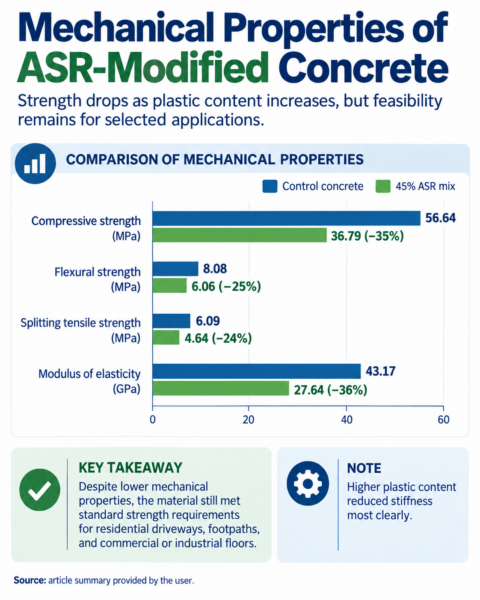
Mechanical testing showed that ASR-modified concrete had lower strength and stiffness than control concrete, but still met requirements for selected infrastructure applications. Credit: Plastics Engineering- generated with AI.
Looking ahead
Researchers emphasize that ASR variability and feedstock quality control remain major challenges for industrial implementation. The potential contribution of glass-fiber-reinforced composites to mechanical performance also requires further investigation because researchers have not yet quantified the influence of its content and distribution. Future research should therefore examine ASR from multiple recycling facilities, improve sorting and quality-control methods, quantify the role of GFRC, and investigate additional durability properties such as freeze–thaw resistance, carbonation, chloride penetration, abrasion, drying shrinkage, and wetting–drying cycles.

Daniela Castaño is a mechanical engineer specializing in automotive and motorsport engineering, with experience in material testing, vehicle performance, advanced manufacturing, and emerging transportation systems.