Similar Settings, Different Flow Marks: The Role of Melt Behavior
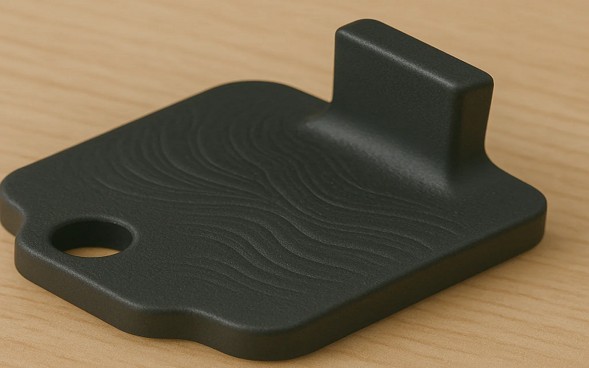
Dimensionless analysis links flow-mark formation in polypropylene injection molding to melt relaxation, cavity scale, and the Weissenberg number.
Flow marks remain a frequent surface defect in injection-molded components. They typically appear as wave-like streaks or bands on the part surface, often roughly perpendicular to the melt-flow direction. In polypropylene systems, these marks create a serious appearance issue, especially on large, uncoated automotive parts such as bumpers, instrument panels, and door panels.
You can also read: Intro to Plastics: Solving Jetting in Injection Molding
Conventional troubleshooting often changes injection temperature, injection speed, mold temperature, or molecular characteristics such as molecular weight distribution. However, this approach can become empirical because flow marks do not respond to a single variable in a simple way. A recent study notes that flow marks relate closely to unstable melt behavior at the material flow front, but the full mechanism still lacks a clear conclusion.
From Machine Settings to Flow Similarity
The study applied dimensional analysis to polypropylene melt flow during injection molding. Instead of treating mold size, melt velocity, relaxation time, temperature, and material interactions separately, the analysis grouped them into dimensionless quantities.
The authors classified these quantities into three categories: geometric quantities related to mold shape, material quantities related to melt and mold materials, and physical quantities related to flow. This framework matters because it compares molding conditions through the physics of the flow field rather than through nominal machine settings alone.
When mold geometry changes proportionally, while melt material, mold material, and initial temperatures remain fixed, the study found that the flow field shape depends mainly on the Weissenberg number.
The Role of the Weissenberg Number
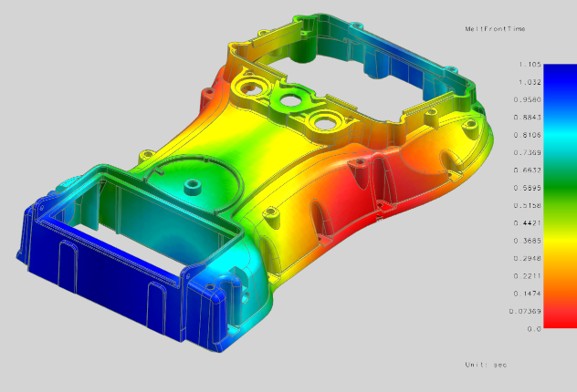
Melt-front-time simulation shows how flow develops across the cavity during injection molding. Courtesy Moldex 3D.
The Weissenberg number compares polymer relaxation time with the deformation time imposed by flow. In this study, it appears as a key similarity parameter for the melt-flow field.
Maintaining a constant Weissenberg number allows changes in injection speed, polypropylene relaxation time, or mold scale to produce similar flow-field geometries. This gives flow-mark analysis a stronger physical basis. Surface defects may result not from an isolated setting change, but from a shift in the balance between melt deformation and viscoelastic relaxation.
This distinction helps explain why similar machine settings may produce different surface quality after a material change, geometry change, or scale-up. The same injection speed does not guarantee the same flow field if relaxation behavior or cavity scale changes.
Smaller-Scale Simulation
The study also applied molecular dynamics simulation to test the dimensional-analysis conclusions at a reduced scale. This step addressed a practical modeling problem. Full injection-molding flow occurs at a macroscopic scale, which makes direct molecular simulation computationally unrealistic. Larger-scale simulations are more practical, but they can lose information about polymer-chain conformation and microscopic evolution.
By scaling the flow field through dimensionless similarity, the authors aimed to preserve the relevant flow behavior in a smaller simulation domain. Their molecular model compared systems with different plate spacings, injection velocities, friction coefficients, and polymerization degrees while keeping dimensionless conditions comparable.
The simulations supported the dimensional-analysis result. Systems with the same Weissenberg number showed similar flow fields, while systems with different Weissenberg numbers showed clearly different flow patterns.
Relevance to Process Development
The study does not claim to solve flow marks completely. It provides a framework for studying them more systematically. Flow marks reflect the combined effects of melt-front instability, viscoelastic relaxation, cavity geometry, and local flow development. Dimensionless analysis helps separate those coupled effects from simple changes in machine settings.
This approach can also support scale-down simulation. If the relevant dimensionless groups remain consistent, smaller simulations can reveal flow-field structures that relate to surface-defect formation. That reduces computational demand while preserving the physics needed for comparison.
Physical Basis for Defect Control
The main contribution is the move from parameter-based troubleshooting towards flow-field similarity. Flow-mark analysis can therefore focus on the physical conditions generated by machine settings: deformation rate, relaxation time, cavity scale, and material response.
This framework can support process development and scale-up because it explains why identical nominal settings may not produce identical surface appearance. For flow-mark control, the key question is whether the melt undergoes the same dimensionless flow condition, not whether the machine displays the same setpoints.

María José Vargas is a mechanical engineer and MSc candidate in Materials Engineering and Nanotechnology at Politecnico di Milano. Her work focuses on environmental stress cracking in polyethylene, polymer failure behavior, plastics processing, and sustainable polymer applications.