How Researchers Are Solving the Polymer Science Data Gap
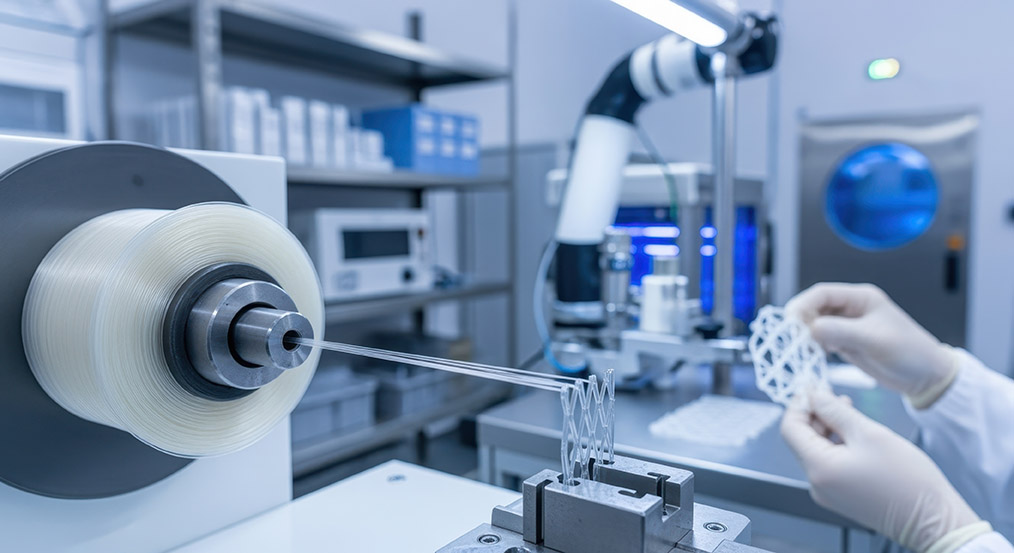
Researchers are addressing polymer data scarcity through AI, high-throughput experiments, simulations, literature mining, and standardized databases.
Unlike fields such as metals or semiconductors, polymers lack large, high‑quality datasets. This gap limits the performance of machine learning models and slows material discovery. Researchers are developing strategies to overcome data scarcity and unlock the full potential of AI in polymer research.
You can also read: Tooling Digitalization: Knowledge Management
A Fragmented Data Landscape
Designing new polymers requires navigating a complex space of molecular structures, processing conditions, and resulting properties. These relationships are nonlinear and high‑dimensional, making traditional trial‑and‑error approaches inefficient. More fundamentally, researchers store polymer data across academia, industry, and simulation repositories. These sources rarely follow consistent formats or standards. Researchers report critical properties such as glass‑transition temperature using incompatible measurement standards, and industrial datasets remain proprietary. This fragmentation undermines the generalizability of AI models. It also leaves understudied families, such as vitrimers and conjugated microporous polymers, without sufficient data. Two main challenges limit progress: prohibitive costs and low experimental throughput, and a lack of standardized formats and measurement protocols.
Expanding Data Through Smart Generation
A key strategy for overcoming data scarcity is to generate new data efficiently. High‑throughput experimentation and active learning enable autonomous discovery cycles in which algorithms suggest experiments that maximize information gain. Closed‑loop platforms that combine robotics, real‑time characterization, and machine learning can rapidly generate self‑consistent datasets. For example, Jurģis et al. built a system for solid electrolyte discovery in which impedance spectroscopy guides experimental selection. Such workflows reduce experimental cycles and target under‑sampled regions of the design space, mitigating bias.
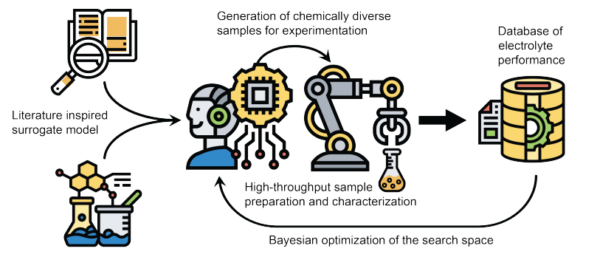
A model generates batch suggestions that are evaluated experimentally, with results used to update and improve future predictions. Courtesy of Autonomous Discovery of Polymer Electrolyte Formulations with Warm-start Batch Bayesian Optimization.
A model generates batch suggestions that are evaluated experimentally, with results used to update and improve future predictions. Courtesy of: Autonomous Discovery of Polymer Electrolyte Formulations with Warm-start Batch Bayesian Optimization.
Simulation-based data provides another pathway. Researchers increasingly combine quantum calculations, molecular dynamics, and machine learning to generate synthetic datasets. These datasets expand coverage without requiring costly experiments. Generative models, such as adversarial networks, can also create realistic polymer data distributions. These models augment limited datasets and improve prediction performance.
From Papers to Datasets
A large amount of polymer data already exists, but it remains scattered across scientific publications. Advances in natural language processing, particularly large language models fine-tuned on materials science literature, enable systematic data extraction. These models convert decades of unstructured papers and patents into structured information. Extracting information from inconsistent reporting formats can introduce errors. Ensuring data accuracy and consistency is critical for reliable model training.
Building Standardized Polymer Databases
Data fragmentation remains one of the largest barriers in polymer science. Unlike inorganic materials, polymer research lacks a widely adopted, large-scale database. Existing datasets often vary in format, quality, and scope. The adoption of FAIR (Findable, Accessible, Interoperable, and Reusable) principles adapted to polymer ontologies could promote data sharing and standardization. These would enable data sharing across institutions and support large-scale model training.
Scientific Machine Learning for Data-Limited Systems
When datasets contain limited information, model design becomes critical. Scientific machine learning (SciML) integrates physical knowledge into machine‑learning architectures. SciML methods can leverage sparse experimental or simulation data to build more accurate, interpretable models. Graph and sequence‑based networks enable rapid screening of polymer chemistries, while surrogate models and active‑learning frameworks accelerate high‑throughput discovery.
Researchers apply random forests, neural networks, and SVM to predict thermal, mechanical, and optical properties from molecular descriptors. Transfer learning adapts models trained on related chemistries to new polymer tasks. Multi-task learning shares information across properties. Dimensionality‑reduction techniques such as principal component analysis help simplify high‑dimensional data and improve generalization.

With a B.Sc. in Mechanical Engineering and a Postgraduate Degree in AI, Sebastian Villalba's work sits at the convergence of technology and its broader implications. He writes about how AI is transforming science and the Workplace. He currently works as a Venture Analyst for tech startups; outside of work, Improv is his hobby of choice.