
Petrochemical Feedstock Strategy Shifts Beyond Cost

Petrochemical feedstock strategy is shifting from lowest cost toward flexibility, carbon reduction, and geopolitical resilience.
From Refinery Integration to Shale Disruption
Europe and much of Asia built petrochemicals on naphtha integrated with refining systems, which optimized co-product value and refinery economics for decades. North America broke that pattern after the shale boom unlocked abundant natural gas liquids, allowing ethane-rich cracking to lower U.S. ethylene costs and shift global cost curves. Analysis by Foster et al. shows how shale gas reshaped supply chains and investment flows.
You can also read: Rethinking the System: We Need Molecular Recycling
The shift extended beyond cost. Ethane crackers produce fewer co-products than naphtha units, thereby altering propylene and aromatic balances across global markets. Producers adjusted portfolios, and regions became structurally specialized.
The New Geography of Advantage
The United States now anchors the low-cost end of the global ethylene curve. Data from the U.S. Energy Information Administration shows record ethane production of 2.8 million barrels per day in 2024. Exports reinforce this advantage, with volumes nearing 500,000 barrels per day and China absorbing nearly half. This flow supports North America’s dominance in polyethylene exports.
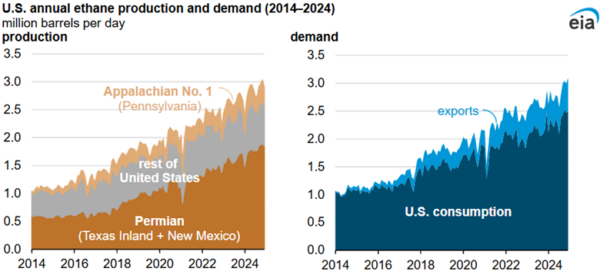
Surging U.S. ethane production and demand highlight how domestic supply growth underpins both internal consumption and the expansion of export-oriented petrochemical capacity. Courtesy of U.S. Energy Information Administration.
Europe faces the opposite dynamic. The European Commission reports that ethylene production costs reached more than triple U.S. levels in 2023. Older, naphtha-heavy assets struggle to compete, and capacity closures already exceed 8% of the regional base.
Asia occupies a more complex position. China and others still invest in large naphtha-linked complexes, while operators pursue feedstock flexibility and import U.S. ethane where logistics allow. OECD analysis highlights this shift toward optionality rather than substitution.
When Geopolitics Meets Molecules
Feedstock economics no longer operate in isolation from geopolitics. U.S. export licensing changes in 2025 briefly disrupted ethane flows to China. According to EIA analysis, those restrictions altered trade expectations before being reversed.
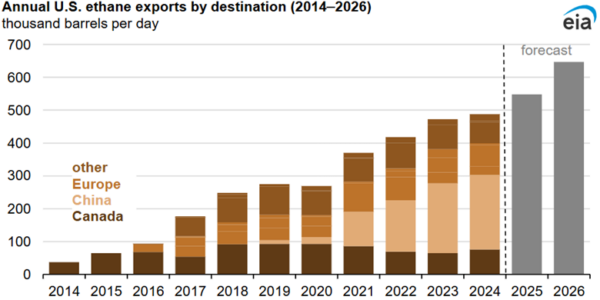
Rising U.S. ethane exports illustrate how shale-driven feedstock advantages reshaped global trade flows and reinforced North America’s position on the cost curve. Courtesy of U.S. Energy Information Administration.
China responded by expanding naphtha import quotas and reinforcing supply security, which underscores a key lesson. Cheap feedstocks do not guarantee resilient supply chains. Recent Middle East disruptions also moved naphtha markets sharply, and Asian buyers adjusted procurement strategies to manage exposure. Feedstock choice now reflects risk management as well as cost optimization.
Beyond the Naphtha–Ethane Binary
Producers now invest in flexibility rather than single-feed dominance. Patent filings from companies such as Honeywell UOP and TotalEnergies show active development of feed-flexible cracking systems that process heavier, recycled, or bio-derived feeds alongside traditional inputs.
Bio-naphtha and pyrolysis oil also enter commercial strategies. BASF and LyondellBasell pursue mass-balance approaches that integrate alternative carbon into existing assets, allowing incremental change without replacing infrastructure. Research by Jung et al. shows that feedstock choice alone cannot deliver deep emissions cuts. Producers must combine feed selection with electrification, circular inputs, and carbon management. The industry now moves from a cost-driven model toward a constraint-driven one. Feedstock strategy must balance price, carbon intensity, and supply security. Feedstock advantage will persist, but it will no longer define competitiveness alone. Producers that build flexible, low-carbon, and geopolitically resilient systems will shape the next cost curve.

Mariana Holguin is a mechanical engineer with a master’s degree in finance. She specializes in the financial and strategic analysis of engineering projects, with experience evaluating capital investments, supply chain economics, and FP&A across industrial sectors.