
In-Line Resin Monitoring Targets Recycled Resin Variability

Real-time resin diagnostics help processors monitor melt behavior, manage recycled-content variability, and improve plastics quality control.
An Instrumented Process With One Blind Spot
Over the past several decades, plastics processing has become one of manufacturing’s most heavily instrumented sectors. Across injection molding, extrusion, and compounding lines, processors control and record many variables in real time. These include barrel temperature, melt pressure, screw speed, and clamping force. However, one critical variable remains largely unmeasured. Processors still lack continuous visibility into the melt’s dynamic state.
You can also read: The Complexity of Recyclate
Melt viscosity and elasticity shift with composition, molecular weight distribution, and thermal or shear history. These changes can appear between lots, but they can also occur within a single lot. Melt flow index, or MI, remains the industry’s standard quality measurement. However, MI testing happens off-line, in batches, and away from the production run. As a result, most plastics processes still assume that resin entering the die remains uniform. That assumption creates a blind spot, especially as processors use more recycled material.
Recycled Resin Makes Variability More Visible
Recycled-content mandates now make the cost of this assumption more visible across major end-use markets. The EU End-of-Life Vehicles Regulation, which took effect in August 2026, requires recycled plastics in new vehicles. Starting six years after entry into force, new vehicles must include at least 15% recycled plastic. After ten years, that requirement rises to 25%. Meanwhile, the EU Packaging and Packaging Waste Regulation and similar policies are increasing pressure on packaging and electronics. However, recycled resin usually enters the same process with wider quality variation than virgin material.
The table below compares MI variation for automotive-grade virgin polypropylene and mechanically recycled polypropylene. Both materials were measured under identical test conditions across multiple lots.
| Material | Mean MI | MI Std. Dev. | CV |
|---|---|---|---|
| A — Virgin PP, automotive grade | 42.9 | 1.8 | 4.2% |
| B — Recycled PP, post-consumer mechanically recycled | 11.4 | 1.3 | 11.4% |
Table 1. MI variation, virgin PP vs. mechanically recycled PP. Source: internal measurement data. Courtesy of CoatingSolution4U.
Why MI Variation Matters
The coefficient of variation for recycled PP reached 11.4%, roughly 2.7 times higher than virgin material’s 4.2%. That viscosity spread can directly affect dimensional precision, residual-stress distribution, and long-term dimensional stability in molded parts. As a result, processors may face defects even when machine settings remain unchanged.
In precision assemblies, this variation can create interfacial stress concentrations. Over time, those stresses may cause fatigue failure, dimensional rejects, or performance issues. Automotive interior parts show this risk clearly. When clearances widen, or friction noise develops, the result can trigger quality claims and reduce brand trust. Processors can reset parameters each time a lot changes, but that approach increases downtime and scrap. Alternatively, they can hold parameters fixed, but that choice raises defect risk. Until recently, processors lacked real-time resin data to guide that decision. They could measure the result, but they could not see the resin state during processing.
Reading Resin Behavior In-Line
PlasticXpert, developed by CoatingSolution4U, mounts sensors at the die or nozzle of an extrusion or injection line.
The system continuously measures the resin’s dynamic rheological state during processing. It does this by interpreting the pressure signal generated as the fluid flows.
Because the system works in-line, it requires no extra sampling or process interruption. Instead, it turns normal process behavior into continuous diagnostic data. One polypropylene production-line analysis shows how this approach works. Pressure-signal analysis separated the resin’s dynamic state into two groups, labeled Class A and Class B.
In practical terms, the process produced two different quality levels under nominally identical conditions. Class A represented about 65% of the production data (roughly 17 hours). Class B represented about 35%.
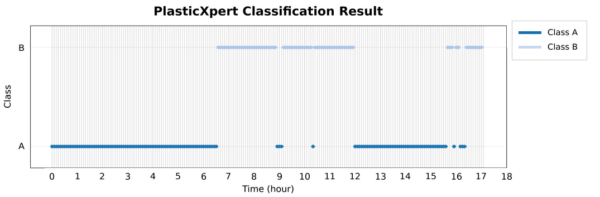
Resin dynamic-state classification result. Pressure-signal analysis identifies two classes with distinct rheological behavior. Class A accounts for about 11 hours, while Class B accounts for about 6 hours. Courtesy of CoatingSolution4U.
Mapping the Resin’s Dynamic State
Beyond classification, PlasticXpert also expresses the measurement as a dynamic state map. The map plots resin condition on a two-dimensional coordinate plane. Each point represents the resin’s dynamic state at a specific moment. As the resin’s microstructure changes, its position on the map shifts.
In one process dataset, the blue Class A region appeared tightly clustered. By contrast, the red Class B region appeared more dispersed. This difference matters because a compact region indicates more stable rheological behavior. A dispersed region suggests greater variability and less predictable processing.
Processors can define the map region that corresponds to the desired MI range before production. Then, they can selectively use resin that falls within that target range. According to the company, this approach can reduce MI deviation by more than 50%. That reduction could help stabilize recycled-resin processing and improve part consistency.

Resin dynamic-state map. The blue Class A region is tightly clustered, while the red Class B region is more dispersed. Gray points represent the full process dataset. Courtesy of CoatingSolution4U.
Real-Time Data Supports Faster Decisions
The system makes this determination in real time during production. When resin enters the predefined MI range, the system confirms it immediately.
Although Figure 2 shows a narrow stable region for illustration, operators can adjust that range. In actual operation, they can widen or narrow the region to match the target quality standard. The same principle applies to injection molding. When resin quality shifts, the system reflects that change immediately.
As a result, operators can adjust process parameters before defects occur. This shifts the process from delayed inspection to active control. For recycled resin, this capability matters because lot-to-lot changes can arrive without warning. Without in-line diagnostics, processors may only identify the problem after scrap accumulates. With continuous resin-state measurement, the process can respond earlier. As a result, processors gain a more practical route to recycled-content quality control.
The technology applies to extrusion and injection molding lines, where sensors can be mounted at the die or nozzle to monitor resin behavior in real time. CoatingSolution4U also applies the platform to plastic compounding and recycled-resin processing under PlasticXpert.
Toward Data-Driven Process Control
Industry 4.0 continues to push plastics processors toward AI-based monitoring, OEE analytics, and smart-factory architectures. However, many of these systems share one underlying assumption. They treat resin state as uniform because processors have not measured it continuously.
Closing this gap makes data-driven process control more realistic. True optimization requires equipment data and resin property data together. As recycled-content use rises, this combined view becomes more important. At the same time, part-quality requirements continue to tighten across automotive, packaging, and electronics applications. PlasticXpert can retrofit existing plastics processing lines without separate process changes or added sampling routines. The underlying diagnostic technology received a 2026 Edison Award. The company also applies the same platform across other process domains. These include battery electrode slurry under SlurryXpert and plastic compounding and recycled resin under PlasticXpert.
You can also read: Digital Twin in Manufacturing and Beyond.
Recycled-Resin Quality Needs Better Control
Recycled-plastics variability does not come only from the feedstock. It also reflects a control gap created by limited real-time measurement during processing. Continuous resin-state measurement can help close that gap. By expressing resin behavior as a dynamic map, processors can connect material variability with process response. This approach may support recycled-resin quality control, injection-process stabilization, and future AI-based smart factories. More importantly, it gives processors a clearer view of a variable they have long managed indirectly.
This article was written by CoatingSolution4U and edited for online publication by Juliana Montoya.

Juliana Montoya is Director of Content for Plastics Engineering. A mechanical engineer with an MSc in materials engineering, she has experience as a sustainability and packaging consultant focused on ecodesign and recycling. Her work centers on technical content for the plastics industry, connecting polymer innovation, manufacturing trends, and sustainability strategy for industry audiences.