
Circular Automotive Foams: Recyclable TPE for Soft-Touch Parts
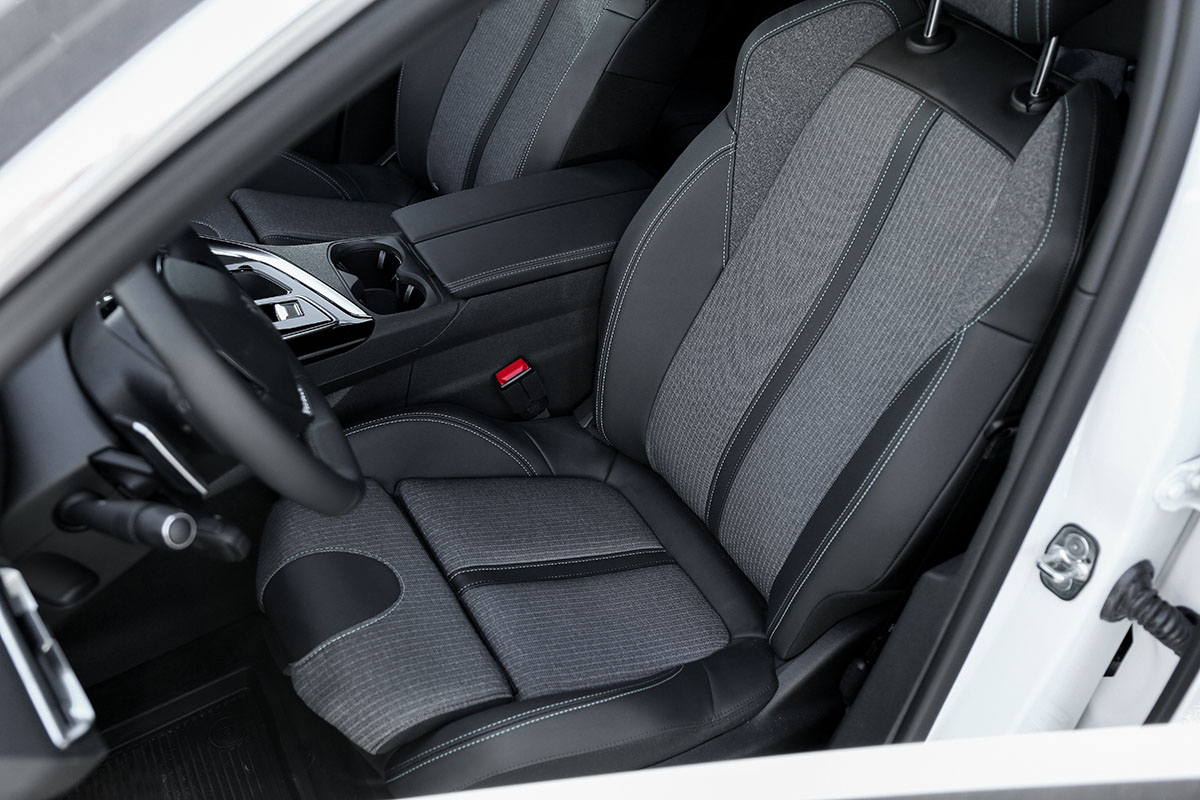
Foamed TPE and PP could replace non-recyclable automotive soft-touch structures while reducing weight and increasing recycled content.
Upcoming European regulations require automotive applications to incorporate at least 15% post-consumer recycled plastic by 2032, and 25% by 2036. With this increasing pressure, there is a need to look for circular material solutions for end-of-life vehicles (ELV).
You can also read: Polypropylene Recycling from Disposable Face Masks
Recyclable TPE for Soft-Touch Parts
Foams, in particular, are widely used in soft-touch applications inside the vehicle and are the focus of several new developments. One approach aims to replace thermoset foams and composite foamed structures with thermoplastic, recyclable alternatives.
A research project at the IKV, Institute of Plastics Processing in Aachen, Germany, aims to develop circular foamed products for soft-touch applications. In this case, the objective is the substitution of non-recyclable composites through foamed TPE (thermoplastic elastomers).
Conventionally, soft-touch components are made from a thermoplastic carrier (such as PP or fiber-reinforced PP), a polyurethane foam, and a decorative layer made of PVC or leather. The project “Foam2Cycle”, currently under development and funded by the German Federal Ministry for Economic Affairs and Energy, investigates a thermoplastic structure that combines structural PP with TPE, produced via foam injection molding using physical foaming agents.
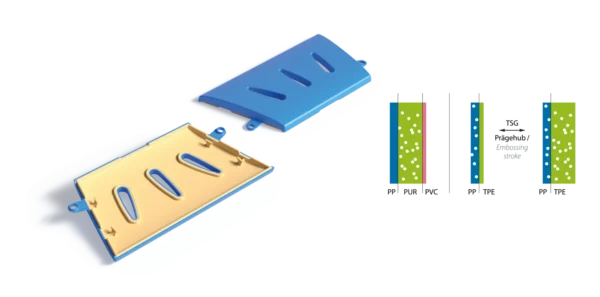
A new process developed at the IKV targets the production of a mono-material soft-touch thermoplastic component. This alternative replaces composite structures, and the foaming is achieved via foam injection molding with an expansion of the mold cavity. Image courtesy of IKV.
The project currently studies the interaction between these parameters and the molding processing windows to achieve homogeneous foam morphology with significant weight reduction. Currently, it is possible to achieve a weight reduction between 50% and 80%.
An inadequate control of the expansion process may result in several defects in the foam structure. For example, the foam structure in the core may tear up. Also, insufficient nucleation or foaming-agent escape before foaming can result in a low degree of foaming. The target is to obtain a homogeneous foam structure, as seen in the middle section of the image below.
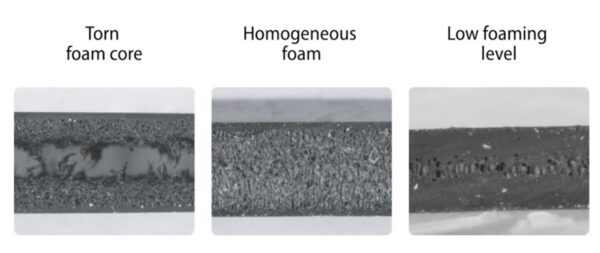
Homogeneous foam structure (middle) in contrast to defects (left and right) caused by unfavorable process control. Image courtesy of IKV.
Tailoring Soft-Touch Performance
The project furthermore studies how to tailor the haptics of the soft-touch component. At K 2025, a demonstration showed the incorporation of over 30% recycled material to meet ELV regulations.
Typically, the injection molding process delivers surface qualities that are not acceptable for automotive indoor standards. Another objective was to develop texturized mold surfaces, which may mask defects inherent to the foaming process.
Finally, to ensure part quality, the project analyses how to couple an optimized indentation test method to obtain relevant information about foam quality, within the limited time of a production cycle. This test may allow parameter adjustments to ensure consistent part properties.

Laura Florez is a mechanical engineer and holds a PhD in plastics processing. She has worked as an editor in the plastics industry for over 25 years and has experience in research, training, and consulting. Her main fields of expertise are injection molding and plastics recycling.