Chemical Safety in Plastics 2026 Tackles PFAS Reformulation
PFAS restrictions are forcing plastics suppliers to reformulate high-performance materials without sacrificing heat, friction, or durability.
Regulators are pushing the industry toward fluorine-free materials, while engineers still need plastics that withstand heat, voltage, friction, and aggressive chemicals. This tension has created one of the industry’s most difficult reformulation challenges.
The Hidden Dependence on PFAS
PFAS restrictions now extend well beyond fluoropolymer resins to include processing aids, surfactants, lubricants, and specialty additives used throughout plastics manufacturing. According to the OECD’s fluoropolymer lifecycle analysis, many of these fluorinated additives perform several functions at once. They can reduce melt fracture and die build-up while also improving weatherability and electrical stability. Finding a single alternative that delivers the same combination of benefits remains difficult.
You can also read: What’s All The Fuss About PFAS?
Polyolefin extrusion shows this most clearly. Fluoropolymer processing aids have long prevented surface defects in blown-film production. Suppliers now offer silicone-based, hyperbranched, and boron nitride options. Yet processors still report trade-offs in throughput, surface quality, and long-run production.
The problem goes beyond processing. Fluorinated additives also support low friction, chemical resistance, plasma stability, and dielectric reliability.
SPE technical discussions and patent activity from Ampacet, BASF, and Avient show a common pattern. Fixing one problem often creates another. A new formula may meet compliance rules but lose durability or heat stability.
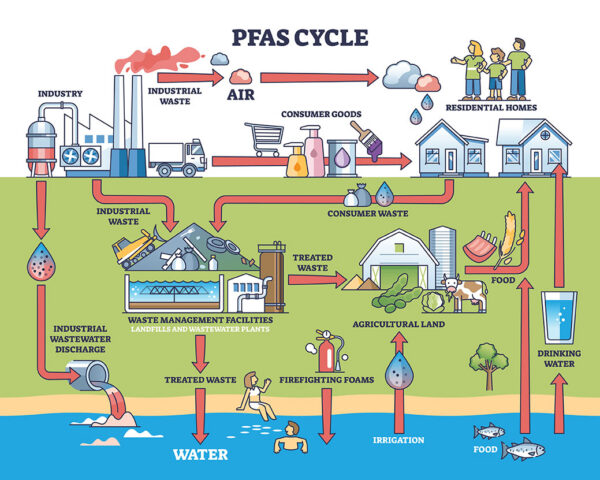
Regulators increasingly examine the full lifecycle of fluorinated materials, from manufacturing emissions to waste management and environmental persistence. That scrutiny now shapes material selection and product design decisions.
Flame Retardants Create New Trade-offs
Flame retardancy is another hard frontier. PTFE anti-drip additives remain common in thin-wall electronics that need UL 94 V-0 certification.
Companies now use phosphorus-, silicone-, mineral-, and melamine-based systems instead. Patent activity from ICL Group, Lanxess, and Albemarle shows intense development across non-halogen formulations. But these options come with new trade-offs. Some cut hydrolysis resistance. Others narrow processing windows or raise smoke output during combustion. Industry discussions at SPE ANTEC and K 2025 show that many compounders now face repeated qualification cycles. These cover electrical, automotive, and wire-and-cable uses. Each cycle takes time, needs customer sign-off, and demands extensive reliability testing. This favors large multinationals. Big suppliers have toxicology teams, application labs, and certification tools. Smaller compounders often lack all three.
Critical Industries Resist Simple Substitution
The hardest debates center on “essential use” cases. Semiconductor fabs, EV power electronics, hydrogen systems, and aerospace parts still depend heavily on fluorinated materials.
ECHA background materials and analysis by White & Case show that regulators still debate whether fluoropolymers deserve separate rules from smaller PFAS molecules. Industry groups argue the two have different exposure and hazard profiles. Science teams remain split on that point, per reporting by The Guardian.
OEMs now push for broader chemical disclosure across supply chains. Regulators and customers scrutinize “regrettable substitutions” just as closely as the original PFAS chemistry, per Le Monde.fr.
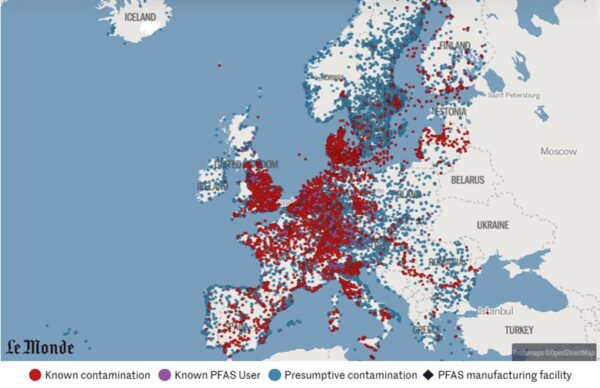
PFAS regulation gained momentum as evidence of contamination spread across Europe’s industrial regions. That pressure now drives reformulation efforts throughout global plastics supply chains. Courtesy of Forever Pollution Project.
That shift is reshaping competition across the plastics sector. Reformulation is no longer just a compliance task. It now shapes supplier status, customer retention, and long-term market access.
The next phase of PFAS rules will test more than chemistry. It will test whether the plastics industry can maintain high performance while rebuilding formulas modern manufacturing has depended on for decades.
PFAS Reformulation Takes Center Stage
These reformulation challenges will take center stage at SPE’s Chemical Safety in Plastics: PFAS & Beyond 2026, taking place October 20–21 in Baltimore. The event will bring together plastics professionals to examine how evolving chemical regulations are changing material selection, formulation, processing, and long-term product development.
PFAS substitution will be central to that discussion. For compounders, resin suppliers, processors, and OEMs, the challenge goes beyond simply identifying fluorine-free alternatives. New formulations must also maintain processing stability, mechanical properties, flame resistance, electrical performance, and durability under demanding service conditions. At the same time, companies increasingly need stronger chemical disclosure, traceability, and documentation throughout the supply chain.
The program will explore substitution technologies, regulatory developments, testing strategies, and approaches for evaluating chemicals of concern without creating regrettable substitutions. These discussions are especially relevant for high-performance applications where material changes can trigger extensive qualification and reliability testing.
As PFAS regulations continue to evolve, events such as Chemical Safety in Plastics: PFAS & Beyond 2026 offer the industry an opportunity to connect regulatory expectations with practical material-development challenges. For plastics companies, the question is no longer only which chemicals may face restrictions, but how to redesign formulations while preserving the performance customers expect.
Click here to register for the event.

Mariana Holguin is a mechanical engineer with a master’s degree in finance. She specializes in the financial and strategic analysis of engineering projects, with experience evaluating capital investments, supply chain economics, and FP&A across industrial sectors.