Catalytic Pathways Target Chemical Circularity for Polyolefins
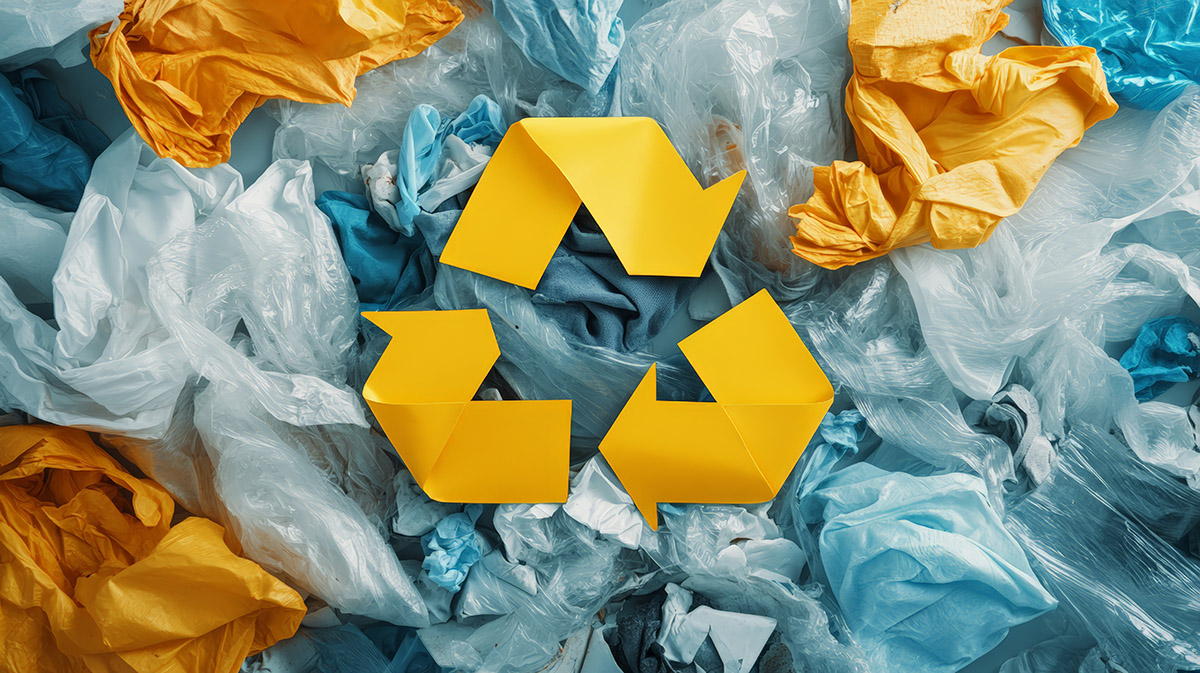
Heterogeneous thermal catalytic pathways for upcycling polyolefins offer a promising approach towards chemical circularity.
Polyolefin waste, a persistent pollutant, remains a significant challenge for recycling. As an alternative to mechanical recycling, catalytic upcycling can convert polymers into valuable materials. Polyolefins, which account for over 60% of plastic waste, are highly resistant to depolymerization. This is due to their strong C–C bonds and chemical inertness. Additives, fillers, pigments, and mixed polymer streams further complicate recycling in real-world waste streams. Next-generation heterogeneous catalysts, paired with careful engineering considerations, have potential for bridging this gap and supporting a circular plastic economy.
You can also read: Upcycling of Polyolefins Through C–H Bond Activation.
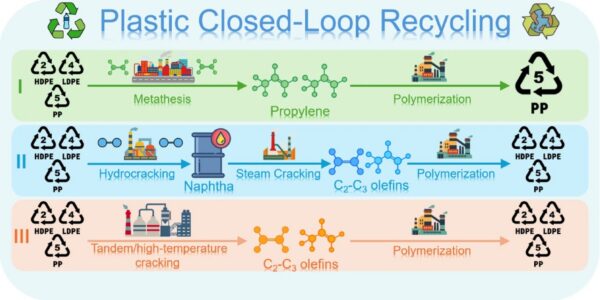
Metathesis, hydrocracking, and tandem/high-temperature cracking are three primary catalytic methods for polyolefin upcycling. Figure courtesy of Current perspective on heterogeneous thermal catalytic approaches for closed-loop polyolefin plastic recycling.
Selectivity and Mild Conditions: Metathesis
Metathesis directly converts polyethylene or polypropylene into propylene monomers. This method uses ethylene as a co-reactant and can take place under mild conditions. Metathesis requires substantial amounts of ethylene to drive the reaction. It favors longer-chain olefins, and ethenolysis cleaves the polymer chain’s internal C = C bonds during the reaction. During the reaction, side reactions, such as transfer dehydrogenation, also consume significant ethylene, which is primarily fossil-derived.
This reaction produces propylene, which can be polymerized to form polypropylene. Because polypropylene’s market price is about twice that of ethylene, this method, though effective, is not currently commercially appealing.
Industrial Maturity and Refinery Compatibility: Hydrocracking
Hydrocracking polyolefins to naptha-range hydrocarbons, then steam cracking to yield ethylene and propylene, is another heterogeneous catalytic upcycling approach. The first reaction requires moderate temperatures under a hydrogen atmosphere, but steam cracking requires significantly higher temperatures. Additionally, the separation of the resultant ethylene and propylene is energy-intensive.
This route does not require costly co-reactants, such as ethylene used in metathesis. It is also compatible with existing refinery operations. Still, its energy requirements limit hydrocracking as a long-term solution for circular upcycling.
Direct High-Temperature: Tandem Cracking
High-temperature thermal cracking or tandem catalytic processes directly convert polyolefins into light olefins. Recent research has sought to address challenges in energy management and selectivity control. Such advances leverage multi-stage catalytic systems and Joule heating-based processes. Ultrafast temperature ramping, achieved by exploiting resistive or plasma heating, can overcome issues such as over-cracking and coke formation. This approach remains energy-intensive, and the resulting ethylene and propylene mixtures require downstream separation.
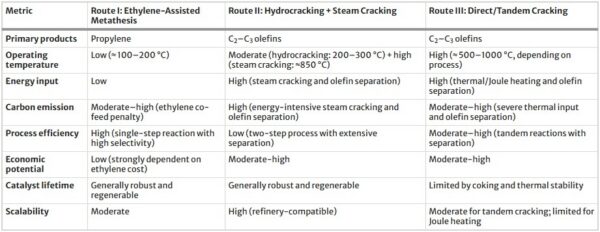
Each approach for heterogeneous thermal catalytic polyolefin recycling offers unique advantages and disadvantages, demanding data-driven engineering choices. Figure courtesy of Current perspective on heterogeneous thermal catalytic approaches for closed-loop polyolefin plastic recycling.
Future Outlook for Heterogeneous Catalysis
Current approaches for closed-loop polyolefin recycling each have distinct techno-economic and lifecycle tradeoffs. Low-carbon catalytic pathways and renewable energy inputs, such as sunlight for thermal catalytic conversion, can decrease the process’s environmental footprint. Techno-economic assessment (TEA) and lifecycle assessment (LCA) will continue to guide economically viable design at an industrial scale. As heterogeneous catalysis continues to evolve, it can serve as a route to circularity, enabling sustainable polymer regeneration.

Having studied Geology, Julienne Smith focuses on environmentalism, sustainability, and the policies that impact plastics professionals today. As a technical writer, she is passionate about the intersection of science, technology, and communication. In her free time, she loves learning new things and writing fiction.