
Apricot Shell Flour Enhances Zein Bioplastics for Packaging

Apricot shell flour improves ductility, impact strength, and compostability in injection-moldable zein bioplastics for packaging.
The plastics industry continues to search for materials that combine sustainability with processability. Protein-based polymers such as zein, derived from corn, offer biodegradability and renewability, but limited ductility and processing constraints have restricted their industrial use.
You can also read: Improving Seafood Packaging with Biopolymers and Nanotechnology
Turning Agricultural Waste into High-Performance Bioplastics
Recent research demonstrates a viable pathway to overcome these limitations by combining zein diethylene glycol (DEG) and apricot shell flour (ASF), a lignocellulosic byproduct. This approach transforms an agricultural residue into a functional component that enhances performance while supporting circular material strategies.
The study moves beyond lab-scale film formation and demonstrates that zein can be processed using conventional thermoplastic techniques. Researchers compounded zein with 25 wt% DEG and varying amounts of ASF via extrusion, followed by injection molding at 130°C. This processing route brings protein-based materials closer to industrial reality. It shows that manufacturers can use existing equipment to produce rigid or semi-rigid parts from bio-based formulations without requiring specialized processing technologies.
Synergistic Plasticization Drives Exceptional Ductility
The most notable outcome lies in the mechanical performance. Zein plasticized with DEG already exhibits high flexibility, reaching a strain at break of 57.2%. The addition of ASF further enhances this property, increasing strain at break to 119.2% at the highest filler content. Impact strength shows a similar trend, increasing from 6.4 to 15.9 kJ/m2 upon ASF incorporation. These results indicate a synergistic plasticization effect between DEG and ASF.
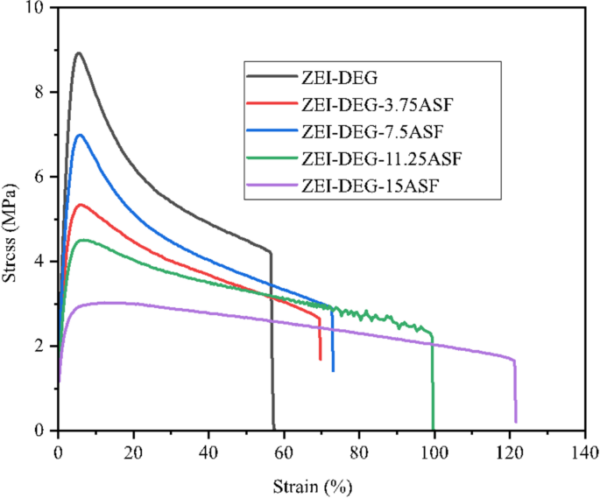
Stress-strain curves of the Zein-DEG-ASF thermoplastic materials. Courtesy of Incorporation of Apricot Shell Loads into Novel Highly Ductile Thermoplastic Zein Biopolymers Through Injection Molding for Food Packaging.
Instead of acting purely as reinforcing filler, ASF promotes chain mobility through interactions between its oxygen-containing components and the zein matrix. This behavior contrasts with conventional lignocellulosic fillers, which typically increase stiffness and reduce ductility. The trade-off remains clear: stiffness and tensile strength decrease as ductility increases. However, this balance aligns well with applications that require flexibility, such as trays, lids or cushioning packaging components.
Thermal Behavior for Industrial Processing
Thermal analysis confirms that the developed materials maintain stability under processing conditions. Although ASF slightly reduces thermal stability, all formulations remain stable well above the temperatures used in extrusion and injection molding. Dynamic mechanical analysis shows a decrease in glass transition temperature from 46°C in zein-DEG to approximately 39-40°C with ASF addition, reinforcing the observed plasticization effect. These findings indicate that DEG provides more effective plasticization than traditional systems such as glycerol, enabling greater chain mobility and improved ductility.
Moisture Sensitivity Defines End-Use Potential
The materials exhibit strong hydrophilic behavior. Water contact angle decreases with ASF content, and water absorption reaches up to 275% in zein-DEG formulations over extended immersion. ASF reduces overall water uptake compared to zein-DEG alone, but the materials still absorb significant moisture due to their polar structure and high free volume. This characteristic limits their use in high-humidity or liquid contact reinforcements but does not preclude applications in dry or short-life packaging.
Biodegradability and Circular Potential
All formulations demonstrate rapid disintegration under controlled composting conditions. The materials achieve complete degradation within several weeks, with higher ASF content accelerating the process. ASF enhances biodegradability by increasing moisture uptake and promoting microbial activity. This behavior reinforces the environmental advantage of combining bio-based polymers with agricultural waste streams.
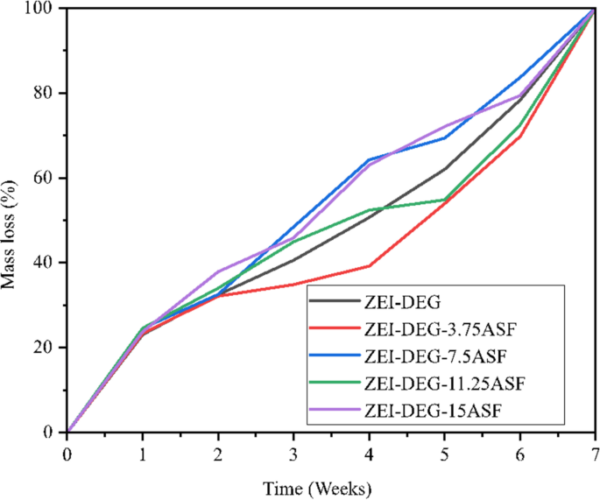
Disintegration rate of zein-based materials under controlled composting conditions. Courtesy of Incorporation of Apricot Shell Loads into Novel Highly Ductile Thermoplastic Zein Biopolymers Through Injection Molding for Food Packaging.
Implications for Packaging and Beyond
This work positions zein-based composites as viable candidates for sustainable packaging applications. The materials combine industrial processability, high ductility, and full biodegradability while incorporating waste-derived fillers. However, challenges remain. High water absorption and reduced mechanical strength limit their use in demanding environments. Future developments must address barrier properties and moisture resistance to expand application scope.
Despite these limitations, the study demonstrates a compelling strategy: using agricultural byproducts not only as fillers but as active contributors to material performance. For industry and researchers alike, this approach opens new pathways toward scalable, circular bioplastics.

Paula Sánchez is a recent mechanical engineering graduate focused on sustainable manufacturing and materials innovation, with research experience in bio-assisted manufacturing at Purdue University and bioplastics at Universidad de los Andes, Colombia.