AI Injection Molding Ecosystem: Smarter Together

The AI Injection Molding Ecosystem is not about predicting the future. It connects materials, simulations, machines, molds, sensors, and AI into a single ecosystem that enables better decisions in real time.
The Next Chapter of Injection Molding Has Already Begun
For more than forty years, simulation software has helped injection molders answer a critical question before the first shot: What will happen inside the mold?

Engineers learned to predict filling patterns, pressure requirements, cooling performance, fiber orientation, shrinkage, and warpage long before making tooling investments. Courtesy of Moldex.
Engineers learned to predict filling patterns, pressure requirements, cooling performance, fiber orientation, shrinkage, and warpage long before making tooling investments. Simulation became an essential decision-making tool, reducing development time and minimizing costly trial-and-error activities.
You can also read: Digital Twins and Predictive Analytics in Plastics Supply Chains
Today, however, the industry stands at the beginning of a new chapter. Artificial Intelligence is transforming not only simulation, but the entire injection molding value chain. What was once a collection of independent technologies is rapidly becoming an interconnected digital ecosystem where software developers, machine manufacturers, material suppliers, start-ups, and producers work together to create a more intelligent manufacturing environment.
This transformation is at the heart of the AI Injection Molding Simulation Panel during the 2026 SPE Injection Molding Innovation Summit, where some of the industry’s most influential technology providers will discuss what comes next.
From Better Simulations to Smarter Engineering Decisions
The first wave of digitalization focused on prediction. The next wave focuses on decision-making.
Leading simulation companies such as Moldex3D, Autodesk Moldflow, and SIGMASOFT have spent decades improving virtual molding accuracy. Their software platforms have become indispensable tools for product developers and process engineers worldwide.
Today, the challenge is no longer simply generating simulation results. Engineers must extract value from increasingly complex datasets while working under pressure to launch products faster, use more sustainable materials, and meet stricter quality requirements.
Artificial intelligence is emerging as the bridge between data and decisions.
Rather than replacing traditional physics-based simulations, AI is helping engineers navigate complexity more efficiently. Automated optimization, intelligent process recommendations, defect prediction, and simplified result interpretation are beginning to reduce repetitive tasks and let engineers focus on higher-level manufacturing challenges.
The result: A shift from simulation-centric workflows to knowledge-centric engineering.
Why the Industry’s Biggest Players Are Coming Together
One of the most remarkable aspects of the 2026 SPE Injection Molding Innovation Summit is the diversity of organizations represented.
- Moldex3D, Autodesk Moldflow, and SIGMASOFT bring deep expertise in virtual molding and simulation technologies.
- RJG contributes decades of knowledge in process monitoring and cavity pressure-based molding strategies.
- Osphim represents a new generation of AI-driven process optimization solutions designed to make molding operations smarter and more autonomous.
- Moxietec focuses on advanced manufacturing technologies that leverage data-driven decision-making.
Together, these companies illustrate an important reality: the future of injection molding will not come from a single software package, machine, or algorithm. It will emerge through collaboration across the entire ecosystem.
When Virtual and Real Worlds Start to Converge
Perhaps the most exciting development discussed across the industry is the growing connection between simulation and production. Historically, simulation ended when production began. Engineers would validate a design, optimize a process window, and then transfer the project to manufacturing. Once production started, simulation often became a reference document rather than an active engineering tool.
Artificial intelligence is changing this relationship. Machine data, cavity pressure measurements, quality inspections, and production performance can now be used to continuously improve process understanding. As a result, simulation is gradually evolving from a project-based activity into a living system that learns alongside production. The long-standing gap between prediction and reality is becoming smaller.
The Emergence of Autonomous Manufacturing
While simulation companies improve virtual decision-making, machine manufacturers are pushing intelligence directly onto the shop floor.
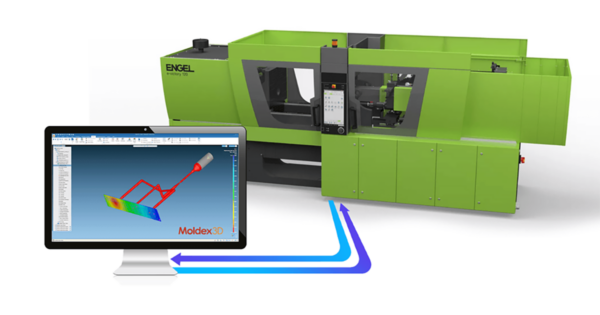
The vision is clear: Future injection molding systems will not simply execute predefined process parameters. They will continuously evaluate quality targets, learn from production data, and adapt to changing conditions. Courtesy of ENGEL.
Organizations such as ENGEL are demonstrating systems that can continuously monitor production conditions, identify deviations, and support corrective actions in real time. Instead of reacting to quality issues after they occur, manufacturers are increasingly moving toward predictive and preventive process control.
The vision is clear: Future injection molding systems will not simply execute predefined process parameters. They will continuously evaluate quality targets, learn from production data, and adapt to changing conditions.
This journey toward autonomous manufacturing represents one of the most significant technological shifts the plastics processing industry has ever experienced.
Why Materials Will Become Even More Important
As artificial intelligence becomes more sophisticated, material science becomes even more critical. No simulation, digital twin, or optimization algorithm can produce reliable results without accurate material information. Material suppliers are therefore evolving beyond their traditional roles and becoming essential contributors to the digital ecosystem.
Advanced material characterization, digital material databases, simulation-ready datasets, and engineering support services are becoming increasingly important as manufacturers seek greater predictive accuracy. In many ways, the future of AI-driven manufacturing may depend as much on material intelligence as on artificial intelligence itself.
The Future Belongs to Connected Ecosystems
The most important message emerging from the AI Injection Molding Simulation Panel is that the industry is no longer moving toward isolated technological improvements. Simulation software, machine intelligence, process monitoring, material science, and artificial intelligence are converging into a connected ecosystem designed to transform manufacturing knowledge into measurable business value.
For engineers, this means new opportunities to innovate faster and make better decisions. For manufacturers, it means improved quality, reduced waste, shorter development cycles, and greater operational efficiency. And for the injection molding industry as a whole, it represents the beginning of a future where simulation no longer supports manufacturing from the sidelines but becomes an active participant throughout the entire product lifecycle.
As the experts gather at the 2026 SPE Injection Molding Innovation Summit one thing becomes increasingly clear (my personal reflection):
“The future of injection molding will not be defined by individual technologies. It will be defined by how effectively the ecosystem connects them”. Let’s stay connected!
To Read More: 2026 Injection Molding Innovation Summit