Transporting Plastics in a Low-Carbon Economy

Low-carbon transport strategies can reduce emissions across plastics supply chains, from resin logistics to the movement of recycled materials.
Logistics Moves into the Scope 3 Spotlight
Polymer producers once focused decarbonization efforts inside plant boundaries. That focus now extends across logistics networks and transport decisions. Companies must now account for emissions from shipping, trucking, and distribution under Scope 3 frameworks.
You can also read: How Blockchain is Transforming Plastic Waste Management.
Transport choices increasingly influence procurement decisions and product carbon footprints. According to ISO 14083 guidance, companies must quantify emissions across entire freight chains using standardized methods. This requirement raises scrutiny on how resin and feedstock move globally.
Major producers already respond. Dow’s 2024 reporting highlights deeper collaboration with logistics providers and suppliers on emissions tracking and reduction. These efforts reflect a broader shift. Logistics now functions as a strategic lever rather than a transactional cost.

The shift toward low-carbon energy systems is reshaping industrial logistics, pushing plastics transport toward cleaner fuels, stricter accounting, and new cost structures. Courtesy of Dow.
Regulation Rewrites Freight Economics
European policy now reshapes the economics of polymer transport. The EU Emissions Trading System covers maritime shipping, with full emissions obligations approaching by 2027. This framework directly increases costs for carbon-intensive shipping routes into Europe.
FuelEU Maritime adds further pressure by mandating reductions in the greenhouse gas intensity of marine fuels from 2025 onward. Together, these measures alter carrier selection and route planning for global resin trade.
Road freight faces similar regulatory tightening. Revised EU heavy-duty vehicle standards impose aggressive emissions reduction targets through 2040. However, zero-emission truck adoption remains uneven, according to data from the IEA. This gap complicates near-term decarbonization for regional plastics distribution.
Companies must now integrate carbon exposure into landed cost calculations. Freight decisions increasingly reflect both regulatory compliance and financial risk.
Operational Gains Outpace Technology
Freight decarbonization depends more on operations than on breakthrough technology in the near term. Research in Nature Communications shows that logistics optimization delivers faster emissions reductions than vehicle changes alone.
Companies, therefore, focus on improving load factors and reducing empty miles. Organizations also shift volumes toward rail or intermodal transport where service levels allow. These changes deliver measurable emissions cuts without waiting for fleet turnover.
Maritime research supports this approach. Studies in Advances in Applied Energy show that operational efficiency complements fuel transitions in reducing shipping emissions. Port and short-sea shipping strategies can further lower emissions across regional supply chains.
These measures require coordination across multiple actors. Producers, carriers, and customers must align on schedules, service expectations, and data sharing.
Carbon Meets Containment in Plastics Logistics
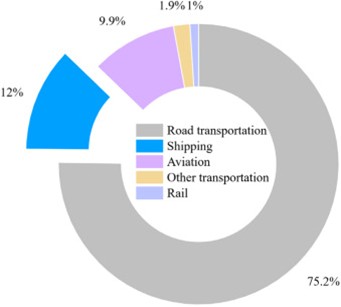
Distribution of CO2 emissions in the global transport sector by sub-sector in 2023. Courtesy of Statista.com.
Plastics transport introduces a unique constraint: pellet loss. New EU regulations impose binding requirements across handling, packaging, and transport operations. These rules extend into maritime logistics and raise compliance expectations.
Logistics providers must now deliver both low-carbon performance and strict material containment. Industry initiatives such as Operation Clean Sweep reinforce this expectation across the value chain. Companies increasingly evaluate carriers on both emissions metrics and spill prevention practices.
At the same time, emissions accounting standards are converging. The GLEC Framework now aligns with ISO 14083, improving consistency in freight emissions reporting. This alignment makes carbon claims more comparable and more auditable.
A New Competitive Variable
Logistics now defines a critical frontier in polymer decarbonization. Companies must balance emissions reduction with cost, reliability, and product integrity. Trade-offs remain unavoidable, especially as technology and infrastructure evolve unevenly.
This shift signals a structural change in the industry. Freight strategy will increasingly determine how producers compete in carbon-constrained global markets.

Mariana Holguin is a mechanical engineer with a master’s degree in finance. She specializes in the financial and strategic analysis of engineering projects, with experience evaluating capital investments, supply chain economics, and FP&A across industrial sectors.