
Polymer Coating Improves Flame Retardancy in Bamboo

A composite polymer coating improves bamboo flame retardancy, water resistance, char formation, and smoke suppression.
Bamboo is an abundant, rapidly growing renewable resource. When processed into recombined bamboo (RB), the material’s increased strength makes it a suitable replacement for plastic in certain applications. Nevertheless, bamboo has poor water resistance and is inherently flammable, limiting its uses. Many coatings currently used for bamboo products offer flame retardancy but lack water resistance, or vice versa. To enhance the applications of bamboo products, there is a need for a coating that addresses both limitations. In a recent study, researchers engineered a composite coating to optimize flame retardancy and water resistance in RB.
You can also read: Limiting Volatile Organic Compounds in PP Wood-Plastic Composites
Coating Preparation
Researchers developed this coating using commercial fluorocarbon (FC) and PolyX (X = 1, 2, 3), a self-synthesized flame-retardant copolymer. Alone, FC increases flammability, but the FC component is crucial for the coating’s water resistance. Because FC-based materials are persistent in the environment, this formulation incorporates it only as a minor component. This allows the coating to achieve hydrophobic and barrier performance while reducing the environmental burden associated with high-PFAS coatings.
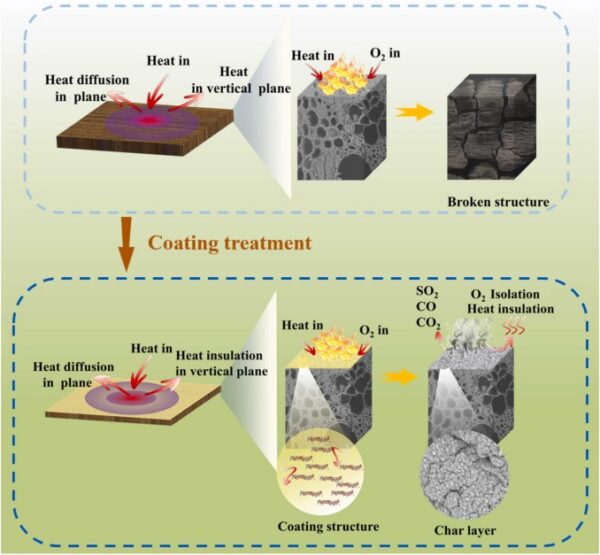
The composite coating, referred to as FPX, is comprised of PolyX (X = 1, 2, 3) and FC. Figure courtesy of Synergistically engineered multifunctional composite coating for recombined bamboo with optimized flame retardancy, water resistance and thermal insulation performance.
Researchers prepared samples with hydroxyethyl acrylate:sodium vinyl sulfonate (HEA:VS) ratios of 50:50, 45:55, and 40:60, which they referred to as Poly1, Poly2, and Poly3, respectively.
Among the samples, Poly3 exhibited enhanced flame retardancy, and researchers selected it for further investigation in the composite. This material, combined with FC, formed the novel FP3 composite coating. This composite achieved a strength of 819 psi and a hardness of 4 H.
Water Resistance
When applied to bamboo, the FP3 treatment resulted in a smooth waterproof film during water resistance testing. The treated bamboo’s water absorption rate was 13.2%. This is below the national standard threshold of 15% for bamboo.
Flame Retardancy
The FP3 (1 FC:3 Poly3) composite coating offered a loss on ignition (LOI) of 31.1 vol%. This sample extinguished quickly upon ignition. Without the coating, the RB sample burned rapidly, with an LOI of 25.3 ± 0.4 vol%.
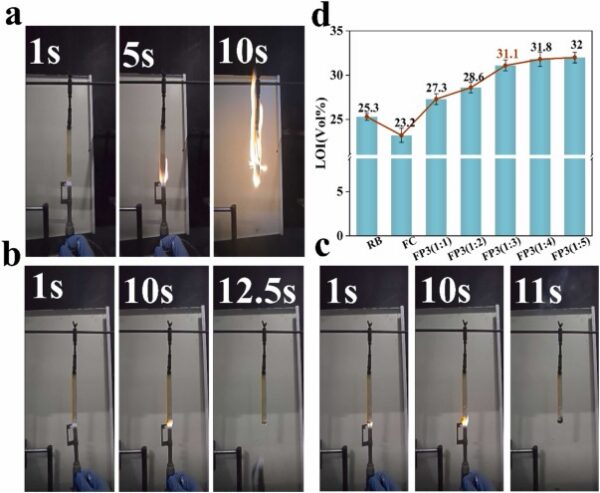
FP3 (1:3)-RB (b and c) demonstrated a quick extinguish when ignited, while untreated RB (a) burned quickly. Figure courtesy of Synergistically engineered multifunctional composite coating for recombined bamboo with optimized flame retardancy, water resistance and thermal insulation performance.
Additionally, FP3 (1:3) showed a residual char rate of 21.6%, compared to untreated RB’s rate of 8.6%. Thus, the composite coating enhanced RB’s residual char rate significantly. By forming a dense char layer, the composite coating creates a physio-chemical barrier to reduce CO and CO2 production. This composite resulted in a lower maximum smoke density and smoke density rate compared to untreated RB.
Flame Retardant Functionality
During ignition, the coating prevents heat spreading through RB due to the char layer serving as a vertical barrier. At elevated temperatures, the flame retardant’s molecular chin reacts to form inorganic sulfate compounds. These compounds adsorb onto the substrate’s surface, forming a dense, compact structure which isolates oxygen and heat. This process releases non-combustible gases which further diluter the concentration of combustible gases. This composite is a practical, scalable approach to improving the safety of bamboo-based products.

Having studied Geology, Julienne Smith focuses on environmentalism, sustainability, and the policies that impact plastics professionals today. As a technical writer, she is passionate about the intersection of science, technology, and communication. In her free time, she loves learning new things and writing fiction.