Plastics in Menstrual Products: Performance, Safety, and Sustainability
Plastics in menstrual products affect hygiene, comfort, additive exposure, PFAS concerns, and environmental impact.
Feminine hygiene, or menstrual products, is often a taboo subject, even though half of the world’s population experiences menstruation. Even so, the Smithsonian Museum identified that the global industry is worth an estimated 15 billion USD. With such a large market share, the spotlight on menstrual plastics, particularly their safety and environmental impact, has risen quickly.
You can also read: Team Designs Digital Health Tools for Pregnant Refugees.
Though most are familiar with today’s plastic, compact tampon and thin absorbent pads, their predecessors were not as convenient. Before the advent of commercial feminine hygiene products, women used pieces of cloth to absorb menstrual fluid, then washed and reused these clothes. The introduction of plastics in packaging, product manufacturing, and effectiveness was not explored seriously until the 1970s. By prioritizing women’s health and integrating plastics research, products are now commercially available.
Construction of Menstrual Products
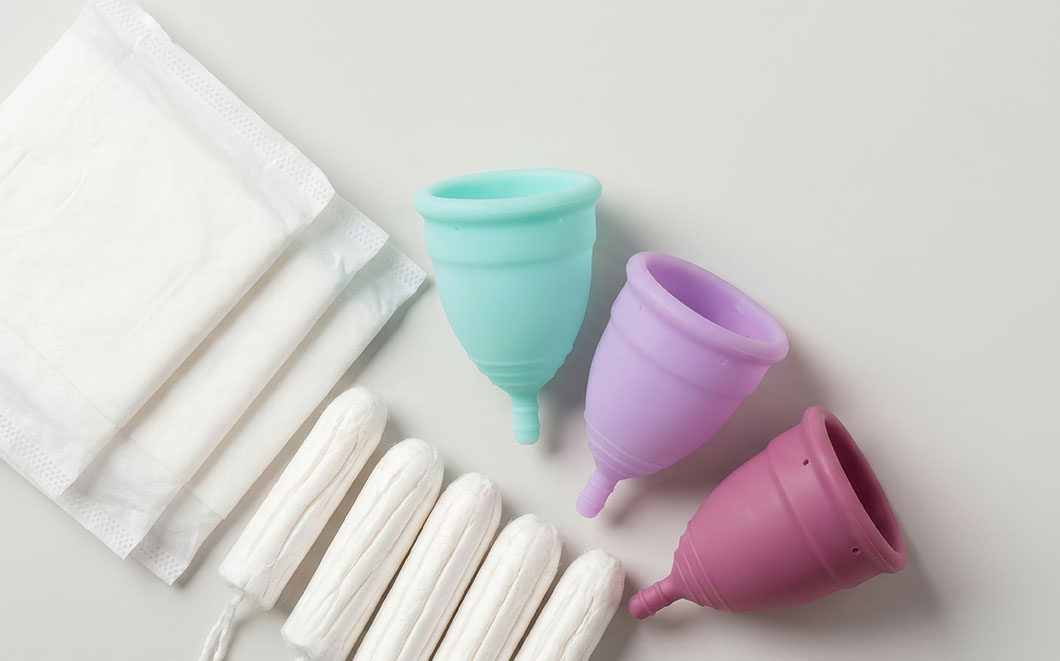
Menstrual products range from single-use items like pads, liners, and tampons to reusable items like menstrual cups, underwear, and some pads. Though all these products’ purposes are similar, to absorb or collect menstrual fluid, the function of plastics varies.
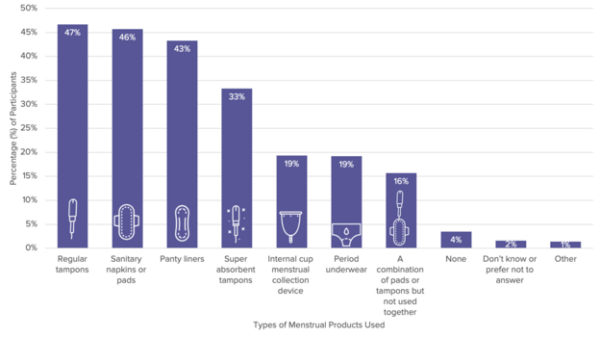
Summary of the menstrual product variety used among still menstruating (pre-menopausal) participants. The study was a “choose all that apply” questionnaire, therefore the sum of the percentages does not equal 100%. Courtesy of Harvard University School of Public Health.
Packaging for Sanitary Protection
Most products are packaged with external wrappings to protect them from contamination and moisture, with selection focusing on tear strength and durability, ensuring they remain sanitary before use. Typical single-use pads and liner wrappings are made from polypropylene and polyethylene films, typically bonded together with pressure-sensitive adhesives or heat joining. Most tampon applicators are generally made from injection-molded polyethylene, while applicator-free tampons differ. Applicator-free tampons are often shrink-wrapped in cellophane or polypropylene films, which are removed before use.
Absorbent Products
Absorbent menstrual products like pads, liners, tampons, and reusable menstrual underwear typically rely on a multilayer construction. Generally, these products incorporate three primary layers: the surface, the acquisition layer, and the absorbent core. This ensures user comfort, fluid transport, and retention. Materials selection focuses on pore structure, capillarity, and resiliency under compression.
The user contact surface layer in absorbent products is usually fabricated from nonwoven blends of polypropylene, polyethylene, and polyester. These plastics are selected to keep consumers dry and comfortable while transferring liquid away from the skin. Beneath the surface layer, the acquisition layer provides intermediate fluid handling. This porous layer is typically made of nonwoven polyester or, in some cases, wood fiber. It’s designed to transport liquid from the surface towards the absorbent core, storing liquid. The final layer in this type of product is the absorbent core. It is responsible for fluid retention and storage. Depending on the required absorptive capacity, materials such as polyester, viscose, and superabsorbent polymers are used alongside paper pulp.
Together, this multilayer layup is designed to deliver reliable performance across both single‑use and reusable absorbent products.
- Fluid Collection: For fluid collection products like menstrual cups, the fabrication process is simpler. Materials selection for these single-material devices focuses on durability, flexibility, and hypoallergenic properties. The most common material used is medical-grade silicone, though medical-grade alternatives like thermoplastic elastomers and latex rubber have been reported.
- Challenges in Today’s Market: Menstrual products are designed for hygiene and comfort, yet their use can significantly affect the health of users and our environment. It’s crucial to consider these implications as consumers choose which products to use.
Chemical Safety in Menstrual Products
Safety evaluations of menstrual products have increasingly focused on the presence and potential migration of plastic additives. A 2025 study by Cioni et al. detected phthalates (PAEs), organophosphate esters (OPEs), and alternative plasticizers (APs) in single-use and reusable products. These additives are widely used in plastics to impart durability and processability. Even so, regulatory bodies have recognized the compounds in each group as chemicals of concern. Exposure to PAEs, like bis(2-ethylhexyl) phthalate and various butyl phthalates, have been categorized as carcinogenic. OPEs are also troubling as they have been linked to immunotoxicity and neurotoxicity, while APs raise various toxicological concerns.
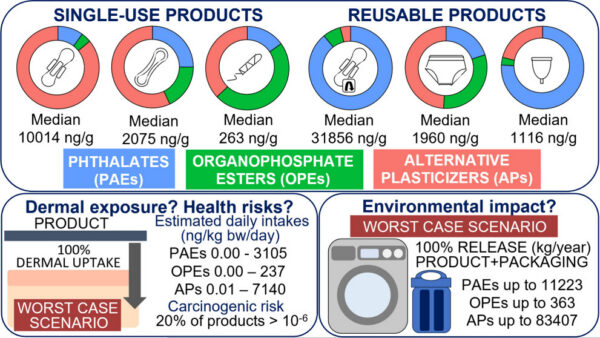
Graphic representation of detected concentrations of PAEs, OPEs, and APs in single-use products like pads, liners, and tampons (left) and reusable pads, menstrual underwear, and menstrual cups (right). The ng/g value listed is the total estimated daily intake of additives through dermal contact with the corresponding product. Courtesy of Plastic Additives in Single-Use and Reusable Menstrual Products: Potential Implications for Human Health and the Environment.
Complementary findings from researchers at Indiana University and the University of Notre Dame identified per- and polyfluoroalkyl substances (PFAS) in several commercial menstrual products. Their studies show PFAS were detected in approximately 30% of the 59 products tested. These chemicals have been associated with serious health issues, including hormonal disruption and developmental problems in children. Only one product in the dataset contained no detectable PFAS or other high‑concern plastic additives, highlighting the variability in manufacturing practices across the market.
Environmental Impact
In addition to safety concerns, menstrual products are now part of the sustainability spotlight. As consumers seek environmentally friendly alternatives to single-use products, reusable options have surged in popularity.
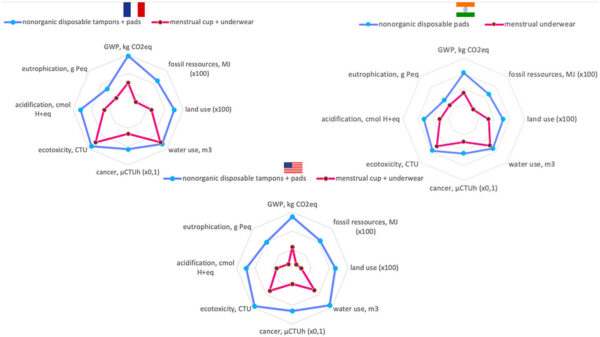
Comparison of eight environmental impact indicators and specific behaviors across of France, India, and the United States. Courtesy of Menstrual Products: A Comparable Life Cycle Assessment.
A 2022 lifecycle assessment comparing menstrual products from France, India, and the United States was conducted. In this study, eight environmental impact indicators of the three countries were evaluated from production to disposal. Menstrual cups were found to have the lowest impact score across all indicators between countries, with menstrual underwear ranked second, and reusable pads third. The items with the highest impact score were disposable, single-use tampons and pads. Another impactful factor was the use of organic versus non-organic cotton in many of the single-use products. Yet, depending on the product, different steps of the lifecycle assessment influenced overall emissions. For all products, the global warming potential was highest during the manufacturing phase, with almost half of the impact from polyethylene production. These findings highlight the need for continued spotlight in polymer formulation, product design, and the intersection of women’s health and research.

Jennifer Chavez is a chemist-turned materials scientist with expertise in advanced plastics manufacturing and experience spanning orthodontic medical devices, consumer products, and renewable energy. She currently works as a materials engineer in the aerospace sector, focusing on process development and compliance for flight-critical hardware.