
PA6F Nanofiber Membranes Offer Sustainable PFAS Removal
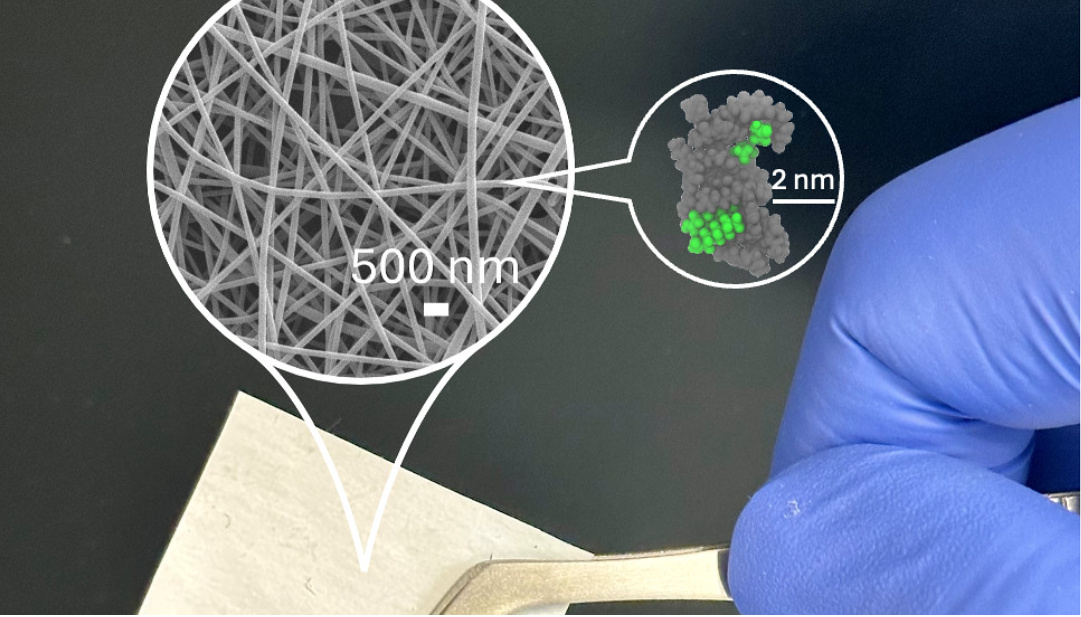
Bio-based PA6F nanofiber membranes capture PFAS from water and support reuse through thermal regeneration and reprocessing.
Per- and polyfluoroalkyl substances (PFAS) remain one of the most persistent contaminants in water systems. Their strong carbon–fluorine bonds prevent natural degradation, allowing them to accumulate in the environment over time. These “forever chemicals” are widely used in industries such as textiles, coatings, and microelectronics, making their presence difficult to control.
PFAS: A Persistent Industry Challenge
Growing evidence links PFAS exposure to serious health risks, including cancer and immune system disruption. This has increased regulatory pressure on industries and water utilities. However, current treatment methods remain limited. Conventional adsorbents such as activated carbon and ion-exchange resins often require frequent replacement and generate secondary waste. More advanced approaches, while effective, tend to be energy-intensive and difficult to scale.
You can also read: When Microplastics Meet PFAS: A Toxic Partnership in the Environment
A Research Breakthrough from the University of Bath
Researchers at the University of Bath have developed a bio-based polymer membrane that offers a different approach. The material is designed not only to capture PFAS efficiently but also to support reuse and circular processing.
The membrane is based on a semi-aromatic polyamide, poly(hexamethylene 2,5-furandicarboxylamide) or PA6F, derived from renewable furan-based feedstocks. This structure combines the mechanical robustness of conventional nylons with enhanced polarity and interaction capability.
According to the research team, the material behaves differently from traditional petroleum-based polyamides. Its structure actively responds to water, enabling improved pollutant capture and retention.
Water-Activated Capture Mechanism
PA6F is fabricated into nanofiber membranes using electrospinning, producing a network of fibers significantly thinner than a human hair. This structure provides high surface area and interconnected porosity, both essential for adsorption-based processes.
What sets the material apart is its response to water. When exposed to aqueous environments, the nanofibers absorb moisture, swell, and reorganize. This process causes the structure to contract, effectively forming a tightening network around pollutants.
Dr. Xiang Ding, lead researcher on the project, explains that unlike conventional nylons, these bio-based nanofibres “reorganise and contract in water,” enabling rapid and efficient trapping of PFAS within the polymer network.
This structural transformation works alongside chemical interactions. Hydrogen bonding, electrostatic attraction, and hydrophobic interactions all contribute to adsorption. At the same time, the densified matrix physically confines PFAS molecules, improving retention.
Performance and Material Specificity
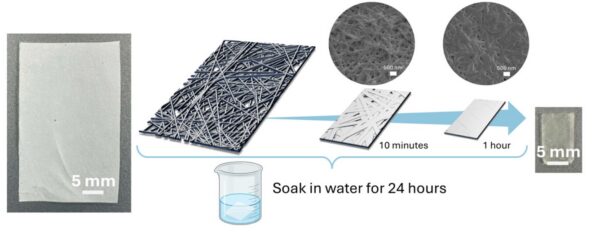
Schematic of the coupled macroscopic shrinkage and microscopic swelling behavior of PA6F nanofiber membranes during water immersion. Courtesy of Water-Induced Confinement of Perfluorinated Pollutants in Biobased Polyamide Nanofibrous Membranes.
Laboratory testing shows strong adsorption performance. The membrane removes approximately 50% of PFOA within one hour and achieves over 94% removal under extended conditions.
Equally important is the material’s specificity. Structurally similar polymers such as nylon-6 and nylon-66 show minimal adsorption under comparable conditions. Researchers attribute this difference to the furan-based backbone and lower crystallinity of PA6F, which allow greater interaction and structural flexibility.
The membrane also performs consistently across a broad pH range, indicating that adsorption is not governed by a single mechanism. Instead, chemical affinity and physical confinement work together to deliver stable performance.
Toward Scalable and Circular Water Treatment
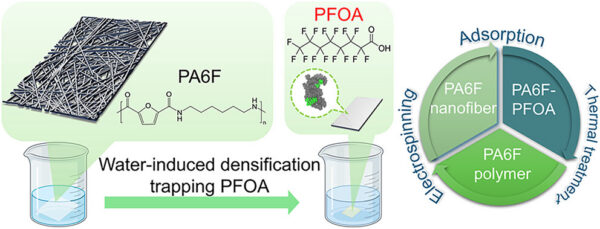
Water-activated PA6F nanofiber membranes capture PFAS through chemical interactions and physical confinement, enabling regeneration and reuse. Courtesy of Water-Induced Confinement of Perfluorinated Pollutants in Biobased Polyamide Nanofibrous Membranes.
One of the key limitations of existing PFAS treatment systems is the lack of efficient regeneration. Many adsorbents require chemical treatment or disposal after use. In contrast, the PA6F membrane is designed for reuse. Captured pollutants can be released through controlled heating, allowing the polymer to be reprocessed into a new membrane. The regenerated material retains up to 93% of its original performance, supporting a closed-loop approach.
This circular capability addresses both cost and environmental impact. It also differentiates the material from pressure-driven systems such as reverse osmosis, which generate concentrated waste streams and require high energy input.
Translating Research into Industrial Practice
The work at the University of Bath highlights a broader shift in materials engineering. Rather than relying solely on separation or degradation, new systems are being designed to combine structure, chemistry, and functionality. The research team notes that the next step involves testing the membrane in real-world water conditions and expanding its application to other PFAS compounds. For plastics engineers, this development signals an important direction. Bio-based, reprocessable polymers are moving beyond sustainability narratives and into high-performance applications.
PA6F nanofiber membranes demonstrate how material innovation can address both environmental and operational challenges. As PFAS regulations tighten globally, such solutions are likely to play a critical role in next-generation water treatment systems.
The complete study, including detailed technical analysis and supplementary data, is available in ACS Applied Materials & Interfaces Journal.

Mariya Raja is a technical writer specializing in engineering and technology-focused content. Her experience covers plastics, sustainability, healthcare IT, and software, with a focus on industry trends, innovation, and regulatory developments.