
Melt Filtration Becomes Critical for Recycled ABS Quality
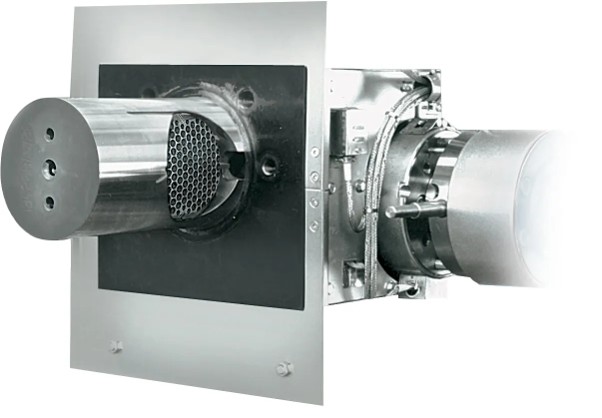
Melt filtration affects ABS recyclate quality, pressure stability, contaminant removal, melt flow, and the risk of polymer degradation.
As processors increase recycled content, melt filtration becomes more than a contamination-control step. It also affects pressure stability, residence time, material degradation, and final part properties. In recycling lines, screen selection can influence both melt quality and process reliability.
Recent research examined how selected particulate contaminants and different melt-screen sizes affected ABS and ABS recyclate. The study focused on contaminants that can appear in recycled streams, including wood and rubber particles, and compared post-consumer ABS recyclate filtered through screens with mesh sizes of 250, 100, 60, and 20 μm.
You can also read: Conveying PCR: Reducing Fines, Angel Hair, and Scrap.
Why Contamination Still Matters
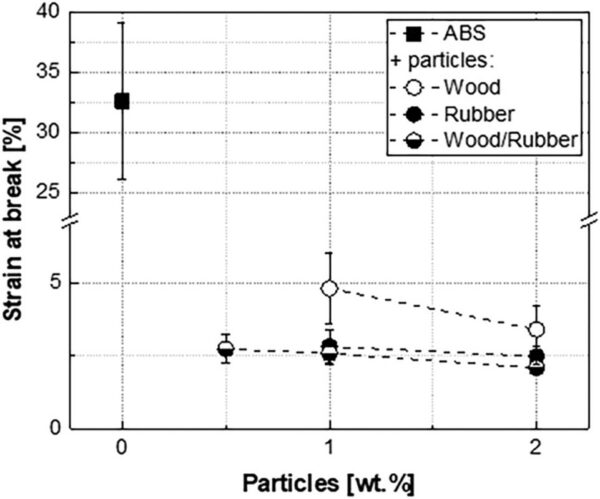
Effect of particulate contaminants on the strain at break of ABS. Courtesy of Influence of selected contaminations and melt filtration on the properties of ABS and ABS recyclate.
Recycled polymers can retain low concentrations of particulate contaminants after sorting, washing, and size reduction. Although these residues may not appear during routine visual inspection, they can influence melt processing behavior and reduce mechanical performance.
In the study, low concentrations of model contaminants measurably reduced key ABS properties. Wood and rubber particles added at 0.5 to 2.0 wt.% decreased material performance, with a stronger effect on ductility-related properties. This finding matters for processors because recycled-content evaluation often emphasizes melt flow, color, and visible contamination. However, residual particulates can also reduce toughness and elongation, directly affecting the reliability of molded components.
The Tradeoff in Finer Filtration
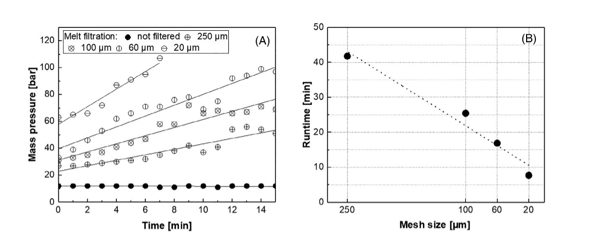
Effect of melt filtration screen size on mass pressure and runtime during ABS recyclate processing. Courtesy of Influence of selected contaminations and melt filtration on the properties of ABS and ABS recyclate.
Melt filtration removes particulate contaminants before the polymer melt enters downstream equipment, pelletizing, or molding operations. Finer screens can increase particle retention and improve melt cleanliness. However, the study shows that screen opening, contaminant removal, pressure development, and final material performance do not follow a simple linear relationship.
For ABS recyclate, decreasing the screen opening produced only marginal increases in elastic modulus and tensile strength. Overall, the mechanical-property response remained limited, indicating that finer filtration did not improve bulk material performance. However, smaller screen openings increased process severity. Melt pressure increased with filtration time, and finer screens reduced the available operating window before the system reached the switch-off pressure.
This pressure response defines a practical operating limit for fine filtration. Smaller screen openings improve particle retention. However, they also promote pressure buildup, reduce throughput stability, and increase material loss during screen changes or interrupted operation. Therefore, the optimal screen size does not necessarily correspond to the finest available mesh. It depends on contaminant load, polymer sensitivity, allowable pressure rise, throughput requirements, and final application targets.
Material Degradation Risk
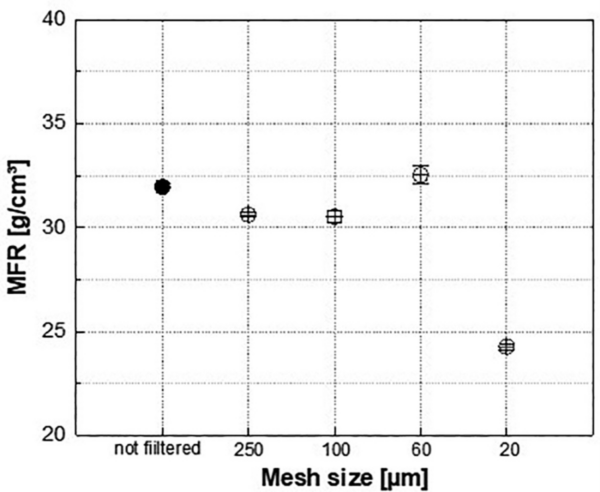
Effect of melt filtration screen size on the melt flow rate of ABS recyclate. Courtesy of Influence of selected contaminations and melt filtration on the properties of ABS and ABS recyclate.
The study also identifies an additional limitation: fine filtration can increase the thermal and mechanical load imposed on the polymer melt. ABS recyclate filtered through the 20 μm screen showed a lower melt flow rate than both the unfiltered material and the samples processed with coarser screens. Researchers attributed this change to the combined effect of elevated temperature exposure, pressure buildup, and longer residence time during fine filtration.
This behavior is relevant for ABS because the polybutadiene phase can undergo degradation or crosslinking under elevated thermal and mechanical loading. Recyclate also carries a previous processing and service history, which can increase its sensitivity to additional stress during melt filtration. Under the finest filtration condition, the process increased particle retention but also imposed more severe thermo-mechanical conditions. These conditions can alter polymer structure and reduce material performance.
Implications for Recycling Lines
These findings indicate that melt filtration should operate as a controlled processing stage rather than as a fixed final cleanup step. Processors need to define filtration conditions according to material quality, contaminant load, and process stability requirements. Screen opening, pressure development, residence time, melt temperature, and screen-change frequency all influence the final balance between contaminant removal and polymer performance.
For recycled ABS, smaller screen openings can improve contaminant retention, but they can also compromise process stability and increase the risk of thermo-mechanical degradation. Larger screen openings can maintain melt flow more effectively and limit pressure buildup, although they may allow residual particles to remain in the melt and affect ductility or surface quality. The appropriate filtration strategy therefore depends on the performance requirements of the final application.
Technical parts with impact or elongation requirements may need stricter control of contamination than parts with lower mechanical demands. However, processors still need to avoid excessive thermal exposure during filtration. This makes pressure monitoring, screen-life evaluation, and material testing essential for recycled ABS.

María José Vargas is a mechanical engineer and MSc candidate in Materials Engineering and Nanotechnology at Politecnico di Milano. Her work focuses on environmental stress cracking in polyethylene, polymer failure behavior, plastics processing, and sustainable polymer applications.