
How Product Design Shapes Medical Plastics Recovery
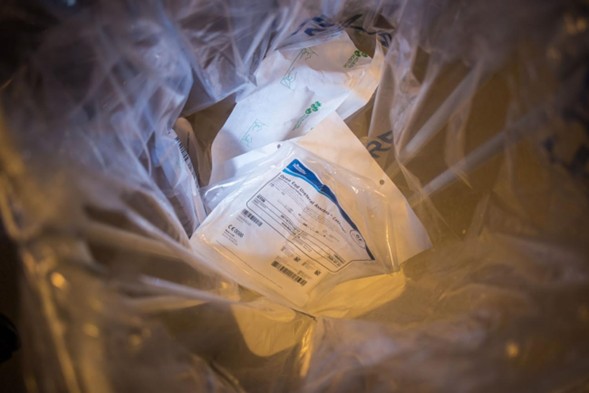
Medical plastics recovery depends on product architecture, contamination control, resin choice, and end-of-life design strategy.
Medical plastics cannot follow the same recovery logic as consumer packaging. A consumer container needs compatible resin chemistry, access to sorting, and downstream market value. Medical products face a narrower design window because they must meet sterility, biocompatibility, traceability, cleaning, and performance requirements. They may also come into contact with body fluids, drugs, disinfectants, or sterilization processes, which can change polymer behavior and recovery options. As a result, recovery depends on product architecture, not only on post-use waste handling.
For that reason, the recovery route should enter the specification stage early. Designers need to decide whether the product can support reuse, regulated reprocessing, mechanical recycling, chemical recycling, or disposal. Each route requires a different polymer architecture, additive package, and joining strategy.
You can also read: Sustainable Healthcare Plastics: Rethinking Design, Use, and Recovery
Reuse: Durable Plastics
Reuse fits durable medical components, not most disposable patient-contact items. Typical examples include sterilization trays, instrument handles, rigid housings, diagnostic equipment covers, and some fluid-management accessories. These parts need polymers that tolerate repeated cleaning and sterilization without distortion, cracking, discoloration, or surface damage.
For that reason, material selection sets the first limit. PPSU, PSU, PEEK, PEI, and selected high-temperature polycarbonates can handle higher thermal and chemical stress than commodity resins. PPSU can suit reusable trays or handles exposed to repeated steam sterilization, while PEEK can support components that need stiffness, hydrolysis resistance, and dimensional stability. These materials support reuse only when the part design also allows for repeatable cleaning, inspection, and access for sterilant application.
However, resin choice cannot, by itself, make a reusable product safe. Geometry also controls cleaning efficiency, because trapped residues can compromise the next clinical cycle. Deep ribs, blind holes, porous textures, sharp internal corners, and overmolded interfaces can retain proteins or detergent residues. Therefore, a reusable part should favor exposed surfaces, generous radii, visible flow paths, and inspection access.
Reprocessing: Single-Use Devices
Regulated reprocessing fits only specific single-use devices. Cleaning, sterilization, and performance validation must support another clinical cycle. This route does not fit products with long narrow lumens, absorbent materials, fragile coatings, or bonded multilayer sections, because these features can block reliable cleaning. Devices with accessible surfaces, stable polymers, and separable functional modules give reprocessors a stronger basis for cleaning validation and functional testing.
Thus, designers should evaluate the full device, not only the main polymer. A compression sleeve, pulse oximeter sensor housing, pneumatic cuff, or electrophysiology cable may combine plastics, adhesives, metals, elastomers, and electronics. Each material must tolerate the selected cleaning chemistry and sterilization method across the defined cycle limit. The polymer cannot embrittle, swell, leach additives, or lose mechanical response. At the same time, the adhesive cannot creep, the coating cannot delaminate, and the connector cannot lose fit.
Mechanical Recycling: Clean Packaging
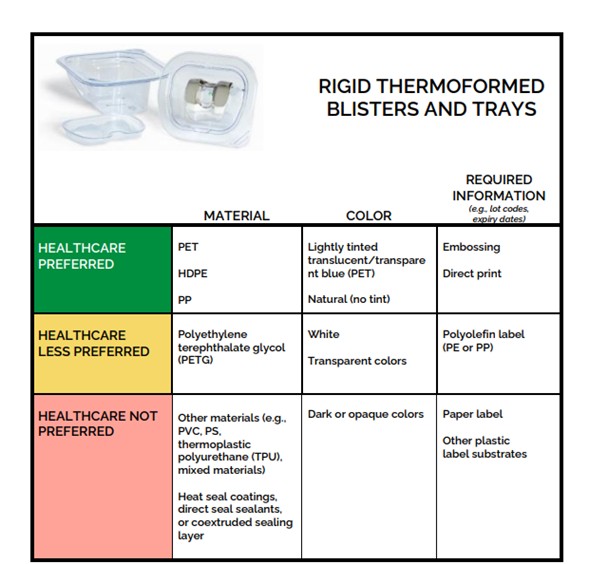
Design guidance for rigid thermoformed blisters and trays shows how resin selection, color, labeling, and coatings affect healthcare packaging recyclability. Courtesy of HPRC.
Mechanical recycling works best when healthcare plastics enter the stream clean, segregated, and compositionally simple. For that reason, the most realistic candidates often include non-contaminated packaging, rigid trays, caps, transport bins, and secondary packaging. Patient-contact devices carry higher recycling risks because contamination, mixed materials, and complex geometries make sorting and washing difficult.
Polymer identity still matters. PET, HDPE, PP, and PE have established recycling routes, but additives, labels, coatings, and adhesive residues can reduce recyclate quality. Literature on polymer recycling repeatedly links contamination and mixed-polymer streams with lower mechanical performance, unstable melt flow, and poorer color control. A PP tray with low pigment loading, compatible label chemistry, and no metalized layer therefore gives recyclers a cleaner feedstock.
Sterile barrier packaging remains more difficult. Multilayer PE/PA, PET/EVOH, coated papers, and Tyvek-type structures improve puncture resistance, seal integrity, and microbial barrier performance, but they limit mechanical recycling.
Chemical Recycling: Feedstock Quality
1965484178. Chemical recycling can process some complex medical plastics, but feedstock quality and contamination control remain critical.
Chemical recycling can process some mixed plastic streams that mechanical recycling cannot handle efficiently. However, feedstock control still determines process performance. PVC, halogens, metals, high filler loads, silicone, and flame retardants can interfere with conversion chemistry. Multilayer structures and high moisture content can also reduce liquid yield, affect oil composition, accelerate catalyst deactivation, or increase emissions-control requirements.
Downstream conversion works better when products contain fewer polymers, lower halogen content, clear material marking, and removable metal inserts. A mixed PP/PE packaging stream with controlled labels and low contamination can support a more consistent feedstock. In contrast, a device assembly with PVC tubing, silicone seals, stainless-steel springs, acrylic adhesives, and printed electronics increases separation difficulty.
Design Starts With the Recovery Path
A polymer can be recyclable on paper while the finished medical product remains unrecoverable after use. Recovery depends on the full product architecture, not only on resin identity. Bonded inserts, pigment packages, narrow channels, multilayer films, coatings, labels, and adhesives can each block a practical recovery route.
These details matter because each end-of-life option creates a fresh design target. Reuse needs cleanable geometry and materials that tolerate repeated sterilization. Regulated reprocessing needs stable function after each validated cycle. Mechanical recycling needs clean and identifiable material streams. Chemical recycling still needs controlled feedstock chemistry and limited contamination.
For this reason, recovery should enter the specification stage early. The intended route should guide resin choice, additives, colorants, labels, joints, coatings, and validation tests. Without that alignment, medical plastics may keep material value in theory but lose recovery value in practice.

María José Vargas is a mechanical engineer and MSc candidate in Materials Engineering and Nanotechnology at Politecnico di Milano. Her work focuses on environmental stress cracking in polyethylene, polymer failure behavior, plastics processing, and sustainable polymer applications.