Digital Process Control Supports Stable Molding of PCR and PIR
Smart controls and modified plasticizing systems help stabilize recyclate injection molding despite variations in viscosity and feedstock.
Processing post-industrial recyclate (PIR) and post-consumer recyclate (PCR) requires process adjustments because material properties can vary considerably.
Arburg has developed several control concepts that help maintain constant mold filling. Through its digital pilot functions, the German machine manufacturer maintains stable injection molding during both injection and holding pressure.
You can also read: The Complexity of Recyclate.
These pilot functions can counteract fluctuations in melt viscosity during processing. The aXw Control ReferencePilot and aXw Control RecyclatePilot detect and compensate for irregularities while controlling the ongoing injection process. As a result, processors can keep mold filling as constant as possible and maintain consistent part quality despite major material variations.
Feeding the Unstable
In conventional injection molding, processors usually feed the machine with granules. However, the shape and quality of the feedstock directly affect the production process. When processors use flakes, they can expect large variations in both size and shape.
Reground material behaves differently. It comes from plastic parts shredded with a sprue grinder. Ideally, this material contains particles between two and five millimeters. However, these particles usually contain finer material, such as dust-like fractions. To ensure a stable melting process, processors must remove this dust from the regrind.
For processing regrind and flakes, Arburg offers a retrofittable recyclate package that combines hardware and software features. A modified cylinder module enables uninterrupted feeding, even when materials flow poorly. In addition, a plasticizing screw with a deeper high-compression geometry supports homogeneous processing.
Grooves in the feed zone help the screw draw in irregularly shaped material and convey it forward more consistently. The screw also uses a CrN coating, which reduces deposit formation and wear caused by unexpected foreign bodies.
Ensuring Stable Filling
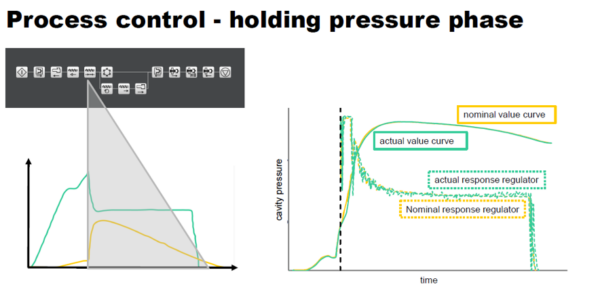
The ReferencePilot uses sensors to control the injection molding process during the holding-pressure phase from the switch-over point (left image, green actual-value curve). The mould cavity pressure curve of a good part serves as a nominal value reference (right image, yellow curve). Image courtesy of Arburg.
To ensure consistent mold-cavity filling, Arburg offers a function called “position-regulated screw.” This function adapts filling to the flow-path requirements in several stages through speed-regulated screw movement.
Dr. Thomas Walther, director of process development at Arburg, compares this screw-movement control to a driver-assistance system. “This concept can be compared to a driving assistant for cars: if the movement deviates from the programmed speed due to disruptive influences (here, for example, variations in the viscosity of the plastic melt), it is regulated in a way that ensures that the distance is still covered in the allotted time,” he explains.
Active acceleration and dynamic braking compensate for disruptive influences. Therefore, the machine feeds a constant amount of melt into the cavity. This dynamic control helps prevent pressure peaks and overfilling.
The system also considers short-term influences during holding pressure. A sensor inside the mold, placed as close as possible to the sprue, measures the holding-pressure curve in real time. Then, the ReferencePilot uses the nominal reference curve of a good part as the basis for active regulation.
“The way it works is comparable to autonomous driving: even with GPS and a known route, a vehicle still needs additional active sensors to be able to move safely in road traffic. This is the only way to detect unforeseen bumps, road works or other road users, for example,” explains Dr. Walther.
Autonomous Process Adjustment
The software receives real-time mold-cavity pressure signals from the sensor. Therefore, it can quickly counteract disruptive influences and actively balance pressure variations. This enables ReferencePilot to regulate the internal pressure curve from the current actual value to the desired nominal value.
When processors use ReferencePilot for control, the system adjusts pressure conditions in the mold from shot to shot. It raises the actual value to the nominal value and keeps the process aligned with the reference curve. As a result, processors achieve constant shot weight and consistently high part quality without manual intervention during process parameterization.
Arburg also offers another closed-loop control option through the aXw Control RecyclatePilot function. This function controls the injection process using data from the standard machine sensor system. Therefore, processors do not need additional sensors. The function balances short-term variations from shot to shot.
The RecyclatePilot analyzes injection behavior, detects distinctive points and deviations, and keeps the injected volume constant. If necessary, it adjusts the switchover point at short notice. It can also adjust the dosing volume to make the overall process more stable over time.
“Knowledge and experience on the part of the user are still crucial to determining which concept will deliver good results for which process. In future, overarching, AI-supported methods could provide additional assistance here,” states Dr. Walther.

Laura Florez is a mechanical engineer and holds a PhD in plastics processing. She has worked as an editor in the plastics industry for over 25 years and has experience in research, training, and consulting. Her main fields of expertise are injection molding and plastics recycling.