
Carbon Black Pigments Create New Recycling Compliance Challenges

Carbon black pigments limit NIR sorting, raising recyclability, compliance, and cost challenges for black plastic packaging.
Carbon black remains the dominant pigment in plastic packaging. It delivers opacity, UV resistance, and cost efficiency. However, it creates a critical limitation in plastics recycling systems. Material recovery facilities depend on near-infrared sorting to identify polymers.
Black packaging appears across food, personal care, and household applications. Each undetected unit lowers overall system efficiency. This issue no longer sits at the material level. It now affects system-wide recycling performance and recovery targets.
You can also read: New BASF Black Pigment for Cars
Carbon black absorbs infrared radiation, preventing polymer detection. Sorting systems fail to identify black plastics and remove them from recycling streams. Data from Resources, Conservation & Recycling confirms that NIR systems cannot reliably detect carbon-black-filled polyolefins. This limitation reduces sorting yield and increases landfill rates. It affects packaging that recyclers could otherwise process.
Regulatory Frameworks Redefine Material Acceptability
Regulators and industry bodies now treat detectability as a design requirement. RecyClass classifies carbon-black packaging as non-recyclable under current. The APR Design Guide discourages its use in rigid packaging streams.
These frameworks influence design specifications across global FMCG supply chains. The EU Packaging and Packaging Waste Regulation links recyclability performance to extended producer responsibility fees. Non-detectable packaging increases compliance costs and financial exposure.
Pigment selection now influences the total cost of ownership. Carbon black creates downstream cost penalties despite a low upfront cost. Engineering teams must align formulation decisions with regulatory and system constraints.
Material Innovation Addresses Detection Constraints
Material suppliers have introduced NIR-detectable black pigments. Companies such as BASF developed alternative chemistries that enable infrared reflectance and polymer identification.
These pigments allow black packaging to re-enter sorting streams without major design changes. However, these solutions introduce trade-offs. Detectable pigments increase formulation costs and may affect color consistency.

Conventional carbon black prevents near-infrared (NIR) detection, while NIR-detectable black pigments enable polymer identification and sorting. These alternative chemistries restore recyclability of black plastics but introduce cost and formulation trade-offs. Courtesy of DIC.
They may also require processing adjustments during compounding and conversion. Pigments also influence recycling performance. Research in Polymers shows that additives affect melt flow index and mechanical properties after reprocessing. Additive accumulation across recycling loops accelerates material degradation and property variation.
System Solutions Versus Design Adaptation
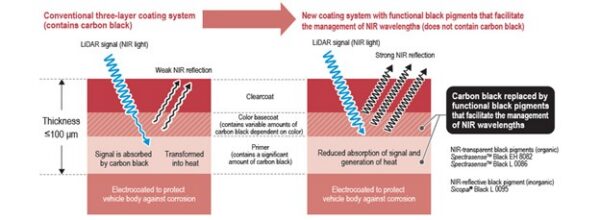
Comparison of conventional carbon-black coatings, which absorb NIR signals and hinder detection, versus functional black pigment systems that reflect NIR wavelengths and enable material identification. These coatings support improved sorting performance but require changes in formulation and system integration. Courtesy of DIC.
Advanced sorting technologies continue to evolve. Digital watermarking initiatives such as HolyGrail 2.0 enable precise identification regardless of color.
Pilot studies show improved sorting accuracy under controlled conditions. However, large-scale deployment requires infrastructure investment and system integration. Most regions lack the capability to implement these technologies at scale in the near term. As a result, companies prioritize design adaptation. Many shifts toward transparent or lightly colored packaging formats. This approach improves compatibility with existing recycling systems and reduces operational risk.
Recyclability Now Defines Material Selection
Carbon black once optimized cost and aesthetics in plastic design. It now limits recyclability and increases compliance risk. Material selection must reflect system constraints, not only formulation performance.
Engineers and decision-makers must evaluate pigments based on detectability, regulatory impact, and recycling quality. Companies that integrate end-of-life performance into design will improve compliance outcomes and material circularity.

Mariana Holguin is a mechanical engineer with a master’s degree in finance. She specializes in the financial and strategic analysis of engineering projects, with experience evaluating capital investments, supply chain economics, and FP&A across industrial sectors.
While the article correctly notes the historical challenges that carbon black pigments have posed for conventional near-infrared (NIR) sorting systems, it overlooks the significant advances in detection and sorting technologies that have emerged in recent years. Today, NIR-detectable black pigments, hyperspectral imaging, AI-assisted optical sorting, tracer-based technologies, and digital watermarking systems are capable of identifying and separating black plastic materials that were previously difficult to detect. The issue is therefore no longer whether carbon black-containing materials can be detected, but rather the pace at which these newer technologies are being adopted throughout the recycling infrastructure. Carbon black continues to provide important performance benefits, including UV protection, durability, opacity, and cost efficiency, making it an important material choice for many applications. A more balanced assessment would recognize that advances in sorting technology are increasingly enabling the recovery of black plastics while preserving the functional advantages of carbon black, and that continued investment in modern recycling systems may be a more effective path than discouraging the use of a material that remains valuable from both a performance and economic standpoint.
Thank you, Gary! I really appreciate your perspective. I agree that sorting technologies have evolved significantly, and that’s an important part of the conversation.The article’s intention was not to suggest that carbon black is inherently unrecyclable, but rather that its compatibility with recycling systems depends heavily on the detection and sorting infrastructure available. As you mentioned, NIR-detectable pigments, AI-assisted sorting, and digital watermarking are creating new opportunities to recover black plastics while maintaining their performance benefits. The real challenge now is finding the right balance between performance, cost, infrastructure, and recyclability. Great point!