
BTX Aromatics Drive High-Performance Resins and Polymers
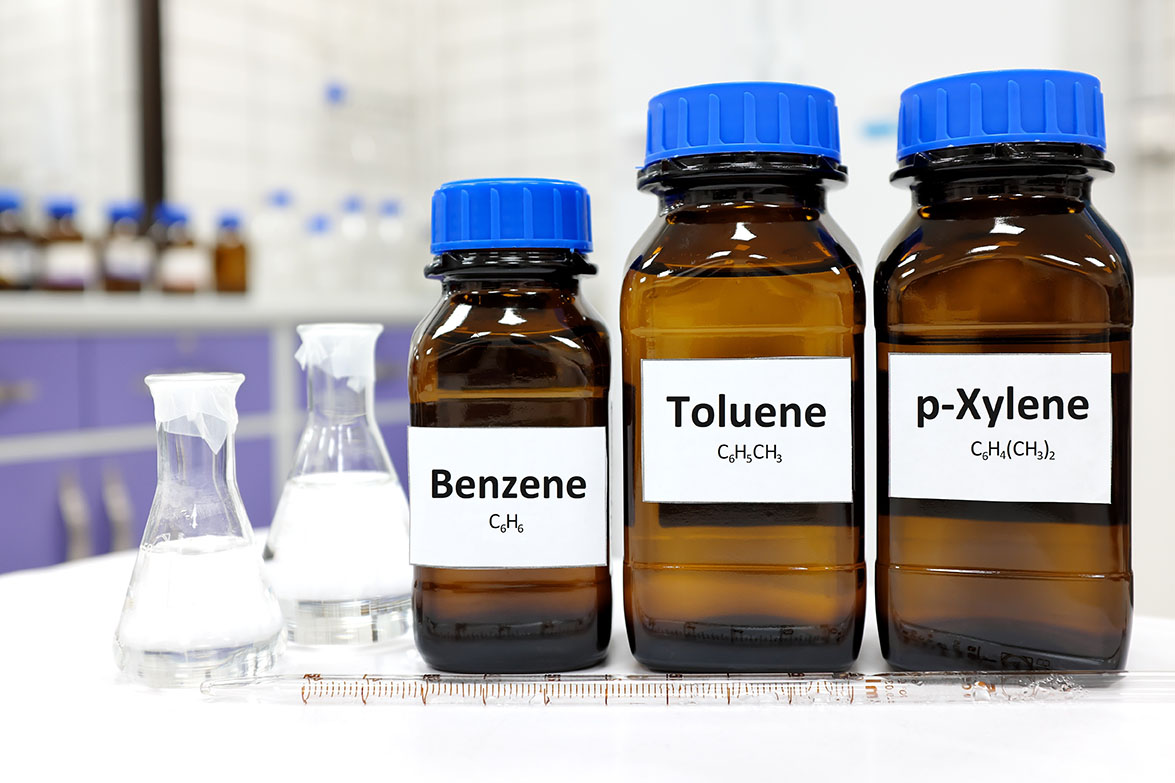
BTX aromatics provide key building blocks for resins, polyesters, polyamides, and high-performance plastics.
The BTX aromatics, benzene, toluene, and xylenes, are basic hydrocarbons characterized by their six-carbon ring structure. This structure gives them distinctive chemical stability. That is why BTX compounds serve as the starting platform for many engineering polymers. It is the benzene ring that provides rigidity, thermal stability, and resistance to oxidation; qualities that aliphatic chains cannot match. In industrial practice, it is not only volume that matters but also the ability to pursue selective pathways toward high-margin monomers.
You can also read: Inside Materials – Kevlar.
Introduction to BTX Production
Crude oil provides almost all aromatics; however, coal produces small quantities. The most important industrial route for BTX production is the catalytic reforming of naphtha, also known as the platforming process. This accounts for 70% of the global supply of BTX. Some modern facilities use technologies such as CCR platforming to create aromatic rings from paraffins and naphthenes. Refineries achieve this through dehydrogenation, dehydrocyclization, and isomerization processes using bifunctional catalysts. This route dominates because it combines high conversion with hydrogen recovery.
Other emerging methods include the Cyclar process, which directly converts LPG into high-purity liquid aromatics. There are also methods that use gallium-aluminum-silicate catalysts to aromatize light alkanes such as propane. More specifically, Parex-type adsorption systems allow for the recovery of p-xylene with higher yield and purity than crystallization. Other secondary methods utilize byproducts from ethylene plants, such as pyrolysis gasoline (pygas). To a lesser extent, producers also use the coal-to-aromatics and methanol-to-aromatics routes.
Processing of Resins, Polyesters, and Polyamides
Manufacturers convert aromatics into specific monomers to produce high-performance polymers. Benzene is a versatile building block for more than 250 products. It serves as the starting point for polyamides (nylon 6 and 6,6) via cyclohexane, phenol, and adipic acid. Meanwhile, manufacturers use toluene in the production of toluene diisocyanate (TDI), a precursor to polyurethanes. On the other hand, producers oxidize p-xylene to terephthalic acid or dimethyl terephthalate (DMT). These are the precursors to polyethylene terephthalate (PET) and polyester fibers. Meanwhile, manufacturers use m-xylene to produce isophthalic acid, which they use in specialized PET resins. For applications with higher thermal demands, manufacturers use naphthalene derivatives such as 2,6-DMN to produce polyethylene naphthalate (PEN). The latter is a polyester with improved barrier properties and dimensional stability.
In high-performance resins, manufacturers use benzene to produce phenol, the basis of phenolic and epoxy resins. These resins exhibit excellent adhesion and chemical resistance. Manufacturers use toluene, on the other hand, in the manufacture of toluene diisocyanate (TDI), a precursor to polyurethanes. Likewise, manufacturers can oxidize durene (1,2,4,5-tetramethylbenzene) to form pyromellitic dianhydride (PMDA). This raw material is essential in the production of polyimides, high-performance plastics with high thermal resistance.
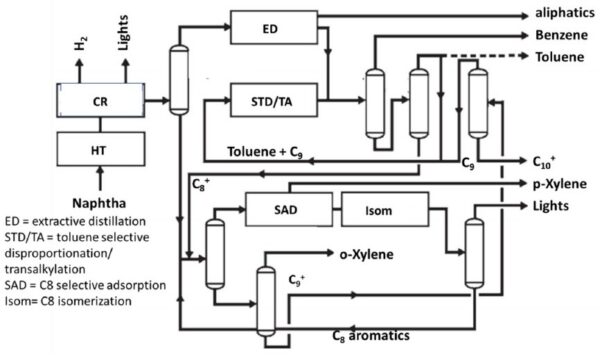
Catalytic reforming and aromatization processes to produce BTX from naphtha and light hydrocarbons. Courtesy of Production of Gasolines and Monocyclic Aromatic Hydrocarbons: From Fossil Raw Materials to Green Processes.
Technical Aspects: Rigidity and Thermal Stability
The incorporation of aromatic rings into the polymer chain drastically alters its physical properties. First, the structural rigidity of the aromatic rings restricts segmental rotation within the chain. As a result, the glass transition temperature (Tg) and heat deflection temperature (HDT) increase. For instance, polyethylene naphthalate (PEN) exhibits greater heat resistance than conventional PET. Meanwhile, phenolic resins with suitable fillers can withstand temperatures up to 185 °C.
In terms of mechanical strength and dimensional stability, aromatic derivatives provide higher elastic modulus, toughness, and wear resistance. Consequently, they are suitable for manufacturing parts such as nylon gears, maintaining their shape under mechanical load and temperature. Furthermore, the presence of aromatic rings significantly improves fire resistance and stability against oxidation. The reason is that these structures are more rigid and less susceptible to thermal degradation. In this context, phenolic resins stand out as protective barriers in insulation applications and mechanical components. Additionally, polyimides excel due to their stable behavior at extreme temperatures. For its part, nylon combines good resistance to wear and chemical agents. Better yet, these materials form a charred layer during combustion, which helps reduce flame spread.
Industrial Applications
These materials have critical applications across various sectors due to their superior properties:
- Automotive and aerospace: Engineering plastics for engines, housings, and high-strength components, including nylon and polyimides.
- Electronics: Epoxy resins for electrical laminates, polyimides, and polycarbonates for high-performance components.
- Consumer goods: PET dominates in lightweight recyclable packaging and textile fibers, while polyester leads the way in synthetic fibers.
- High-performance applications: Engineers use PEN when they require greater thermal resistance and mechanical stability than PET provides.
- Defense: Materials such as polyimides are essential due to their extreme heat resistance.
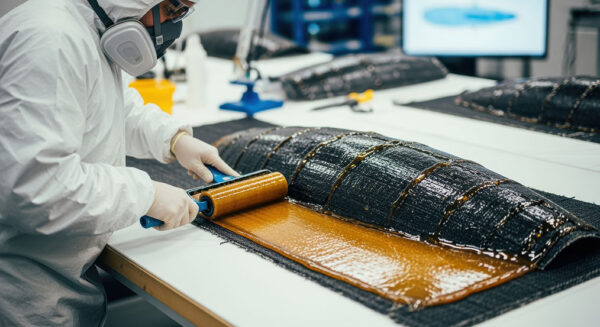
Special Resin application to pre-impregnated composite sheets forming the low radar signature naval mine shells.
Industry Transition and Challenges
Today, industry faces the challenge of transitioning toward diversification and sustainability using renewable resources. A growing trend is the development of catalytic pathways for the selective conversion of biomass and lignin into value-added aromatics. This integrates with CO2 capture processes, which, together with green hydrogen, produce para-xylene in a sustainable manner. The most attractive method or route is the direct alkylation of benzene and toluene.
The future challenge lies in designing more robust and selective catalysts that enable the cost-effective synthesis of advanced monomers. At the same time, these catalysts must maintain profitability in the face of the global oversupply of conventional BTX. This oversupply is forcing a transition from fuel producers to suppliers of high-margin specialty chemicals.
In this context, the optimization of catalysts using artificial intelligence and the development of more efficient processes for isomer separation, such as the Parex process versus crystallization, will be decisive. At the same time, the market for heavy aromatics, such as durene and naphthalene, is expanding to meet the demand for plastics with more demanding thermal specifications.

Carlos Ruidiaz is a mechanical and aeronautical engineer with experience in fluid systems design for Aero-Propulsion, Oil & Gas, and Power Generation.