
New Report Highlights Why Communication Is Becoming a Core Engineering Skill
Study analyzes nearly one million words from 200 engineering leaders, founders, and STEM professionals.
As engineering projects become more complex, cross-functional, and fast-moving, technical expertise alone is no longer enough. A newly released State of Technical Communication report shows that communication is increasingly a key driver of engineering performance, innovation, and leadership effectiveness.
The report synthesizes insights from approximately 200 Teach the Geek podcast transcripts, totaling nearly one million words of qualitative data. Researchers used pattern recognition, thematic clustering, narrative analysis, cross-interview comparison, and recurrence frequency estimation to identify common experiences and communication challenges described by engineers, technical leaders, founders, and STEM professionals.
What the Research Found
One conclusion appeared repeatedly across interviews:
Technical expertise enables engineers to solve problems, but communication skills determine whether those solutions influence decisions, gain organizational support, and create measurable business impact.
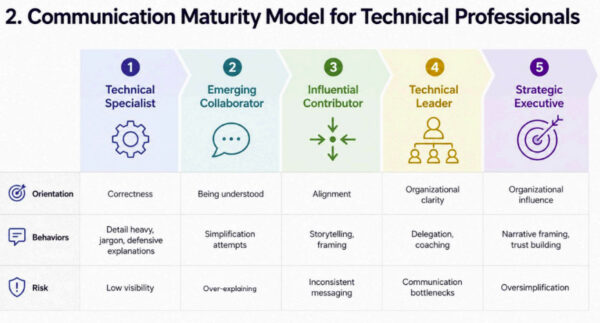
Communication Maturity Model for Technical Professionals. Courtesy of Teach the Geek.
Participants across industries and career stages described many of the same challenges:
Explaining complex technical concepts to nontechnical audiences
Presenting recommendations to executives
Aligning cross-functional teams
Leading through organizational change
Communicating confidently in high-visibility situations
Why This Matters for Plastics Engineers
For plastics engineers, these findings are especially relevant. Whether introducing a new polymer, defending a material selection, presenting test data, implementing process improvements, or leading sustainability initiatives, success often depends on how effectively technical information is communicated to colleagues, customers, suppliers, and decision-makers.
In many organizations, engineers who can clearly connect material performance, processing data, cost implications, and business objectives are often the ones who gain influence and move into leadership roles.
Growing Importance of Technical Communication in Engineering Leadership
The report reinforces a broader trend across manufacturing and engineering: communication is becoming a core engineering competency, not an optional professional skill.
As companies invest in advanced materials, automation, sustainability, and digital transformation, engineers are increasingly expected to collaborate across disciplines and communicate with stakeholders who may not share the same technical background.
For plastics professionals, stronger communication skills can improve project alignment, accelerate decision-making, reduce misunderstandings, and help translate technical innovation into real-world results.
More Insights
Insights from the State of Technical Communication Report show that clarity, framing, and audience‑aligned communication help engineers reduce rework, improve cross‑functional alignment, and increase the visibility of their technical work. This complimentary, upcoming SPE webinar gives engineers practical strategies to translate complexity without oversimplifying, strengthen executive and customer communication, and build the leadership presence needed in high‑stakes technical environments.

Plastics Engineering keeps plastics professionals worldwide up to date on the latest trends and innovations in materials, equipment and process technologies that impact all aspects of product development and applications in the plastics industry.