
Waste Coffee Grounds as an Additive for Flame-Retardant Films
As an additive in polylactide (PLA) biocomposite films, spent coffee grounds (SCG) can improve flexibility and toughness while preventing combustion.
Bio-Based Additives for Sustainable and Effective Flame Retardants
PLA is a widely used bioplastic, but it is brittle, flammable, has low crystallinity, and has a slow crystallization rate. Plasticizers that serve as multifunctional additives can enhance PLA’s toughness while addressing these limitations. Increasing PLA’s flame retardancy is a critical area of research, as it is highly flammable. Primarily composed of lignocellulosic materials, bio-based additives can enhance flame inhibition, suppress melt dripping, and promote self-extinguishing behavior in PLA.
You can also read: Upcycling Coffee Grounds: A Packaging Alternative.
Spent Coffee Grounds as a Flame Retardant
One source for bio-based additives is SCGs. SCGs, the solid waste generated during coffee brewing, are a major byproduct of the coffee industry. When used as biodegradable additives or fillers, this material can enhance mechanical properties and reduce production costs for polymer composites. Additionally, they can interact with flame retardants to form intumescent flame retardant (IFR) systems, improving the flame retardancy of PLA. Coffee oil, found in SCGs, also acts as a natural plasticizer, further increasing toughness and reducing brittleness of PLA composites. A recent study explored how SCGs, in tandem with phosphate-based plasticizers, enhance the mechanical properties and heat resistance of PLA.
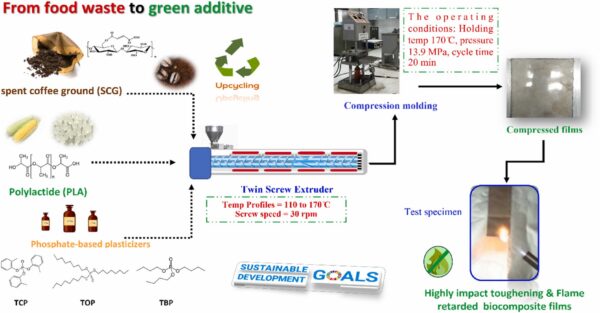
Researchers developed biocomposite films with added plasticizers and SCGs. Figure courtesy of Upcycling spent coffee grounds as a sustainable additive for superior impact-resistant and flame-retardant polylactide biocomposite films.
Effect of Plasticizer
Researchers produced film samples with varying loadings of tricresyl phosphate (TCP), tributyl phosphate (TBP), and trioctyl phosphate (TOP). These phosphate-based plasticizers should enhance the material’s flexibility, toughness, flame inhibition, and anti-dripping behavior. Mechanical, thermal, morphological, and flame-retardant studies showed TCP and TBP performed success as multifunctional additives for PLA film. The final biocomposite film comprised 10 phr SCG and 20 phr TBP, with both additives playing crucial roles in performance. Reactive flammable gases, offering a dilution effect, and char, inhibiting heat and oxygen transfer, allow for anti-dripping and self-extinguishing behaviors.
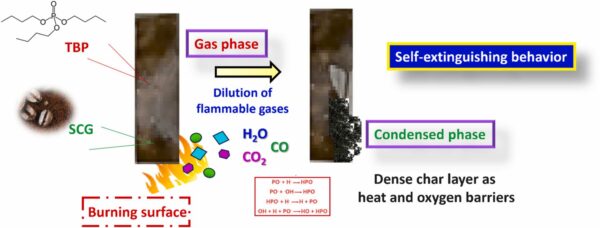
TBP and SCG both contribute to the flame inhibition properties of the PLA biocomposite film. Figure courtesy of Upcycling spent coffee grounds as a sustainable additive for superior impact-resistant and flame-retardant polylactide biocomposite films.
How the Flame Retardant Functions
During thermal decomposition, TBP releases phosphoric acid molecules, thus producing active radicals. Then, active molecules capture other high energy radicals during combustion, converting them into lower energy molecules (e.g., HPO and HPO2). This inhibits continuous combustion. Then, the phosphoric acid molecules interact with PLA’s hydroxyl groups, producing water vapor and polyester polyols. A stable char forms as the polyols break down, serving as a heat barrier. SCG is a carbon source, accelerating the formation of char to stop fire propagation.
This material is an example of how bio-derived additives can increase the performance of biocomposites. Increasing the fire resistance of PLA can expand its applications for industries such as automotive and electronics.

Having studied Geology, Julienne Smith focuses on environmentalism, sustainability, and the policies that impact plastics professionals today. As a technical writer, she is passionate about the intersection of science, technology, and communication. In her free time, she loves learning new things and writing fiction.