
Robotic Ultrasonic Welding Scales Fuselage Assembly
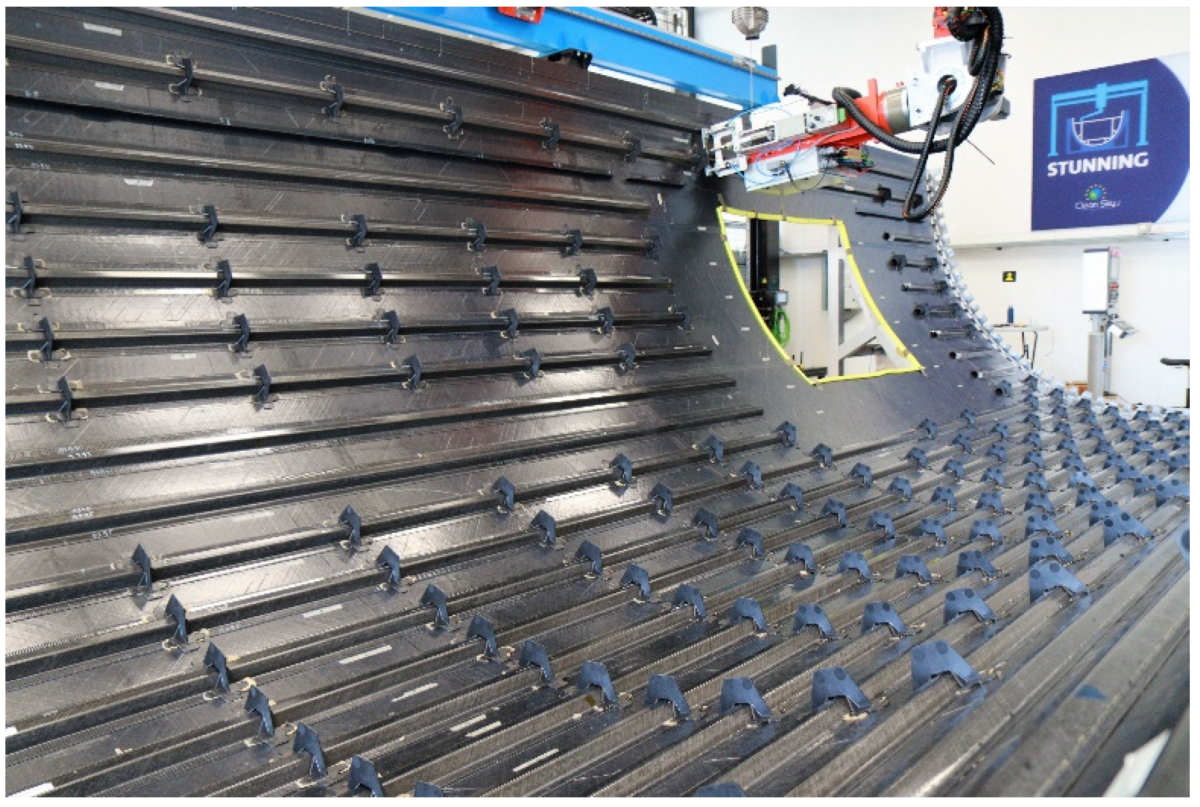
Engineers leverage ultrasonic welding to assemble full-scale thermoplastic fuselages, eliminating mechanical fasteners and cutting cycle times.
Aerospace engineers face massive bottlenecks when utilizing traditional mechanical fasteners to assemble large-scale aircraft structures. To solve this problem, manufacturers leverage robotic sequential ultrasonic welding. This innovative process converts high-frequency, low-amplitude mechanical vibrations from a specialized sonotrode into intense, localized heat. The system focuses on frictional heating at the interfaces and viscoelastic heating directly within the composite matrix. By precisely directing this thermal energy, aerospace technicians permanently fuse structural thermoplastic composites without a single rivet.
You can also read: Welding Wood-Plastic Composites.
Precise Heat Control
Engineers control this rapid heating using a specialized feature called an energy director. Designers mold these discrete geometric protrusions directly onto the mating surfaces of the composite parts. Manufacturers frequently utilize 0.2 mm-high triangular ridges possessing a 90º apex. The energy director intentionally features a lower stiffness than the surrounding bulk composite structure. When the robotic sonotrode applies its 20 kHz frequency and exactly 65.8-micrometer peak-to-peak amplitude vibrations, this localized lower stiffness forces the energy director to undergo an increased cyclic strain. This targeted strain concentrates all heat generation exactly at the weld interface. The thermal energy rapidly melts the thermoplastic, facilitating deep molecular bonding before the surrounding composite matrix degrades. This precise thermal control allows aerospace manufacturers to ensure repeatable bonds across massive structural components.
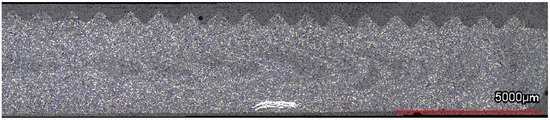
Longitudinal cross-section micrograph of a SF CF/LMPAEK coupon. The triangular ridges molded during panel production (visible at the top of the image) act as an energy director during welding. Courtesy of Robotic Sequential Ultrasonic Welding of Thermoplastic Composites: From Coupons to a Full-Scale Fuselage Demonstrator
Ultrasonic Joint Performance Metrics
To optimize robotic assembly pipelines, developers map specific operating parameters across different material configurations. Technicians trigger sonotrode using an 850 N force for short-fiber-to-unidirectional (SF-to-UD) composite welds.
| Performance Metric | SF-to-UD Single Spot | SF-to-UD Multi-Spot |
| Weld Vibration Time | 800 ms | 1400–1550 ms |
| Ultimate Failure Load | 5270 ± 200 N | 8914 ± 420 N |
Performance comparative between Single and Multi Spot Welding. Adapted from Robotic Sequential Ultrasonic Welding of Thermoplastic Composites: From Coupons to a Full-Scale Fuselage Demonstrator
Reviewing these comparative metrics reveals clear structural advantages for industrial manufacturers. Robotic sequential ultrasonic welding produces composite joints exhibiting comparable load-carrying capabilities to mechanically fastened joints. Furthermore, the ultrasonically welded assemblies provide higher joint stiffness, experience lower secondary bending forces, and resist peel stress effectively. Structural failure within these assemblies’ results in highly localized damage, preventing widespread delamination. The total cycle time per weld averages only ten seconds. This cycle includes a critical 6 to 10 seconds consolidation hold, during which the system applies 800 N of constant force to dissipate internal heat safely before releasing the robotic clamp.
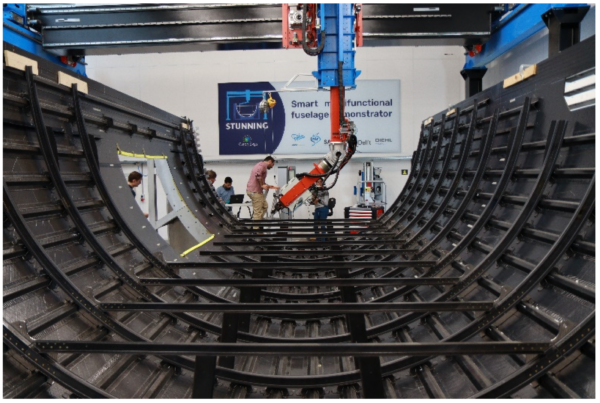
The lower shell of the MFFD demonstrator after welding the frames to the clips. Courtesy of Robotic Sequential Ultrasonic Welding of Thermoplastic Composites: From Coupons to a Full-Scale Fuselage Demonstrator.
Resistance Welding for Hybrid Structures
While ultrasonic systems excel at rapid thermoplastic joining, engineers deploy resistance welding to fuse complex hybrid composite structures. This alternative process utilizes an embedded heating element, such as a metal mesh or carbon nanotubes, placed between the mating surfaces. Technicians pass an electrical current through this embedded element to generate heat, melting the surrounding polymer matrix rapidly. Resistance welding empowers manufacturers to join dissimilar materials seamlessly, creating robust bonds between thermoplastics, thermosets, and metal components. By integrating this highly automated process, production facilities reduce overall manufacturing costs by up to 40%. To overcome electrical leakage and metal corrosion bottlenecks, material scientists actively replace traditional metal meshes with advanced carbon nanotube elements.
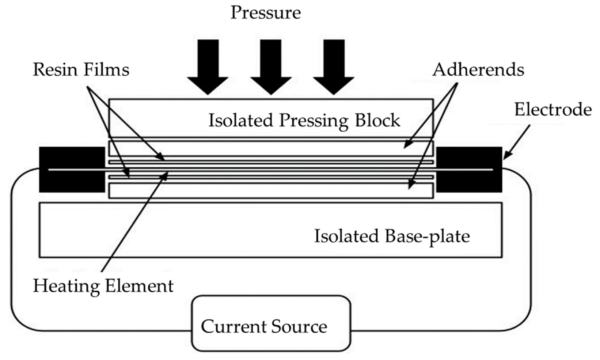
Schematic of resistance welding setup. Courtesy of Resistance Welding of Thermoplastic Composites, Including Welding to Thermosets and Metals: A Review.
Advanced thermoplastic welding fundamentally transforms modern aerospace manufacturing. By leveraging both ultrasonic vibrations and electrical resistance heating, structural developers bypass the severe weight, cost, and labor constraints characterizing legacy mechanical fasteners. Engineers successfully validated ultrasonic techniques on an eight meter long European Union Clean Aviation fuselage section, executing exactly 1696 spot welds to mate structural clips securely. As industrial automation expands globally, these localized thermal fusion processes provide production teams with the ultimate scalable toolkit to manufacture exceptionally durable, multi-material aircraft at unprecedented speeds.

Andres Delgado is a mechanical engineer specializing in design and quality assurance, with experience in precision seal design, turbomachinery maintenance, and orthopedic medical devices. He currently works as a Design Quality Engineer focused on New Product Introductions for knee implants and compliance with advanced manufacturing standards.