
Recycled Cobalt Pigment Adds Color and Flame Retardancy to PLA
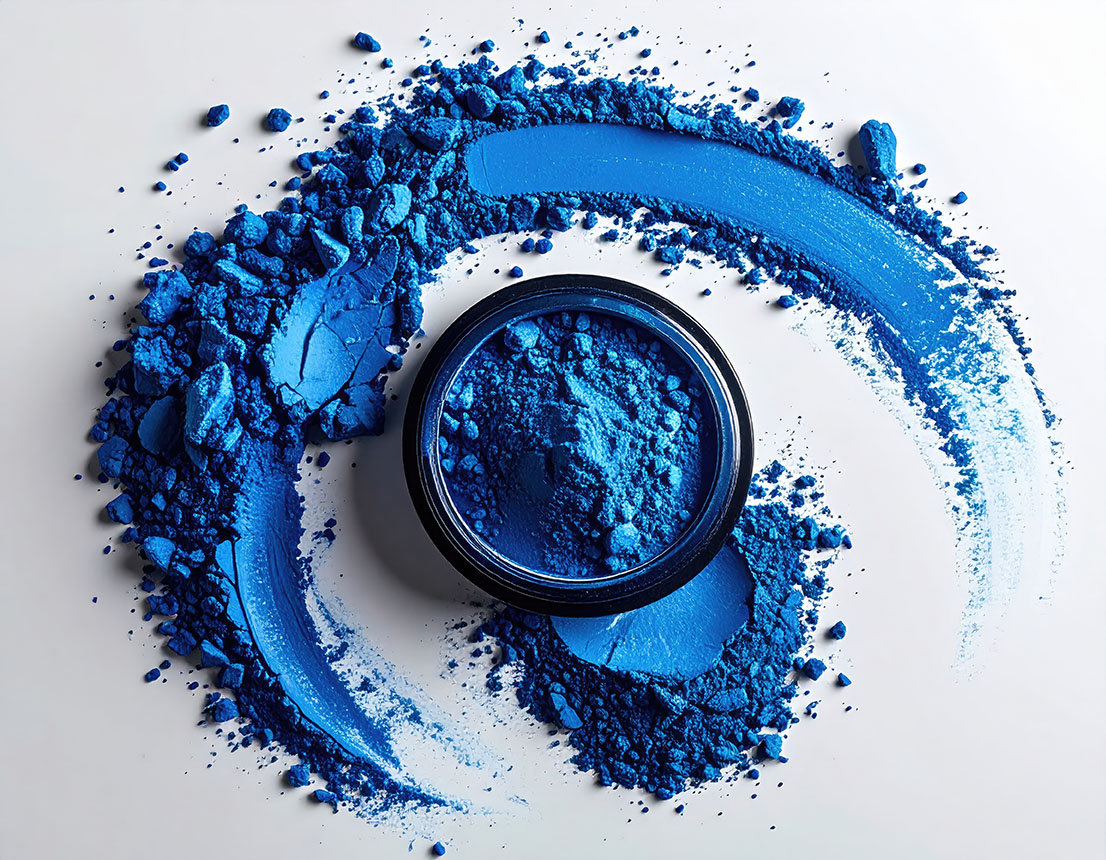
Researchers synthesized a cobalt aluminate pigment (CoAL2O4) that acts as both a flame retardant and colorant in polylactide (PLA).
Recently, researchers developed a method for synthesizing a stable blue cobalt pigment using aluminum from recycled can seals. The resulting material, CoAL2O4, has a spinel form, which allows insertion of chromophore ions. Insertion of these ions provides intense color, high thermal stability, and chemical resistance. The strategy is based on doping metal oxides with chromophore ions and transition metals. Thus, it is easy to control the pigment’s chemical composition.
You can also read: Setting the Tone with Functional Pigments
Supporting Circular Flame-Retardant Additives
Composite metal oxide pigments, which have multiple metal constituents, exhibit significant benefits over single metal oxides. With superior opacity, thermal stability, infrared properties, and weather- and chemical-resistance, they are beneficial for a variety of applications. One such composite metal oxide pigment, cobalt aluminate, has flame-retardant properties and provides an intense blue pigment.
In a recent study, researchers adapted the cobalt pigment into a brightly-colored flame retardant for PLA. This sustainable additive, synthesized from recycled materials, aligns with circular economy principles. Furthermore, researchers see this PLA composite as a candidate for three-dimensional (3D) printing applications.
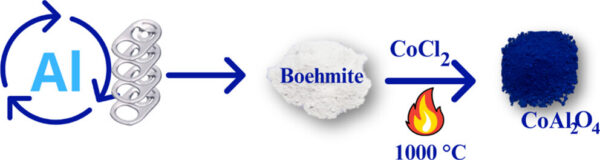
Researchers tailored the CoAL2O4 pigment for use as a flame retardant. Figure courtesy of Two in One: Recycled Cobalt Aluminate as a Pigment and Synergistic Flame-Retardant Agent for Polylactide.
Synthesizing Cobalt Aluminate from Recycled Materials
Researchers recycled aluminum can seals using hydrochloric acid to form a solution containing Al3+ ions. Then, they added sodium hydroxide (NaOH) to the solution to obtain boehmite. They obtained blue aluminates from the boehmite combined with Co2+ and Ni2+ ions calcinated at 1000 °C. The pigment’s color depends on the coloring ion when absorbed by boehmite. Thus, for this application, researchers used 20% (w/w) of the coloring ion, Co2+ for an intense blue pigment. Researchers produced samples of neat PLA, PLA blended with ammonium polyphosphate (PLA@APP422), and PLA with APP422 and CoAl2O4 (PLA@APP@CoAl2O4).
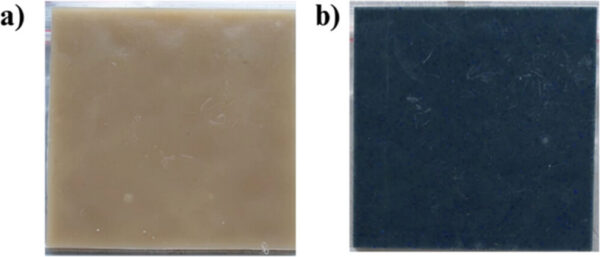
Researchers fabricated sample plates of neat PLA, PLA@APP (a), and PLA@APP@CoAl2O4. Figure courtesy of Two in One: Recycled Cobalt Aluminate as a Pigment and Synergistic Flame-Retardant Agent for Polylactide.
Thermal Stability and Fire Properties
Using thermogravimetric analysis, researchers evaluated the fire performance of the PLA@APP@CoAl2O4 composite. Neat PLA exhibits a one-step thermal decomposition, whereas PLA@APP decomposes in two steps, forming a char. In PLA@APP@CoAl2O4, the final residue during thermal decomposition was higher than PLA@APP, indicating an interaction between the components. This increased char results in better thermal stability than PLA with APP422 alone. The charred layer rapidly covers the entire burning plate during Mass Loss Cone (MLC) calorimetric testing.
The resultant blue pigment is thermally stable up to 1,000 °C. In PLA@APP@CoAl2O4, it enhances quality and thermal stability of decomposition residue and avoids thermal degradation when exposed to fire. This material is an example of sustainable material development for flame retardants, aligning with circular economy principles.

Having studied Geology, Julienne Smith focuses on environmentalism, sustainability, and the policies that impact plastics professionals today. As a technical writer, she is passionate about the intersection of science, technology, and communication. In her free time, she loves learning new things and writing fiction.