
Quantum Pigments Bring Programmable Light to Plastics

Quantum pigments use quantum dots to create purer, brighter, and programmable color effects in plastics, coatings, and masterbatches.
Quantum dots have long attracted attention in electronics, displays, and advanced optics; however, Quantum Light is extending their value into coatings, plastics, masterbatches, and engineered industrial surfaces. The company develops quantum pigments that move beyond passive color reflection by capturing light, converting it, and emitting highly controlled optical responses.
You can also read: Color Coordinates.
Olga Alexopoulou, CEO of Quantum Light, describes this development as the emergence of a new pigment class. While conventional pigments rely on chemical processes to generate color, quantum pigments derive their optical behavior from quantum confinement in nanocrystals. As a result, manufacturers can control color purity, brightness, and spectral behavior with a level of precision that traditional pigment systems cannot deliver.
A New Class of Pigments
Conventional pigments primarily reflect incident light; by contrast, quantum pigments absorb light and re-emit it as highly pure color.
According to Alexopoulou, these materials can produce “laser narrow” emissions, allowing manufacturers to achieve cleaner, more saturated, and more tightly controlled optical outputs.
This spectral control extends across both visible and non-visible wavelengths. Consequently, Quantum Light can tune emissions to specific nanometer ranges, enabling surfaces that combine aesthetic value with functional optical performance. In practice, a plastic component could present a distinctive color to the human eye while also carrying optical information for sensors, robots, or autonomous vehicles.
Where Quantum Pigments Fit

A quantum pigment dispersion emits a saturated red response, highlighting the ability of quantum dots to convert absorbed light into narrow, vivid optical output. Courtesy of Quantum Light.
Quantum Light currently sees the strongest market pull in three application areas, each driven by a distinct performance advantage. First, brands and manufacturers want purer signature colors that remain difficult to replicate. Quantum pigments meet this requirement by producing cleaner, more controllable emissive effects than many conventional colorant systems.
Second, manufacturers seek brighter fluorescence, particularly in color spaces where conventional fluorescent pigments perform poorly. Because quantum dots convert absorbed light into vivid emission, they can expand the available fluorescent palette and improve effects in difficult shades such as dark red.
Third, the company is engineering pigments with more complex optical behavior. Quantum Black, for example, appears black to the human eye but exhibits a subtle red sheen. Quantum Light creates this effect by directing most of the emission into the non-visible infrared range while preserving a small visible red tail. Therefore, luxury and automotive designers can specify finishes that combine depth, exclusivity and optical identity.
Integrating Quantum Dots into Polymers
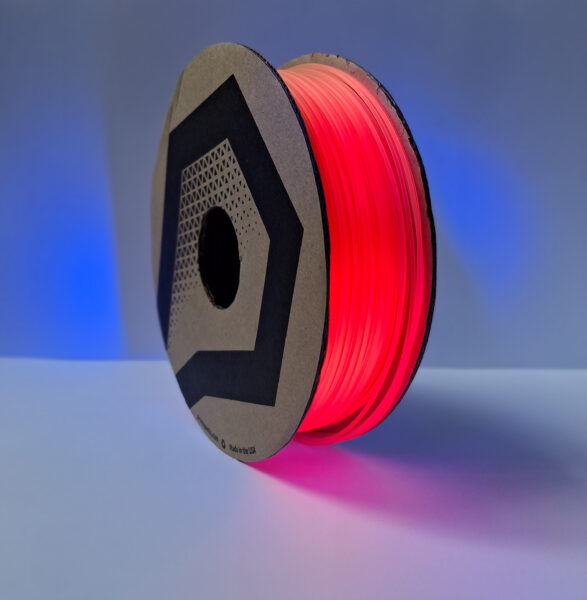
Quantum Light’s red-emissive materials show how nanocrystal-based pigments can bring programmable color effects to plastics, coatings, filaments and masterbatches. Courtesy of Quantum Light.
For plastics processors, additive compatibility remains a critical consideration. Any new colorant must integrate into existing substrates without compromising mechanical performance, transparency or surface finish. Quantum Light addresses this challenge through interfacial engineering. Although quantum dots are inorganic semiconductor nanoparticles, the company coats them with tightly bound molecular ligands whose chemistry can be tuned to match the target polymer.
Because the particles measure only a few nanometers and are typically used at low loadings, often between 0.01% and 1%, they do not significantly alter the mechanical properties of molded or extruded parts. Moreover, their size remains far below the wavelength of visible light, so they do not scatter light significantly when processors prevent aggregation during compounding or conversion.
Moving Toward Commercial Scale
Regulatory compliance also shapes the company’s technology roadmap. Historically, many high-performance quantum dots relied on cadmium-based chemistries, which created barriers for consumer, industrial and design applications. Therefore, Quantum Light focuses on cadmium-free systems, including indium phosphide-based quantum dots, to help customers access quantum color while moving away from restricted materials.
The company is also transitioning from development work toward commercial implementation. Alexopoulou says Quantum Light is working with global players across the plastics value chain, with early applications expected to enter the market this year. Its first product, a quantum 3D printing filament developed with Protoplant, launched in April 2026 and sold out, indicating early demand for programmable optical materials.
The Future of Dynamic Surfaces
Looking ahead, Alexopoulou sees significant potential in materials that reveal emission through motion. She points to textiles, such as a nylon windbreaker, where color and emission shift as the material moves through space. In that type of application, the surface does not simply display color; it creates a dynamic optical experience.
For plastics, coatings and design-led manufacturing, quantum pigments raise a larger technical opportunity. They allow engineers and designers to treat color as a programmable material function rather than a static surface attribute. Ultimately, Quantum Light’s work points toward polymer surfaces that do not merely carry color, but actively control light.

Juliana Montoya is Director of Content for Plastics Engineering. A mechanical engineer with an MSc in materials engineering, she has experience as a sustainability and packaging consultant focused on ecodesign and recycling. Her work centers on technical content for the plastics industry, connecting polymer innovation, manufacturing trends, and sustainability strategy for industry audiences.