
PLA Foam Aircraft Wings Use Nature-Inspired Design

Inspired by the porous bones of birds, these porous materials offer a new design framework for aircraft wings.
Learning from Bird Bone Structures
The bones of flying birds are composed of external shells reinforced by internal cellular microstructures. This structure allows for low density while still retaining sufficient stiffness and strength to carry aerodynamic loads. Similar low-density, high-strength structures have garnered attention in the aerospace, automotive, biomedical, and robotic fields. Cellular structures provide a high stiffness-to-weight ratio while also reducing material use.
You can also read: Designing the World’s Largest Aircraft Through Smart Structural Analysis.
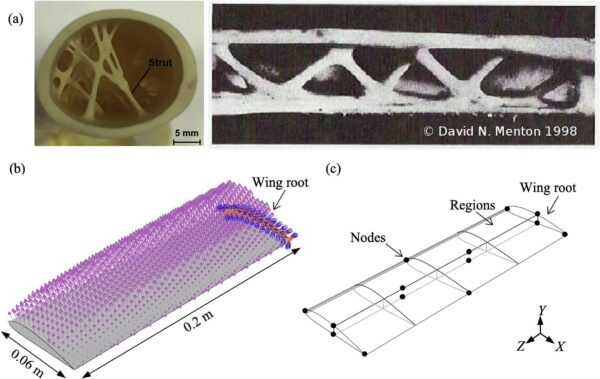
Figure 1 – The internal structure of vulture bones (a) is a source of inspiration for researchers designing aircraft wings. Figure courtesy of Optimization, additive manufacturing, and testing of bird-bone-inspired materials for aircraft wing designs.
Printing Complex Wing Structures
The morphologies of these bird-bone-inspired materials cannot be fabricated using traditional manufacturing methods. Additive manufacturing can overcome these limitations, but printed parts often exhibit anisotropy. Weaker bonding between printed layers than within layers can lead to directional differences in mechanical properties. When designing plastic parts using additive manufacturing, engineers must take this into consideration.
When developing the design and optimization framework for bird-bone-inspired aircraft wings, researchers employed fused deposition modeling (FDM). The printing process significantly influences the mechanical properties of FDM parts. Thus, this framework accounted for anisotropy in these complex cellular lattices and closed-cell foams.
Optimizing the Wing Interior
Researchers chose a small-scale wing geometry based on unmanned aerial vehicle (UAV) designs. Unlike larger aircrafts, small UAVs do not have fuel stored within their wings. Thus, the proposed interior lattice structure is compatible with their functional requirements. The objective of the wing’s design was to minimize structural mass and maximize load-carrying capacity under aerodynamic loading. Researchers accomplished this optimization using the Covariance Matrix Adaptation Evolution Strategy (CMA-ES) optimization algorithm.
The final wing designs comprised internal structures with lattice and foam architectures, each with a different weight factor (WF) combination. These WF combinations represent different design priorities for load carrying capacity and mass minimization. For the lattice architectures, smaller cell sizes and larger strut radii near the wing root increased load carrying capacity. Thinner struts and larger cells, in turn, minimize mass. Foam architectures exhibited comparable properties, with smaller cells and thicker faces for regions subjected to higher loads. Larger cells and thinner faces allowed for a reduction in mass.
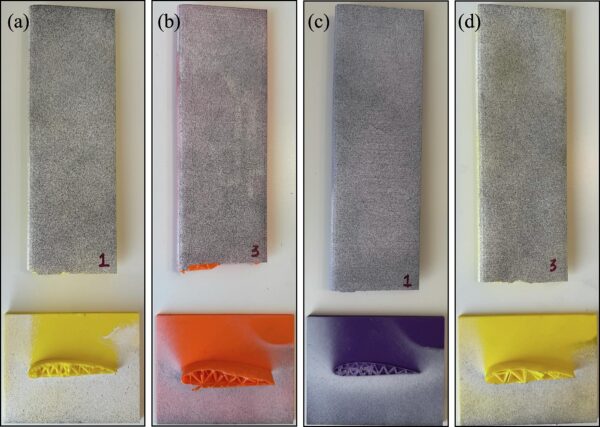
Researchers fabricated the lattice (a and b) and foam (c and d) wings for experimental testing. Figure courtesy of Optimization, additive manufacturing, and testing of bird-bone-inspired materials for aircraft wing designs.
Soaring Towards Enhanced Structural Performance
Both the lattice and foam designs showed an improvement in structural efficiency over a reference foam wing. Optimization improved structural efficiency by 48-54% and 23-37% for the lattice and foam design, respectively. This design eliminates the need for components such as ribs, spars, and stiffeners in aircraft wings. Simultaneously, it enhances or maintains structural performance while offering potential for weight reduction.

Having studied Geology, Julienne Smith focuses on environmentalism, sustainability, and the policies that impact plastics professionals today. As a technical writer, she is passionate about the intersection of science, technology, and communication. In her free time, she loves learning new things and writing fiction.