
Memory Polymers: Preventing Aneurysm Recurrence in Endovascular Care
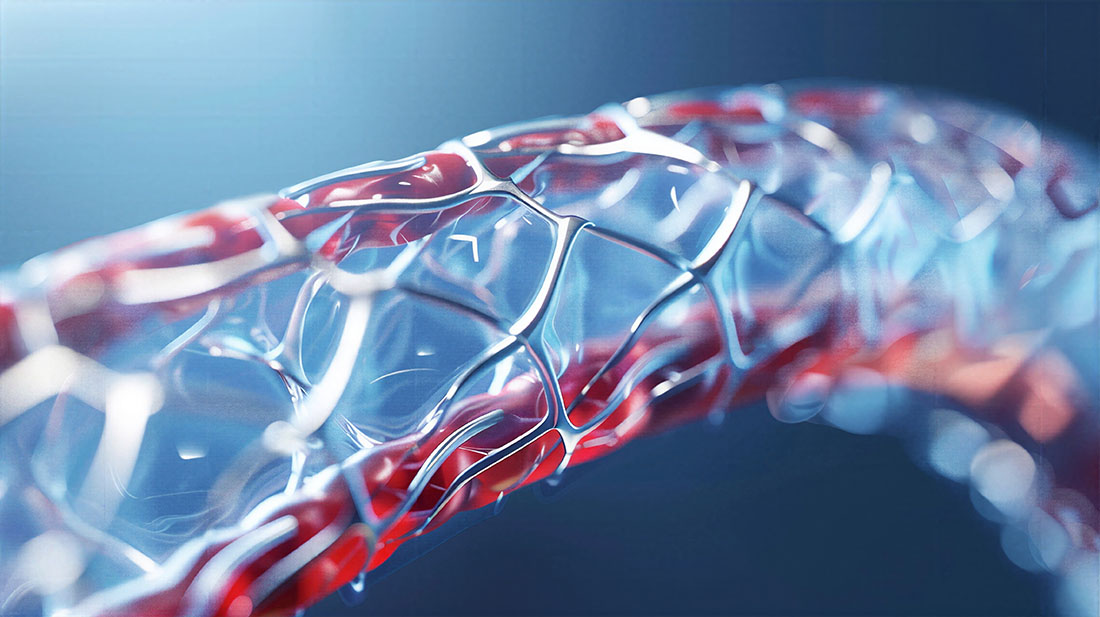
Shape memory polymers expand massively to eliminate aneurysm recurrence. Engineers utilize entropic recovery to optimize endovascular devices.
Surgeons often struggle with bare-metal platinum coils because these traditional devices leave structural gaps. Consequently, aneurysm recurrence rates reach 30%. To eliminate these failures, engineers utilize shape memory polymers driven by entropic recovery. Specifically, material scientists store polymer chain segments in a high-energy, non-equilibrium temporary shape. Then, once surgeons expose the device to body heat, the chains spontaneously reorganize into their thermodynamically preferred, high-entropy original shape.
You can also read: Innovative Hydrogel Coatings for Medical Catheters
Molecular Architecture and Actuation
Engineers build shape-memory polymers using architectures that combine molecular switches and network points. Switches fix the temporary shape as the material undergoes vitrification. Netpoints remember the permanent shape through dipole-dipole interactions, van der Waals forces, or hydrogen bonding. Manufacturers create these structures using either physically cross-linked co-polymers, such as polyurethanes with soft and hard segments, or chemically cross-linked glassy thermosets that rely on reversible covalent bonds.
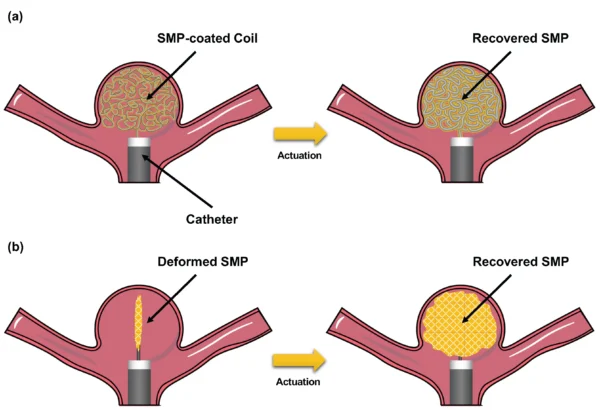
Schematic of two potential approaches to fabricate shape memory polymer (SMP)-based endovascular devices for ICA treatment: (a) SMP-coated coils; and (b) SMP coil-free foams with patient-specific geometries. Courtesy of Shape Memory Polymer-Based Endovascular Devices: Design Criteria and Future Perspective
To ensure safe thermomechanical recovery, developers tune the glass transition or melting temperature to the physiological range of 30–37 °C. Production teams fabricate porous structures using gas-foaming agents or solid-particle leaching. During leaching, technicians dissolve dispersed particles, such as sodium chloride, after curing to create porous gaps. These foams achieve highly interconnected porosities up to 98.8%, facilitating extreme compression for microcatheter delivery.
Overcoming Bare-Metal Limitations
Reviewing these metrics, engineers conclude that shape memory polymers trade raw mechanical strength for superior volumetric performance. Highly porous foams offer substantial expansion, eliminating structural gaps left by metal coils. Although polymer stents exhibit an initial elastic modulus ranging from 15 to 153 kPa for wet foams and up to 3.7 MPa for solid elastomers, their biological interaction compensates.
Bioactive porous polyurethane foams actively promote vascular healing. These materials accelerate neoendothelium formation and deposit collagen directly on the surface without triggering severe inflammatory responses. Researchers note these foams reduce blood-clotting time by 30–40% and increase platelet adhesion by 50%. Furthermore, a 4D-printed PCL-AD-4 vascular stent deployed at 37°C demonstrated a shape fixing ratio of 100% and a recovery ratio exceeding 94%.
| Performance Metric | Shape Memory Polymer (SMP) Devices | Traditional Bare-Metal Devices |
| Embolization Material | Polyurethane foam (e.g., TrelliX) | Bare platinum coils |
| Volumetric Expansion | Expands up to 2.5x original volume | Minimal expansion |
| Aneurysm Occlusion Rate | Complete gap occlusion | 16–30% failure rate |
| Stent Mechanical Profile | Lower radial strength and modulus | Superior strength and fatigue resistance |
| Biological Tissue Response | >95% cell viability; accelerates clotting | Inferior baseline healing response |
Performance metric comparison between SMP and Traditional Bare-Metal Devices. Adapted from Shape Memory Polymeric Materials for Biomedical Applications: An Update and Shape Memory Polymer-Based Endovascular Devices: Design Criteria and Future Perspective
Industrial Endovascular Applications
Device manufacturers are currently evaluating several prototypes for endovascular embolization, with a heavy focus on the TrelliX system. In this design, TrelliX coats traditional embolization coils with highly compressible, shape-memory polyurethane foam. Subsequently, surgeons deliver this device directly into the aneurysm sac utilizing a microcatheter. Once positioned, body heat triggers the foam to expand. As a result, the expanding foam fills all remaining gaps between the metal coils, ensuring complete occlusion. Finally, developers advanced this device into human clinical trials following successful deployments within in vivo rabbit elastase and porcine sidewall models.
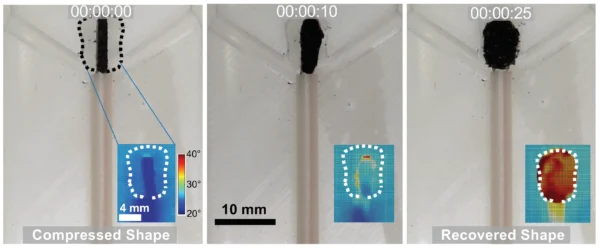
Photos and thermography images (insets) of the shape recovery process of a CNT-infiltrated polyurethane SMP foam. Courtesy of Shape Memory Polymer-Based Endovascular Devices: Design Criteria and Future Perspective
Engineers continue to refine shape memory polymers in order to solve the critical failures of traditional bare-metal endovascular devices. By leveraging entropic recovery and enormous volumetric expansion, developers effectively eliminate the structural gaps driving high aneurysm recurrence rates. Furthermore, bioactive polyurethane foams actively promote vascular healing by accelerating tissue regeneration. As current devices progress through human clinical trials, the medical manufacturing industry is now positioning polymer-based solutions to establish a completely new standard of care.

Andres Delgado is a mechanical engineer specializing in design and quality assurance, with experience in precision seal design, turbomachinery maintenance, and orthopedic medical devices. He currently works as a Design Quality Engineer focused on New Product Introductions for knee implants and compliance with advanced manufacturing standards.