
Core-Shell Flame Retardant Reduces Migration in PA66

Researchers developed a promising solution to prevent flame retardant migration in Polyamide 66 (PA66) while increasing durability.
Halogen-free flame retardants avoid generating the toxic and corrosive gases released by their halogen-containing counterparts during degradation. Nevertheless, they tend to migrate to high-temperature, high-humidity environments. To combat this migration, researchers developed SiR@RF, a core-shell elastic flame retardant. This novel material demonstrated improved fire safety in Polyamide 66 (PA66).
You can also read: Potential of Microencapsulated Flame Retardants.
PA66 has a wide range of uses in the automotive, electrical, and aerospace industries. This high-performance engineering thermoplastic provides good mechanical properties, thermal stability, and chemical resistance. It is inherently flammable, necessitating a solution to improve its fire resistance and enable its use in more applications. Additionally, aluminum diethylphosphinate (ADP) and melamine polyphosphate (MPP) in PA66 can migrate to its surface under certain environmental conditions. This visually alters the material, giving it a white, frost-like appearance.
Encapsulating Flame Retardants
To mitigate migration in PA66, researchers used polymethylsiloxane (SiR) to encapsulate the flame retardants. SiR is thermally stable, hydrophobic, and elastic, with vinyl groups working as cross-linking sites.
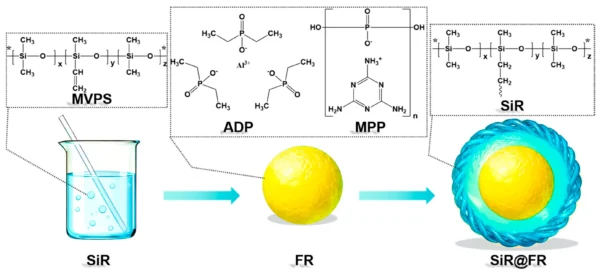
Researchers produced X-SiR@FR samples with an “X” mass fraction of SiR in a mixture of ADP and MPP. Figure courtesy of A Core–Shell Elastic Flame Retardant with Superior Migration Resistance for Fire-Safe and Toughened Polyamide 66.
Using scanning electron microscopy (SEM) and energy-dispersive x-ray spectroscopy (EDS), researchers analyzed the shell’s impact on the flame retardant’s microstructure. In 9-SiR@FR, they observed a significant particle size increase. Particle aggregation indicated that SiR coated the flame retardants surface while also serving as an adhesive between the particles. The shell’s hydrophobicity enabled the agglomerates to form stable contact with the PA66 matrix, hindering migration to the surface.
During thermal decomposition, the SiR provides a physical barrier effect. This material reduced the volatilization of polyphosphoric acid and provided a silicon-based structure. Thus, through mutual support between the cross-linked network from the siloxane framework, it formed a more stable composite char layer.
Adding the flame retardant alone to PA66 reduced its stiffness by approximately 5.8%. Composites with SiR@FR showed greater flexural strength than neat PA66 as well as PA66 with flame retardant alone. Additionally, SiR@FR significantly enhanced impact strength.
Preventing Blooming Behavior
SiR@FR demonstrated improved mechanical properties in the PA66 composites. Furthermore, an accelerated aging test confirmed that the SiR shell significantly suppressed flame retardant migration. Researchers conducted this test at 85 °C and 85% relative humidity.
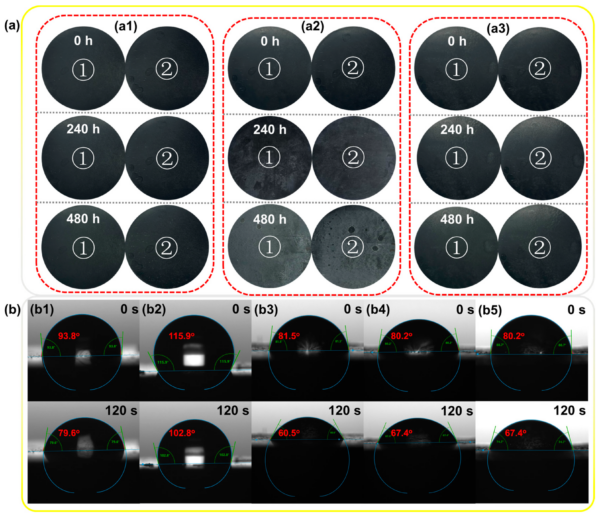
SiR@FR composites (a3) showed no visible exudation throughout the 480-hour aging period. Figure courtesy of A Core–Shell Elastic Flame Retardant with Superior Migration Resistance for Fire-Safe and Toughened Polyamide 66.
These high-performance PA66 composites prevent flame retardant migration while providing good fire safety. Additionally, their good mechanical properties demonstrate their potential in demanding environments. This approach tackles a common issue encountered with halogen-free flame retardants, with promise for advanced applications in high-humidity environments.

Having studied Geology, Julienne Smith focuses on environmentalism, sustainability, and the policies that impact plastics professionals today. As a technical writer, she is passionate about the intersection of science, technology, and communication. In her free time, she loves learning new things and writing fiction.