Balancing Fire Resistance and Transparency in PET
Halogen-free flame retardants improve PET fire performance while preserving transparency for electronics, solar panels, and screens.
PET shows potential for use in applications such as flexible housing for electronic devices. These include Building-Integrated Photovoltaics (BIPVs) and screens, which benefit from PET’s transparency. Currently, poor fire behavior limits its use in these areas, and most research on improving PET’s performance focuses on textiles. Increasing PET’s fire performance without sacrificing transparency is crucial for expanding its use to these applications.
You can also read: Golden Design Rules: Enhancing PET Recycling Through Design.
Commercial Flame Retardants for Transparent PET
In a recent study, researchers investigated PET’s performance and transparency when incorporating commercial, phosphorus-based, halogen-free flame retardants. This study aimed to further research the interactions between flame retardants and PET outside the textile sector. By improving PET’s fire behavior while maintaining transparency, manufacturers can find novel uses for this polymer.
To measure the heat release rate of the samples during combustion, they conducted a cone calorimeter test. By simulating real fire scenarios, this test enables characterization of a material’s burning performance. Additionally, they performed thermogravimetric analysis (TGA) to analyze the thermal stability of the samples. As a reference for the electrical and electronic sector, researchers measured flammability using the UL-94 vertical burning test.
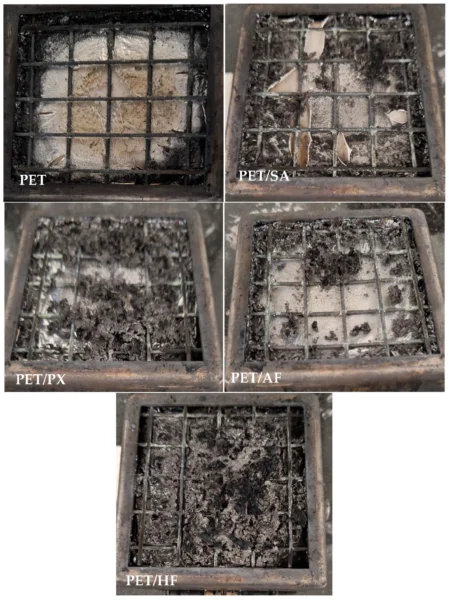
Samples of neat PET and PET with four commercially available flame retardants underwent cone calorimeter testing. Figure courtesy of A Study on Phosphorous-Based Flame Retardants for Transparent PET Composites: Fire, Mechanical, and Optical Performance.
Transparency Effects of Commercial Flame Retardants
To evaluate the optical and ultraviolet (UV) shielding performance of the samples, researchers cut each sample into uniform, rectangular shapes. Then, they observed their optical properties using a UV-visible spectrophotometer.
Crystallization during cooling has a critical impact on PET transparency during processing. When adding flame retardants or other additives, a nucleating effect can cause higher crystallinity and transparence loss. Thus, researchers chose an injection mold cooling time to minimize crystallinity for 1 mm thick specimens. The PET/SA composite showed no appreciable transparency difference compared to neat PET, and PET/PX showed only minor differences in transparency.

Researchers covered a spiral shape with films of neat PET (second from left) and PET with four commercial flame retardants. Figure courtesy of A Study on Phosphorous-Based Flame Retardants for Transparent PET Composites: Fire, Mechanical, and Optical Performance.
Differences in the refraction index of the polymer and the flame-retardant additives may have caused variations in transparency. Additionally, lower miscibility between the matrix and additives may have influenced optical performance. Overall, the commercial flame retardants negatively affected impact properties compared to neat PET. Researchers observed that flame retardants with a higher plasticizing effect heightened this impact. These commercial flame retardants showed good transparency in low-thickness flame retardant PET films. This positions them as a potential option for applications that require good optical performance.

Having studied Geology, Julienne Smith focuses on environmentalism, sustainability, and the policies that impact plastics professionals today. As a technical writer, she is passionate about the intersection of science, technology, and communication. In her free time, she loves learning new things and writing fiction.