
AI Models Predict Polymer Degradation During Extrusion

Engineers use machine learning algorithms to map polymer degradation, replacing physical trials with precise predictive models for industrial extrusion pipelines.
Manufacturers constantly battle thermal, mechanical, and hydrolytic degradation during commercial polymer processing. Heat and shear stress cause chain scission, rapidly reducing molecular weight and altering critical properties like yield stress. To overcome unpredictable variations, engineers deploy machine learning algorithms that successfully map complex thermomechanical relationships. By linking microscopic structural changes directly to macroscopic production parameters, facilities optimize manufacturing lines.
You can also read: Leveraging AI to Speed Product Design Simulations.
Decoding Polymer Degradation with Algorithms
Instead of treating industrial extrusion lines as opaque black boxes, material scientists utilize Near-Infrared spectroscopy paired with Recursive Feature Elimination (RFE) to continuously monitor structural shifts. Feature selection isolates the specific chemical indicators that drive quality degradation. Specific wave numbers detect subtle bending and stretching, capturing real-time changes within polylactic acid chains. When developers process moisture-sensitive medical-grade polylactic acid in a nitrogen atmosphere, they require absolute control to ensure proper bioresorption of the tissue scaffold. In opposition, when fabricating packaging-grade polylactic acid (PLA) under ambient conditions, these algorithms pinpoint precisely how the melt temperature at the extruder die exit directly degrades product strength. This intelligence provides production teams with actionable data, allowing operators to dynamically adjust heating zones before manufacturing out-of-spec products.
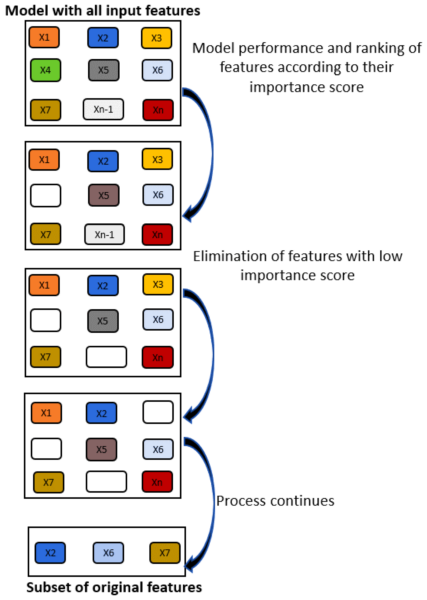
Schematic representation of the RFE process. Courtesy of Interpretable Machine Learning Methods for Monitoring Polymer Degradation in Extrusion of Polylactic Acid.
Quantifying Predictive Accuracy Across Platforms
Engineers quantify predictive accuracy by comparing digital outputs against actual physical tests. The R-Squared (R²) metric provides an overall confidence score; an R² of 96% means the algorithm successfully mapped 96% of the real-world material variations. To calculate error margins, developers use RMSE and MAPE, where lower numbers indicate the prediction closely matched the physical destruction test. Finally, they use AUC as a pass/fail grading system to evaluate defect detection accuracy. The data below shows how reliable specific algorithms are across different manufacturing environments:
| Algorithm Pipeline | Manufacturing Process | Target Metric | Predictive Performance |
| RFE-Bagging | Hot-Melt Extrusion (Packaging Polylactic Acid) | Yield Stress | RMSE = 0.911 MPa |
| RFE-Random Forest | Hot-Melt Extrusion (Medical Polylactic Acid) | Molecular Weight | NRMSE = 10.1%, R² = 83% |
| Support Vector Machine | Blow Molding (High-Density Polyethylene Films) | Tensile Strength | MAPE = 4%, R² = 96% |
| Artificial Neural Network | Blow Molding (High-Density Polyethylene Films) | Defect Classification | AUC = 0.901 |
| Blended Ensemble | Fused Filament Fabrication (Polylactic Acid) | Ultimate Tensile Strength | RMSE = 1.23, R² = 91.75% |
Specific algorithms pair with distinct manufacturing platforms to optimize production. Adapted from Machine Learning Models for Predicting and Classifying the Tensile Strength of Polymeric Films Fabricated via Different Production Processes and Interpretable Machine Learning Methods for Monitoring Polymer Degradation in Extrusion of Polylactic Acid
Reviewing these data points, professionals confirm that advanced feature selection drastically outperforms basic linear regression models. Integrating Support Vector Machines allows technicians to rapidly classify defects in high-density polyethylene films containing calcium carbonate fillers. By establishing highly accurate neural networks, facilities ensure blown films consistently meet rigorous tensile strength specifications, replacing continuous destructive testing with real-time digital verification.
Engineering Advanced Composites in 3D Printing
Beyond traditional extrusion, developers apply algorithmic optimization to Fused Filament Fabrication. Adding carbon fibers to polylactic acid drastically increases ultimate tensile strength, structural stiffness, and thermal conductivity. However, this composite integration subsequently compromises toughness and ductility. To balance these competing variables, engineers utilize Ensemble Learning techniques. These algorithms combine multiple weak learners—including Gradient Boosting and Decision Trees—to minimize predictive variance. Furthermore, software teams deploy Genetic Algorithms to navigate the massive manufacturing parameter space. This computational approach replaces expensive trial-and-error laboratory runs, empowering systems to automatically calculate the optimal layer thickness, printing speed, and extrusion temperature for printed components.
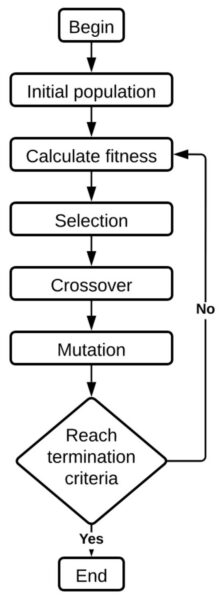
Flow chart of the genetic algorithm. Courtesy of Machine Learning Study of the Effect of Process Parameters on Tensile Strength of FFF PLA and PLA-CF.
Machine learning fundamentally transforms how the plastics sector regulates production quality. Interpretable algorithms eliminate the mystery inherent to traditional black-box models, equipping production teams with actionable insights regarding thermomechanical degradation. As modern manufacturers integrate predictive software directly into hot-melt extrusion and 3D printing equipment, they significantly reduce scrap material, accelerate product development cycles, and establish unparalleled mechanical consistency across industrial applications.

Andres Delgado is a mechanical engineer specializing in design and quality assurance, with experience in precision seal design, turbomachinery maintenance, and orthopedic medical devices. He currently works as a Design Quality Engineer focused on New Product Introductions for knee implants and compliance with advanced manufacturing standards.