
4D Printed PEEK Powers Self-Deploying Space Structures

4D-printed shape-memory PEEK replaces heavy mechanical hinges, enabling lightweight, self-deploying smart structures for next-gen space applications.
Aerospace engineers constantly contend with extreme mass constraints and mechanical complexity when designing deployable orbital structures such as solar arrays and communication antennas. Traditional mechanical hinges introduce heavy, failure-prone moving parts that threaten mission viability. To address this critical bottleneck, developers now use 4D-printed shape-memory polymers (SMPs). These advanced materials leverage thermomechanical phase transitions to enable self-deployment, eliminating the need for rigid motors and significantly reducing overall launch weight.
You can also read: Aerospace Plastics Market: Lighter, Stronger, and Poised for Takeoff
The Physics of PEEK Actuation
Material scientists focus heavily on Polyetheretherketone (PEEK) for extraterrestrial applications. PEEK delivers exceptional thermal stability, high radiation resistance, and robust mechanical strength. Engineers program the polymer by heating the material above its glass transition temperature, deforming it into a temporary, compact storage shape, and rapidly cooling it to lock the microscopic structure in place.
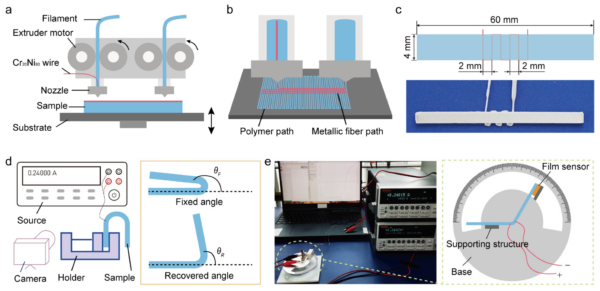
Four-dimensional printing and test method of shape memory PEEK. (a) The equipment and construction of 4D printing. (b) The process of 4D printing PEEK composites. (c) The printed composite sample and sizes. (d) The measurement method and definition of an angle. θF was the fixed angle, and θR was the recovered angle between the horizontal line and the free side of the sample. (e) The test method and devices for the recovery force. Courtesy of The Shape Memory Properties and Actuation Performances of 4D Printing Poly (Ether-Ether-Ketone).
This process vitrifies the polymer chains in a high-energy, non-equilibrium state. When the satellite reaches orbit and requires deployment, onboard resistive heaters apply targeted thermal stimuli. This heat triggers immediate entropic recovery. The polymer chains spontaneously reorganize to maximize entropy, forcing the component to actuate macroscopically and return to its permanent, thermodynamically stable shape with remarkable precision and reliable force.
Eradicating Complex Mechanical Assemblies
Standard spacecraft deployment mechanisms rely on bulky eccentric motors, torsion springs, and complex interlocking metal linkages. 4D printing allows manufacturers to consolidate these multi-part assemblies into single, continuous monolithic polymer hinges. Technicians utilize advanced fused deposition modeling to extrude PEEK into highly specific, optimized geometries that maximize shape recovery ratios and minimize material fatigue.
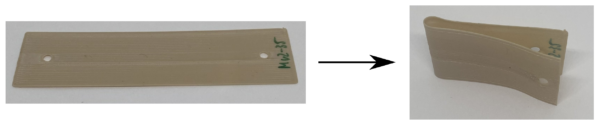
The unfolded hinge before programming on the left and the folded programmed hinge on the right. Courtesy of Development and Assessment of a 4D Printing Technique for Space Applications.
By replacing traditional metal hinges with programmable PEEK structures, mission planners drastically slash structural mass, allowing for larger scientific payloads. Furthermore, eliminating rotating mechanical components directly addresses the severe risk of cold welding and mechanical jamming in the harsh vacuum of space. The solid-state deployment relies entirely on internal molecular shifts, guaranteeing a smooth, shock-free expansion that protects delicate onboard instruments.
Load-Carrying and Self-Sensing Smart Structures
Beyond simple thermal actuation, developers engineer these smart components to carry severe operational loads. PEEK’s inherent high tensile strength ensures the deployed orbital structures remain rigid and structurally stable under intense vibrational and thermal stresses.
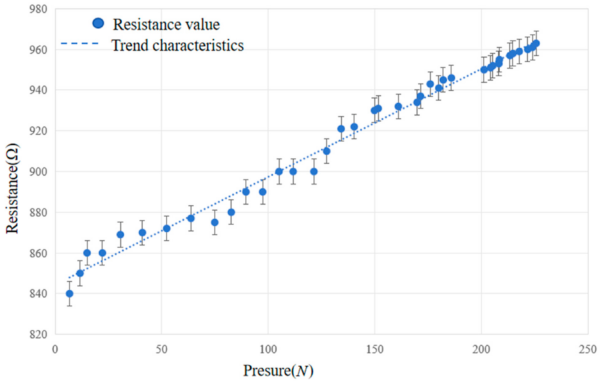
Variation in carbon fiber resistance with external pressure. Courtesy of 4D Printing Self-Sensing and Load-Carrying Smart Components.
Besides, researchers integrate advanced self-sensing capabilities directly into the polymer matrix during the additive manufacturing process. By embedding conductive nanomaterials, production teams create structural components that actively monitor their own deployment status and long-term health in real-time. System engineers receive continuous telemetry feedback regarding material strain and localized temperature variations. This integrated sensing ensures the satellite deploys exactly as programmed and maintains structural integrity, entirely negating the need to install heavy, external sensor arrays across the spacecraft.
Design engineers stand at the forefront of a fundamental paradigm change in spacecraft architecture. 4D printed PEEK components directly replace heavy, unreliable mechanical hinges with lightweight, self-deploying smart structures. By mastering the complex thermomechanical actuation of shape memory polymers, developers unlock unprecedented payload capacities and drastically reduce mechanical mission risks. As the aerospace manufacturing industry refines these self-sensing, load-carrying materials, 4D printing will establish a completely new foundational standard for commercial satellite constellations and deep-space exploration platforms.

Andres Delgado is a mechanical engineer specializing in design and quality assurance, with experience in precision seal design, turbomachinery maintenance, and orthopedic medical devices. He currently works as a Design Quality Engineer focused on New Product Introductions for knee implants and compliance with advanced manufacturing standards.