
3D Printed Artificial Muscles Advance Soft Robotics
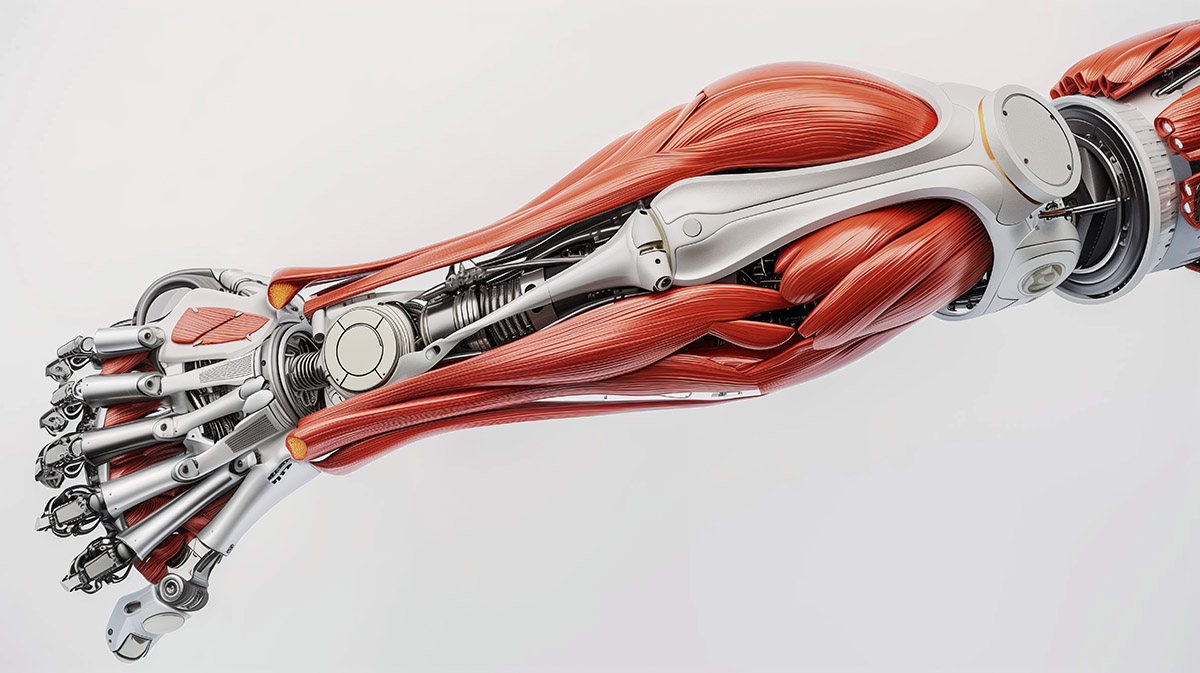
Engineers automate the manufacturing of artificial muscles by printing electroactive PVC gels and thermomechanical shape-memory polymers.
Traditional manufacturing restricts soft robotic developers to simple, rigid motor assemblies and labor-intensive manual casting methods. To eliminate these industrial bottlenecks, materials scientists engineer dynamic polymer artificial muscles that utilize applied electromechanical Maxwell forces and thermomechanical entropic recovery. These advanced materials directly replace conventional hardware, enabling manufacturers to build highly flexible, autonomous actuation systems.
You can also read: Soft Robotics in Medicine: A Growing Trend Powered by Hydrogels.
Driving Actuation Through Maxwell Forces
Engineers targeted electric fields to drive the cyclical actuation of polyvinyl chloride (PVC) gel artificial muscles. When controllers apply an electrical field ranging from 400 to 800 V, PVC molecules migrate rapidly toward the anode. This molecular migration polarizes the internal gel network and generates a robust Maxwell force. This specific electromechanical interaction induces precise creep deformation near the anode, alongside massive structural compression throughout the material thickness. Once operators deactivate the electric field, the inherent elasticity of the PVC network forces the muscle back into its original resting shape. To achieve these properties, chemists formulate the active gel by mixing PVC, dibutyl adipate plasticizer, and tetrahydrofuran solvent at a precise 1:7:12 mass ratio.
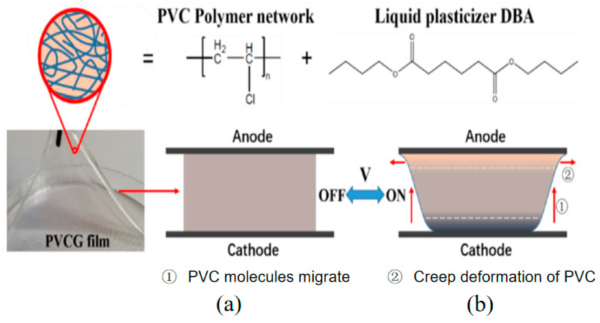
Deformation principle of the PVC-gel actuator. (a) Discharge (b) Charge. Courtesy of Direct Writing Corrugated PVC Gel Artificial Muscle via Multi-Material Printing Processes.
Designing Shape-Memory Polymer Muscles
On the contrary, developers design shape-memory polymers (SMPs) to function as programmable artificial muscles utilizing entropic recovery. Material scientists engineer these polymers using specialized architectures that combine molecular switches and stable net points. Operators store the polymer chain segments in a high-energy, non-equilibrium temporary shape. When engineers expose the muscle to specific thermal triggers, the stored chains spontaneously reorganize into their thermodynamically preferred, high-entropy original shape. This programmed actuation allows designers to build soft robotic actuators capable of complex, multi-stage physical deformations. By manipulating the core polymer network formulation, developers precisely tailor the exact activation temperature required to meet specific industrial application demands.
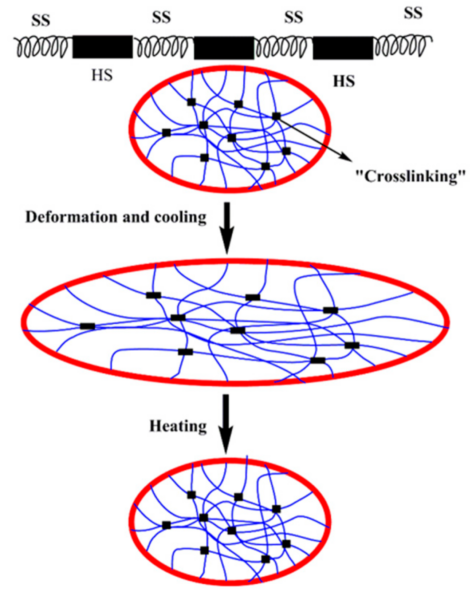
The micro-mechanism of the shape-memory effect of polymers, where HS refers to the hard segment, while SS refers to soft segments. Courtesy of Shape-Memory Polymeric Artificial Muscles: Mechanisms, Applications and Challenges.
Comparative Actuation Metrics
| Metric | PVC Gel Artificial Muscles | Shape-Memory Polymer Muscles |
| Core Mechanism | Electro-mechanical Maxwell forces | Thermomechanical entropic recovery |
| Actuation Trigger | Electric field (400–800 V) | Thermal or optical energy |
| Structural Control | Rapid, elastic contraction cycles | Programmed geometrical phase shifts |
| Ideal Application | Cyclical haptic feedback modules | Expanding autonomous robotic grippers |
Qualitative comparation between PVC Gel and Shape-Memory technologies. Adapted from Shape-Memory Polymeric Artificial Muscles: Mechanisms, Applications and Challenges and Direct Writing Corrugated PVC Gel Artificial Muscle via Multi-Material Printing Processes
Reviewing these metrics, robotics engineers evaluate distinct physical pathways to select the optimal muscle architecture. PVC gels excel in the rapid, high-frequency cyclical actuations necessary for wearable haptics and continuous production environments. On the other hand, shape-memory polymers trade these high-frequency cycles for massive structural expansion and complex morphological changes.
Automating Industrial Production
To commercialize these advanced muscles, manufacturers implement precise multi-material direct ink writing protocols. Production teams formulate the PVC inks as shear-thinning non-Newtonian fluids to guarantee exact extrusion control. Technicians extrude the core PVC-gel ink utilizing 20 kPa of pressure at a printing speed of 12 millimeters per second. This automated system seamlessly integrates alternating layers of active PVC gel cores, conductive composite electrodes, and silicone insulators. This single-process integration eliminates manual physical stacking steps and unlocks robust load-bearing capacities that withstand constant applied stresses up to 300 kPa. Additionally, manufacturers replace high-temperature thermal curing with an innovative stepwise curing protocol. Operators store printed modules at room temperature before submerging them in a 60 °C water bath, dissolving sacrificial support layers without degrading the core muscle integrity.
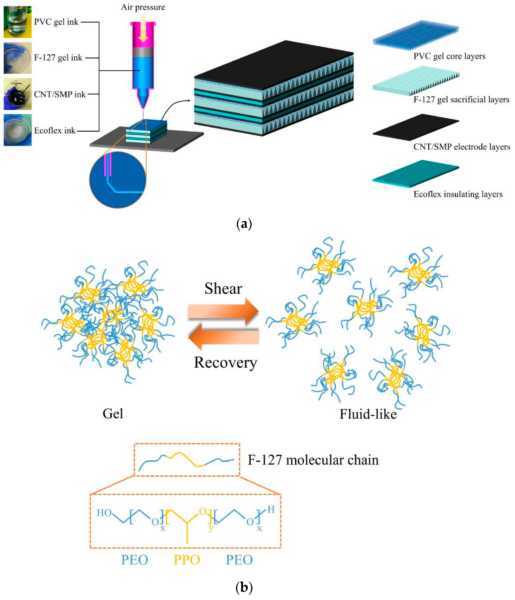
(a) Schematic diagram of the printing process of the artificial muscle structure. (b) Schematic diagram of the thixotropic property of the F-127 gel ink. Courtesy of Direct Writing Corrugated PVC Gel Artificial Muscle via Multi-Material Printing Processes.
By integrating automated multi-material 3D printing and precise dynamic physical programming, manufacturers transition polymer artificial muscles from experimental laboratories directly to commercial production floors. These responsive materials effectively eliminate the physical constraints of traditional rigid motors. By mastering Maxwell forces and entropic recovery, developers provide industrial automation designers the exact manufacturing toolkit required to engineer highly scalable, next-generation soft robotics.

Andres Delgado is a mechanical engineer specializing in design and quality assurance, with experience in precision seal design, turbomachinery maintenance, and orthopedic medical devices. He currently works as a Design Quality Engineer focused on New Product Introductions for knee implants and compliance with advanced manufacturing standards.